Brand 2.0

Presenter: Kevin Yam – Directer, mobile and interactive platforms, National Geographic

500-x-BusHomeFew other publications have the longevity of National Geographic, but like any magazine, it has had to adjust to adapt to technological changes and the way that users choose to experience media.  A few years ago, the company looked at all of its media offerings – magazines, tv, games, online, image collection, music, books, films, and maps – and discussed how it could offer that compelling content together across all of that existing media.  As they develop new content, they consider how it could be used (licensing) and how to best tell the story in many different ways.

Developing this led to a heavy focus on user experiences, which forced them to examine the context in which their content was consumed.  With the emergence of mobile, consumers now have immediate access to information and resources, and National Geographic wants to be there with their rich, outstanding content.  This recent led to the development of a Bird Finder app which helps users identify birds (using location information), and incorporates sounds and video.  Additionally the app allows them to “check in” the bird, creating crowdsourced maps of where types of birds have been seen.

They also recently completed a project to tell the story of going to Antarctica – Bus 2 Antarctica.  They used new and social media to help tell the story of, “1 man, 10 weeks, and 10,000 miles,” traveling from National Geographic’s offices to Antarctica.  He kept followers up-to-the-hour on his travels via Twitter (@bus2antarctica), a blog, facebook, an interactive map, and media partnerships with FOX, ABC, and CBS.  The traveler used only an iPhone, still camera, video camera, GPS, and a tracking device to report his stories through all of these media.  It helped to prove they could tell a tremendously compelling story, in real time, for an extremely low cost.  Every brand needs to consider how they can take advantage of new and social media to tell their story or provide brand content.

Slashing Red Tape to Revolutionize Corporate Communications

Presenter: Paula Berglinhartpr.com – formerly at Southwest Airlines

When Paula Berg started in the customer service area at Southwest Airlines, she never thought she’d end up where she did – with a seven personal social media team.  She started doing some of the social media stuff on the side and made it her goal to integrate social media into every internal and external communication effort in a way that made sense for the community and brand.  She offered five tips for inspiring organization change and helping both the organization and its executives to “get it.”

1. Make jaw-dropping reports – Don’t just focus on the numbers and great looking charts (although great design helps).  Be sure to thoroughly evaluate what the numbers mean, especially in terms of your business and communications goals (make sure they care about the results).  Include what you learned and your intended next steps to do things differently.

2. Launch an Internal PR Assault – People can’t just hear about social media, they have to live it.  Insert social media into every newsletter, magazine, mailer, department update, every meeting, lucheon, summit, etc.

3. Make your executives love it – Make sure you dazzel them, scare them, hypnotize them, and whatever you have to do to get them to understand and appreciate social media.  They need to understand that the risk of not going into it is greater than the risk of doing it.

4. Get your house in order – Social media is more than just PR and/or marketing.  It’s about engaging with consumers when/how they want.  This requires speed, agility, and trusted employees who know the business.  Too often companies try to hand this job over to the “young guns” – the interns or first year people – who must know social media.  It’s better to get people who know your culture implicitly and teach them how to use the tools to communicate.

5. Get tough – It’s a new world, and it’s not going to be easy.  You have to be willing to fight and you have to be willing to take risks and be wrong.  No matter what, things are going to fail, or things will go wrong, and you have to be ready and willing to personally take it on the chin for your company.

Connected Brands

Presenter: Adam Lavelle – iCrossing

iCrossing examined the top 10 “best global brands” and examined how well these brands connect with consumers in the digital world.  They evaluated the brands on visibility, usefulness, usability, desirability, and level of engagement.  Each category has a multiple variables, with a total of 65 data points measured.  The data points were developed by iCrossing to develop a baseline, and the data used for measurement can be debated.  The company did use publicly available data in order to develop a baseline for measurement.

Not surprisingly, the top company was Google  scoring a 7.9 (out of 10).  Most of the other brands scored significantly lower (most under 5 out of 10), and included Disney, Intel, Microsoft, Coke, IBM, Toyota, GE, Nokia, and McDonalds.  When all of the data was scored, all of these brands scored extremely low on engagement scores.  It shows an incredible need for brands, even these well known ones, to improve on their methods of communicating and engaging with consumers in social media.  When you see that Facebook now has more hits than Google, and users visit the site an average of 55 minutes each day, the time for brands to have conversations with consumers in social media is now.

You can download a copy of the full report.

Geolocation on the “Horizon”

Presenter: Jason Finkelstein, Director of Product Management & Marketing, WaveMarket, Inc.

Geolocation is here, but it’s still got a long way to come (pun intended).  Geolocation started with in-car navigation systems and then moved to personal navigation devices.  Now we’re onto personal location devices that can track you or devices.  The focus of this presentation was on mobile phones.

55% of all SMS messages are “where r u?” – That’s about 650 billion location based text messages in 2009.

We are just starting to see the future of location based services:

Today:

  • Navigation
  • Enterprise tracking
  • Family locator
  • Friend finding
Tomorrow:

  • Checkins and notifications when friends are nearby
  • Facebook widgets
  • GPS-indexed local search
  • Location aware advertising/marketing/couponing
  • Crowdsourced traffic systems
  • Location aware messaging applications
  • Security/Fraud Prevention/Compliance

Location is a feature of many kinds of products and services, not an industry unto itself or a vertical market.
Types of Geolocation Data:

  • Latitude/longitude
  • Latency – how long does it take to find your signal/location
  • Confidence – radius – still not a lot of confidence in cellular tower location
  • Reverse Geocoded (real world address) and Points of Interest – pre-populated locations
  • Location Tagged Info (Tweets, Flickr photos, etc.)
  • Map Data Layers/GIS (This is a whole industry) – City names, street names, street geometry (one way street, speed limits), Satellite/birdseye/terrain

The industry is working on a “Z” (XYZ axis) to be able to track altitude.

Variables influencing ability to get location information from mobile devices:

Carrier Network – different carriers have different kinds of location built-into their networks, this location is accessed in different ways on each carrier network and can vary in accuracy and latency.

Device Type – 200 million mobile subscribers, Most (81.5%) have limited devices which generally don’t have GPS, but can be found. Some (18.5%) have smartphones with GPS built in.

While the use of GPS chips is increasing, if you are planning to develop location based apps today, you must still cater to the 4/5 of people who do not have this functionality.  The value chain for this development is structured like this:

1. Infrustructure players – Do the calculation of where that phone is – Qualcomm, Nokia Siemens Networks, Sony Ericson, Redknee

2. Wireless carriers – AT&T, Sprint, T-Mobile, Verizon – provide the phones and services

3. Location Aggregator – Veriplace – pulls together location data for API tie in by developers

4. LBS Developer/Content – develop the apps and plug-ins

5. End User – uses the device, apps, etc.

However, when GPS is built into the phone, this chain is not completely required.  Apps can then be built to interact with the internal GPS API to utilize location data.

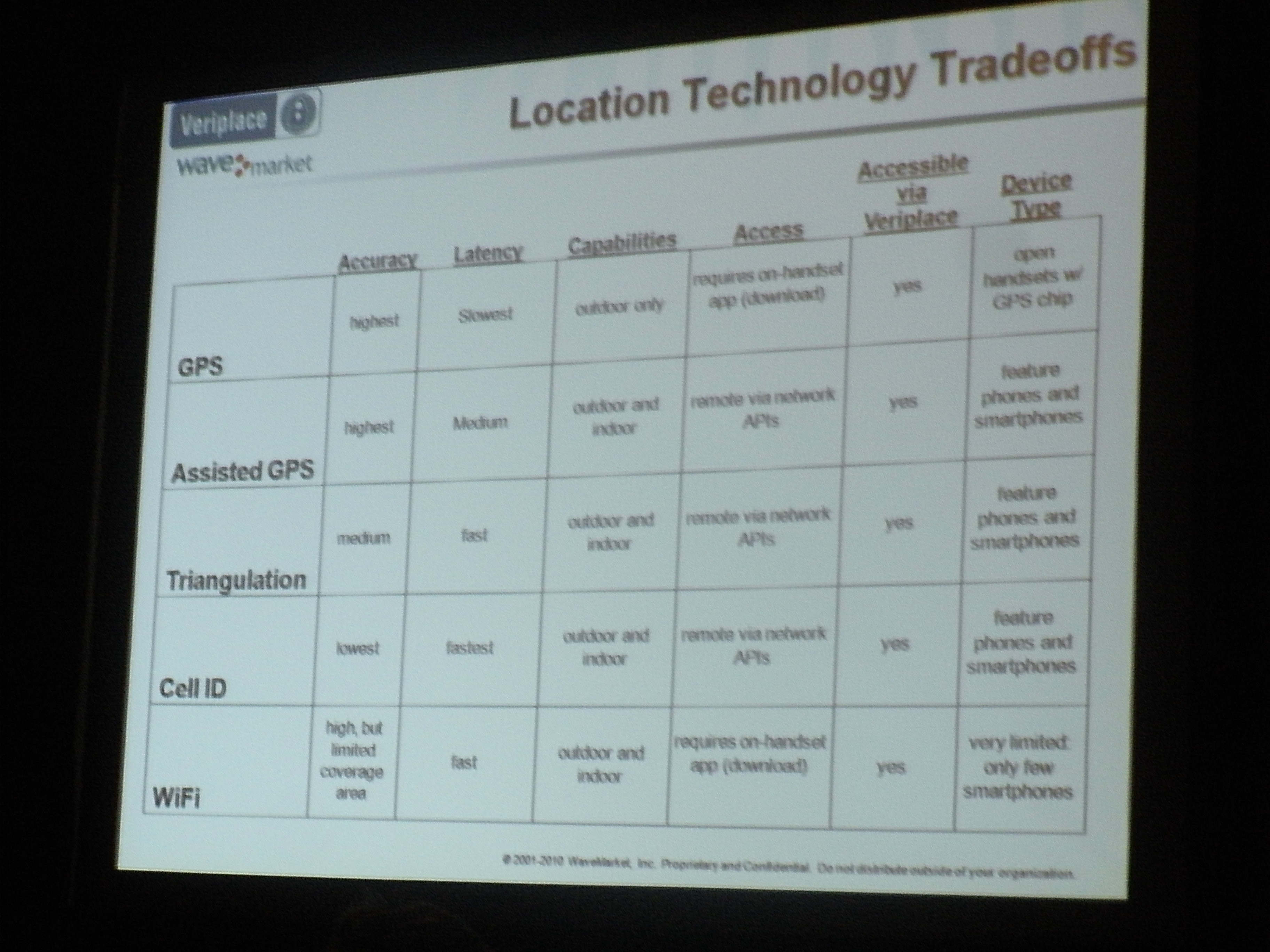
Here are the ways location can be accessed today along with advantages and disadvantages of each:

Standalone GPS – It’s free, uses GPS satellites, so need line of site location.  It’s high accuracy, but it takes a long time to get location (minutes), and some carriers lock the GPS chip.  Download and install an app is still a challange for most people and app developers must develop for different devices.  Also, the app must be running to access location.  It does provide latitude and longitute, which the others don’t.

Cell ID – It depends upon a location database of cell towers.  The phone connects to cell tower and this “location” uses knowledge of where the cell tower is located.  The accuracy of this is lower, but it’s used for both smartphones and feature phones, because it can be located indoors, and has quick location fix (<3 seconds).

WiFi – This also depends on a location database.  It’s similar to Cell ID, but uses MAC addresses on WiFi hotspots – which have limited coverage today.  It can be unreliable due to wifi spots that move. However, if the device has open access to wifi the cost is zero.

Carriers are supporting more location based technolgies on both smarphones and feature phones and sometimes use a combination of the methods above for identifying location:

Assisted GPS – A hybrid of GPS and Cell ID

Triangulation – AFLT – The next level of Cell IDs, it uses multiple Cell ID’s to center a location.  It’s easily accessible via carrier networks and quick  (<10 seconds)

Location is still a challenge for many developers because of this confusing web of networks and the many ways devices can use to find location.  App developers in this area are still sorting through the challenges of location information and authentication and a whole new layer of legal and privacy challenges have arisen.  A recent study showed that people are more concerned about privacy surrounding their location than their credit card data.

Therefore, developer have proceeded forward with a few approaches, such as choosing to focus only on downloadable apps for limited smartphones (iPhone/Android).  Some have made deals with carriers, but there’s a high barrier to entry, so some are working through aggregators like Veriplace to add location to certain app types like sms/voice/web.


Mobile Content is Social

Presenters: Michael Sharon – Facebook , Tom Watson – Facebook, Justin Shaffer – Hotpotato

By itself, mobile devices are immersive – it’s always with you and provides a way for you to exist in a physical or mental place other than where you currently are.  Tools that have been added to those devices have made them “social hubs,” allowing you to connect with others almost anywhere.  There are several things which will continue to evolve to make it even more social.

Friends – Above all, users will tell and demonstrate that this is most important.  However, the debate is what information people want from their friends.  When Facebook changed its mobile friend feed from alphabetized to most recent, it saw an enormous spike in use.  The next debate is figuring out if people want to see the “Top News” or “Most Recent.”  More and more, you’ll see a combination of your Facebook contacts merging with your address book to make sure you have the most updated contact information as well.  Finally, Facebook Connect is even making the gaming experience more social as people can connect games and apps to their friends.

Notifications – There are two types of notifications people are interested in – Active, or what’s happening now, and Passive, or what’s happened since I last checked.  While “push” features make active notifications easier, there’s a fine line between wanted updates and spam.  Therefore, it is extremely important to test this feature before implementation.

Sharing – Facebook knows that people want to share photos (and more and more video and audio).  What has helped this explode has been the speed at which someone can post a photo from a mobile device, and the added ability to “tag” people in photos.  Tagging photos has significantly increased photo viewing as sharing photos becomes a social experience.

Serendipity – The introduction of location based services help you figure out which of your friends is nearby.  This feature has already been implemented by Foursquare, Gowalla, HotPotato, etc.

Discovery – While finding out a friend is nearby is serendipitous, there’s also the potential to discover new people or events.  Mobile offers the ability to do this even better, but what we have yet to see are the privacy implications and the ability to see both your friends and people you don’t know who are nearby (or at the same event).

Control – There has been an explosion in where you can post content.  The same photo/message can be uploaded to Twitter, Facebook, Flickr, YouTube, etc. in the click of a button.  Users want to know how they can decide where to send it, and “take it back” if necessary (which apparently happens WAY more often than you might think).

Intent – Tools need to be designed to elicit the response you’re looking for.  Make it easy to find the way you want people to participate and put it right up front.

Feedback – Commenting provides a cycle of reinforcement and mobile makes this instantaneous.  Feedback is essential, whether it’s comments or Rewards (like Foursquare badges or Gowalla virtual items). Giving somebody something to respond to makes it social.

Mobile becoming more social will be driven by 3 things – Touch, Speed, and Connection

Touch – How it’s designed and what it information it can allow you to share.  An emerging element of touch is a phone that automatically monitors things – temperature, location, weather, altitude, etc.  Things must be designed for the medium (Facebook’s mobile experience diverges significantly from its web experience) and the context in which it will be used.

Speed – Devices are become faster and can do more, but it’s also about the speed of transferring information through networks (getting this information into the cloud and not just onto the device).

Connection – API’s will rule the future.  It’s about connecting all of your networks and information together and allowing the user to determine how/when/what/where/etc. is shared.

Brands Don’t Think What You Think They Think

Presenter: Andrew Palmer, The Barbarian Group

If you want a brand to buy your big idea, here are some things to keep in mind.  Brands want to get in on the next big thing, but…

1. Good Brands Trust Good Brands – They want to deal with professionals who know what they’re doing.  They need to have confidence in you and your brand, so set yourself up to succeed by promoting your brand as well as your idea.

2. Safety in Numbers – If someone else is doing it or involved, brands feel more comfortable.  Take the opportunity to get multiple brands involved in the same idea – utilize partnerships that make sense.

3. Give them Something Unique – Everyone wants something they can say they were first or best at.  The value proposition needs to show how they’ll be able to do that.

4. Know Who to Talk To – Do your homework and know who makes the decisions.  Don’t take a “no” from someone who can’t tell you “yes.”  And although someone can say “yes,” make sure you know all of the players involved so the “yes” doesn’t end up backfiring.

5. Know their Audience – There’s a difference between customers and consumers.  For example, a CPG company’s customer is actually Walmart, but the consumer is the one who buys the product.  Make sure you’re ideas cater as best as possible to both audiences.

Tags

Related Posts

Share This

Customer Service Goes Social

Presenter: Melanie Baker, Postrank

Technology has increased consumers’ expectations for speed and response, and companies have to adapt to provide the level of customer service that’s now expected of them.  Customer service tends to be a bottleneck simply because the amount of people who are “assigned” to do this is limited – there’s typically a “customer service center” or “response center.”  While these are certainly necessarily for efficient business, company cultures must change so that everyone is a customer services advocate.  Even if they can’t directly help or answer the questions, customers want to know that they are being dealt with personally and with sincerity – no matter how they decide to contact you (phone, Twitter, email, etc.).

Baker suggests starting by having everyone in your company go through the same training as the “customer service” people.  Even if it isn’t “in their job” to handle customer service, they need to be prepared to do so if the situation presents itself.  Provide education and resources on how to handle situations.  Opening up this information to everyone in the company – rather than limiting access to it – makes for a more customer-centric organization.  And as consumers take to talking about your company in social media, everyone is prepared to assist (when appropriate), and it’s not just shoved off to “the people whose job it is,” – great customer service should be everyone’s job.

New Rules of Marketing & PR

Presenter: David Meerman Scott, New Rules of Marketing & PR

No one doubts that the rules have changed and social media has made it necessary for businesses to interact with and engage with customers and potential customers.  If companies want to be successful in this new world, Meerman suggests a few principles they’ll have to abide by.

Lose control – Brands don’t just have to adapt and change to their customers’ wants/needs, but they should let their customers help them shape the brand.  It lets them feel most engaged with the brand and makes them more likely to evangelists of your brand.

Be human – Customers are individuals and they want to be dealt with on a one-on-one basis.  They want to deal with a person, not a big faceless corporation, and they want to be genuinely listened to.

Nobody cares about your products except you – People care what they do for them (make their lives easier, better, etc.).  Highlight the benefits and services you provide and don’t use big, fancy, or irrelevant language to talk about them (See The Gobbledygook Manifesto).  Find out the information people are looking for – which you are an expert in – and give them content.  Every brand should be constantly putting out content that illustrates its values and is relevant and interesting to their target consumers (Brand Journalism).

Create triggers that encourage people to share – If people love what you provide them, give them a way to share it with others.  Give them both a method and very subtle reminders to do so.

No coercion required – If people love you, they’ll want to share your message or talk about your brand.  Strive to be the type of brand people want to tell others about – Apple, HP (video), etc.

Stop making excuses – These are the new rules, and the only reasons not to follow them are self-imposed.  It doesn’t matter what your product/service/industry is, anyone can follow these rules.

Media Relations Goes Social

Presenter: Capt. Nathan Broshear, US Air Force

The US Air Force has recognized the power or social media and has been actively opening up its network allowing every airman to post their experiences (in photo, video, etc.) to their personal Twitter, Facebook, etc.  Their goal is to humanize military members, and they feel that this helps enable that mission.  Of course there are concerns about what they may post, and geolocation as part of social media is creating concerns, but as Broshear put it, “you’ve got a 26 year-old kid in charge of a $50 million airplane, and you’re not going to trust him with a Facebook page?”

Obviously, during times of crisis, war, etc. the military is sought out by the media for information.  “I don’t have to find them,” says Broshear.  “They find me.”  Social media has made it easier than ever for media to connect with their public affairs officers.  The Air Force has stopped sending out press releases and manages their relationships with various media through social networking  outlets.  “Only 16 percent of people trust PR people,” says Broshear, ” but 70 percent trust people like themselves or their peers.  It only makes sense to connect via social networks and build relationships with people.”

The theme is that social media enables relationships – which is essential for PR people.  People are coming to the Air Force for bite sized pieces of information when they need them, and that’s a benefit that social media offers.  They are always connected to each other through social media and the flow of communication goes both ways.

Crush It! with Gary Vaynerchuk

Gary Vaynerchuk, Author of Crush it! – Cashing in on your passion

Filled with energy, gratitude, and passion Gary Vynerchuk demands attention (and it doesn’t have to do with him dropping the regular f-bomb).  He’s passionate about what he does and is an evangelist for using your passion to promote your love on the web.  He’s all about using social media to connect with individuals, whether its for your personal brand or your business.

He’s passionate about his belief that everyone is, or should be, in the customer service business and technology is only making that more necessary.  He relayed a story about his brother showing up at a restaurant after calling for a reservation.  They told him he’d have to wait, so he pulled out his phone to call to let people know, and as soon as he pulled out his phone, the hostess told him she’d find him a table immediately.  In the age of social media, and review sites like Yelp, companies are starting to realize they have to change the way they do business and start paying attention to customers needs.  “Word of mouth connects us to good shit, or tells us what to avoid, and that’s the new way of the world,” says Vaynerchuk

Vaynerchuk believes in investing in customer relationships, showing you care for them, and eventually it will pay off.  He says, “everyone is trying to be a 19 year-old dude – they’re trying to close too fast.”  Every business needs to be providing their customers/communities with the attention and content they’re looking for.  Content has never been more valuable, and everyone is in the content business.  People told him his book wouldn’t sell (it made the NYT best sellers list) because he “gave too much content away,” but he believes we live in a “thank you economy” where people are appreciative of his knowledge and buy because of the trust and relationship that has been built.  “You have to care and do good first,” he says, “it’s the only way to convert.

SXSW Video: Podcast Playground

PepsiCo’s Podcast Playground was back again this year, and it appeared to be a busy place throughout South by Southwest Interactive. One day, I stopped to watch a live Blip.tv interview with LLCoolJ about his latest venture, boomdizzle.com. The PepsiCo Zeitgeist was also on display, mining Twitter conversations and presenting trends in real time. Here’s a quick video of the Playground …

Click for  Video

SXSW Video: Chevy Volt Recharge Lounge

Before South by Southwest Interactive, I put up a post about Chevy’s SXSW marketing efforts––including plans for the Chevy Volt Recharge Lounge. Just wanted to share a quick look at the lounge. I didn’t see a lot of people using the technology, but all those power outlets sure got a workout.

Click here for Video