
Guiding Senior Leaders
.jpg) |
 |
Support a strong corporate culture by guiding your senior leaders to speak with authenticity and transparency
Diana Kowalsky (@dianakowalsky), Internal Communications Manager
Libby Catalinich (@lcatali), Director of Corporate Communications, REI
REI has 123 stores in 30 states, with 10,500 employees and has over $2 billion in sales. The have a co-op ownership – anyone can become a member for as little as $20. Pay dividends of around 10% each year. Because they are not a shareholder owned company, they tend to be more transparent and open. However, when you tell everyone, everything, you need to be more focused on being strategic about messages. The company has many long-tenured employees and it has traditionally been a smaller company. Now, as they are growing, the culture is changing and growing which is a bit uncomfortable for many. Two-thirds of employees don’t even have a company email address, making connecting with employees a bit difficult. Therefore, leaders are the source of information, especially since research indicates their leaders are the best source of information.
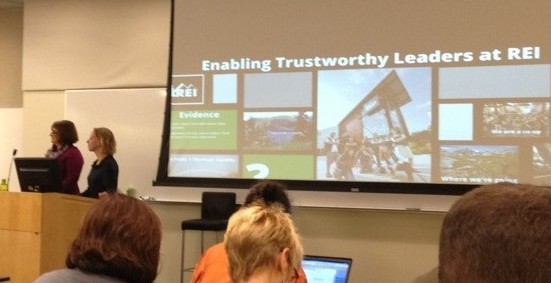 2 Types of Leaders at REI:
- Day-to-day leaders – lots of direct contact with employees
- Strategic leaders – Set long-term vision and direction of the company
3 Characteristics of trustworthy leadership
- Honesty – Leaders need to tell it like it is, and mean what they say.
- Humility – Leaders are open to feedback and learning from employees.
- Humanity – Leaders speak from the heart and make personal connections with employees.
Honesty
They accomplish this by encouraging conversations – The leadership team visits every store, every year to do this. The CEO and other leaders also stay connected by living among employees – at lunch, in the vanpool, at service projects, etc.
They also connect online, using various social media – recently built www.aroundthecampfire.mobi as an employee portal (built on WordPress). In the first month, they’ve had over 200 comments, and average use is 5 minutes. CEO and other senior leaders blog here, no filters.
They learned that leaders weren’t necessarily prepared to blog, and they’ve had to teach them what to talk about and give them direction. Make sure you keep it real, prepare leaders for what to expect, and be consistent.
Humility
Make sure you ask for feedback. Get data and act on it. They give each leader feedback on themselves. They’ve also focused on sharing ideas, and recently created REIdea, a SharePoint community to share ideas between store managers.
They learned that feedback isn’t always easy to get or give, but you can drive it by telling stories with examples of how change was driven by feedback. Most the time, if you want to know, just ask.
Humanity
You need to focus on cultivating personality, having fun, and being real. Focus on making leaders accessible and doing things to bring out their personality.
They’ve learned it’s about incremental change. You need to start small – suggest they talk about something other than business on their blog. Mix in personal learnings and illustrations with your talks and erase the corporate speak.
Case Studies
- Marriage Equality – CEO came out on blog and gave reasons for the change in the company.
- Layoffs – Prepared information for local leaders, so they had consistent speaking points and knew how to handle situations.
Results
People stick around when they have leaders they trust, like and believe in. They’re ranked as one of the best companies to work for, and have record retention of employees in the retail industry.
Tags
Related Posts
Share This


 Strategies for the changing nature and pace of communicationsFrank X Shaw (


 Subscribe via email