Change Management vs Communications

Tobin Burgess Microsoft’s Aquisition of Skype and Change Management
Tobin Burgess
is Senior HR Business Partner

Tobin lead Microsoft’s acquisition of Skype, the largest in the company’s history, and talks about the success of change management vs communications.

Skype (by the numbers)

  • 25% of all international calls are done through Skype
  • 300 Billion minutes of voice and video calls
  • 200,000,000 active users (over 100 minutes a month)
  • 40% Growth Rate

Challenges:

  • Big & Expensive – Largest company acquisition ever ($8.5 Billion).
  • Truly Global – In 10 countries with no headquarters.
  • Stand Alone Division – On it’s own, and has the first president that’s not in Redmond.
  • Change fatigue – Leadership changed frequently, and most employees tenure was less than 2 years.
  • Brand, consumer base, and culture – Strong engineering culture were critical to preserve

20121004-111908.jpg

How do you win their hearts?

They started with a communcation plan, built a team, and made tools to carry out their plan. After a few months, they didn’t win their hearts and minds – 2/3 were negative about the acquisition. So, they gave them XBoxs and Microsoft Phones – but you can’t buy love. So they changed their strategy, and learned, it’s not just about communications, it’s about change management.

Created a change roadmap – Included communications, training, leadership, invovlement based on leadership levels.

  • Leader lead communication – Utilized the CFO because he was trusted (CEO hadn’t been there that long to be trusted)
  • Make a big splash – They had a very interactive culture, and everyone had a voice. They used the company meeting as a platform for kicking things off. They picked 27 of the most influential people to help carry the flame (everyone from new employees to executives) – flew them in and did a week long series of meetings for dialogue (not push, truly a dialogue). Also created a change managment leadership team by supplementing the 27 people with more senior level folks, as well as key stakeholders (based on feedback). They reviewed Skype chats and saw the tone change based on the influence of these individuals.
  • Integrate Milestone Videos – Show and emotional and emersive view of the changes taking place.
  • Let them Help Themselves – Homepage for information about the acquisition.

Survey at the end showed 75% of employees surveyed felt the change was good, and 90% felt they had enough information, and most importantly, production didn’t suffer and product continues to grow.

Ultimately, communications is just a part of a overall change management strategy. It’s important to remember how collaborative and wholistic approach you must take.

Moving Employees to Action

Caitlin DuffyEmployee communications tactics for an ADD world: How to engage, collaborate and motivate employees
Caitlin Duffy (@duffycait), Managing Editor of MSW, Microsoft

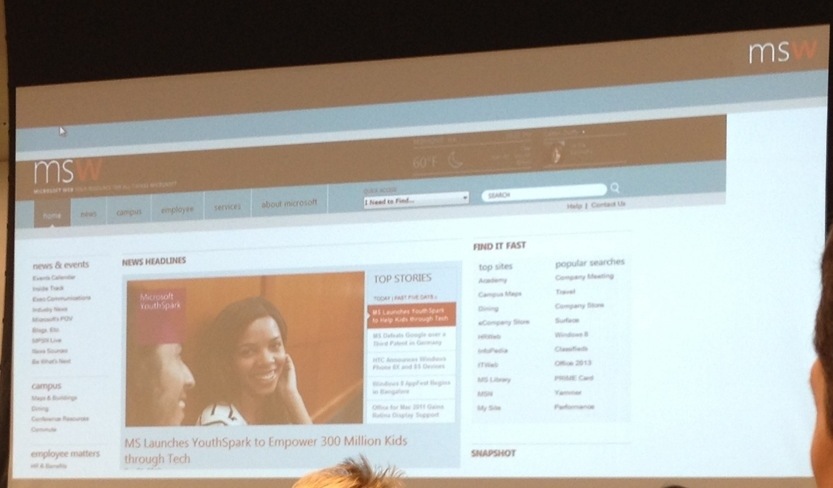
MSW is Microsoft’s internal portal site, includes news and information, as well as links to company resources.  They have a five person editorial team, and a vendor who built the site and manages placing the content.  They handle enterprise-level topics, and localized information is handled separately.  Their sections include – Articles (1 daily editorial story and external story responses), employee submission of stories, snapshot (employee submitted photos), and a few others.  They let people choose their own homepage/portal and don’t force this site on them.  They still have a very high awareness and readership rate.

5 lessons for employee engagment:

  1. Skate to where the puck is going

    Microsoft MSW

    Microsoft’s MSW is their internal portal – a source for news and links to company intranet resources.

    People want information wherever/whenever, want shorter bursts of information, and they expect to be able to interact.  They created “The Pulse” as an extension for their MSW internal brand.  It’s a place for microblogging and interaction in order to engage in conversations.  They can use this to monitor employee sentiment and change internal perceptions around certain issues.

    Similarly, mobile is critical – there’s often more participation due to accessibility of content whenever/wherever – so they’ve developed all these tools on a mobile app.  Mobile is so critical, they’ve eliminated their mass email program to free up resources to implement the mobile aspect of the site.

    What didn’t work – “Submit a Question” – surveys revealed people wanted to ask executives questions.  So they developed a tool to let people post questions and vote them up based on popularity.  Failed because questions that came in often related to secret information that wasn’t ready to be discussed.  They failed to work together with departmental communications managers to be prepared for the questions coming in.

  2. Make it Easy for People to Act
    Infographics make it easy to explain content in a simple way, and can be utilized both internally and externally.  What doesn’t work: A complicated call to action.
  3. Make your Events Social
    Utilized their social platform to socialize events.  There were some minor issues with employee submissions, they were prepared and acted on it.
  4. Make it Real
    Don’t force participation, highlight events, meetings, employee retail deals, etc. to give them what they want and may not be aware of them.
  5. Involve them in Big Moments
    This includes product launches, acquisitions, company meetings, and other big changes impacting the company.  This can be used as a focus group to determine employee sentiment and engagement.


Changing Nature and Pace of Communications

Frank ShawStrategies for the changing nature and pace of communicationsFrank X Shaw (@FXShaw), Corporate Vice President of Corporate Communications, Microsoft

Trends impacting communications:

  • Tech trends – personal computing, cloud computing, social computing.
  • Consumer trends – multi device world, your stuff – everywhere, social networking
  • Marketing trends – Social media marketing, multi channel marketing, video, Interactivity

Nature and pace of communications has changed in the following ways:

  • 20121004-095150.jpgPublishing explosion – Technology tools make it easier and faster than ever for everyone to publish.
  • Influencers are dynamic – Microsoft now watches and develops relationships with blogging influencers. They are literally scouting the up and coming influencers on industry blogs.
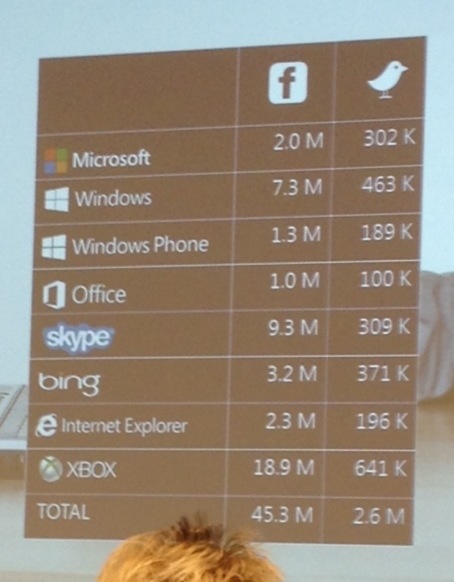
  • Direct storytelling drives action– You can now tell your story as a brand without having to go through anyone else. Microsoft created a News Center to tell their story directly. Internally, they created a news center (includes social features) – it has 5 million page views/month and reachs about 85% of employee base on a monthly basis. They also utilize their corporate Facebook page and have learned, images and tone is everything. People engage most frequently with images. Tone has to be light, some humor, invites conversation, and there’s almost no selling.
  • Engaging invites attention – Before engaging, Microsoft asks the following questions.

    • Do you have the right resources to engage or respond?
      It’s not cheap. You need a dedicated resource to engage. An example: Smoked by Windows Phone – It has a lower cost as a campaign, but it requires a dedicated resource.  They’ve invested in resources because it has great ROI.
    • Does engaging align to your goals?
      Engagement should support a goal. Example: Microsoft Lost Decade – respond, but didn’t want to draw attention to source article, so they responded on TechCrunch article.
    • What is the value you can deliver or contribute?
      On internal surveys, they discovered that external press coverage is one of their most influential things which impacts their employees’ view of the company. Now, when they run a story from the media on their News Central site about the company, they run an accompanying article to tell employees their point of view and give them message points for responding. This clearly adds value to their employees view of company. Externally, goals have clearly defined marketing goals and are usually part of a larger campaign.
    • Will you shift the conversation in your favor?
      Anticipate debate and issues, and share your company’s point of view to help shift the conversation. After a conversation emerges, always discuss whether or not to engage in the conversation. Then when you decide to, track the conversation.
    • Does the risk out weigh the reward?
      If results are going to be negative, what is the impact? Think about it from a short term vs long term – if there’s long-term gain, that will be the focus. Also examine legal/shareholder responsibility and potential impact. Brand, customer, and employee implications need to be reviewed. Finally, personal/professional reputation is examined.

My Plan for Oct. 4

As I mentioned, I’m going to be at the Ragan Employee Communications, PR, and Social Media Summit from Oct. 3 – 5.  There are a few different sessions offered during each period, so I wanted to share the sessions I’m planning to attend here.  You can always follow my live (West Coast time zone) on Twitter (@kkozlen), or here on this blog. If requested, I might do some live video coverage via this site… please take a look at my plan for the conference and let me know if there are any questions or things I can look into on your behalf.

Thursday, Oct. 4

8:45 a.m. (PST) Welcome with Mark Ragan

Frank Shaw

9 a.m.-10 a.m.
OPENING KEYNOTE – Strategies for the changing nature and pace of communications
Frank X Shaw (@FXShaw)
, Corporate Vice President of Corporate Communications, Microsoft

In today’s 24/7 global communications environment it’s harder than ever to know what to say when and what messages should travel through which channels. It’s becoming more challenging to understand what will have the most impact with your target audience. It is also becoming more difficult to strategically respond to competitive opportunities or threats when the pace of communications is instant.  Timely action and response is of the essence. Frank Shaw will share the things he’s learned over the past several years about the changing nature and pace of communications, with an emphasis on competitive PR.

  • What social strategies work best around competitive PR
  • How to best balance a timely response with need for legal review and involvement
  • How to identify a best practice
  • What to measure to know you’ve had impact reaching your target audience around competitive communications
  • When to take a risk and when not to act

Tobin Burgess

Caitlin Duffy

10:15 a.m.-11:15 a.m.
Employee communications tactics for an ADD world:  How to engage, collaborate and motivate employees
Tobin Burgess is Senior HR Business Partner, and Caitlin Duffy (@duffycait), Managing Editor of MSW, Microsoft

We all know that employee engagement is critical—it leads to higher retention, increased productivity and better morale. But between the “old-fashioned” tactics of email and events and the new wave of social tools, how do you really move employees to action as advocates and experts? Microsoft has learned key lessons in both old and new tactics—lessons that may help you reach and engage employees creatively no matter your set of tactics.

  • How employee comms is gathering followers and landing calls to action via internal social channels
  • Microsoft’s key take-aways in designing a mobile news app for employees
  • What kinds of events—from in-person to videocasts to microblogging Q&A—generate the best reach and engagement
  • How one company-turned-division, Skype, managed employee engagement through its acquisition and on-boarding into Microsoft
  • How both specific groups and the corporate team use employee deals and retail to get products into employee evangelists’ hands

Kristin Graham

Mark Schmitt

12:15 p.m.-1:15 p.m. (PST)
Come on, get happy: How Expedia enhances employee engagement online
Kristin Graham, Vice President, Engagement & Communications, Expedia, Inc.
Mark Schmitt, Senior Communications Manager, Employee Programs, Expedia, Inc.

First begun as a project within Microsoft, Expedia was a pioneer in the dot-com boom. Fifteen years later, the company is Expedia, Inc., the worlds largest online travel company, employing more than 9,000 people in 36 countries. Communicating across time zones to go-go employees who are by nature impatient of going through channels and following by-the-book formal procedures, Expedia tackles internal conversation, collaboration and community by using a portfolio of communication tools. Using both traditional and social channels, Expedia keeps learning and adapting to how these channels inform and inspire employees.   The goal is to get employees to share professional and personal content through tools on a global intranet. The mix of tools helps workers cultivate corporate culture, deepens its employee value proposition, and boosts Expedias brand.

In this session:

  • What Expedia learned the hard way as it introduced new tools to email addicts
  • How changing a vacation policy made a competitive difference
  • What channels drive a new health & wellness program
  • How an online employee referral program produces more than 12,000 referrals a year
  • How partnering with PR and IR extends reach, resources, and budget
  • Ideas to get the attention of distracted employees used to reading posts and tweets

Diana Kowalsky

Libby Catalinich

1:30 p.m.-2:30 p.m. (PST)
Support a strong corporate culture by guiding your senior leaders to speak with authenticity and transparency
Diana Kowalsky (@dianakowalsky), Internal Communications Manager, and Libby Catalinich (@lcatali), Director of Corporate Communications, REI

Trust is essential to a thriving business. We all know that leaders play a key part in building trust, fostering culture and sparking dialogue. In this session, you’ll hear how REI is working to empower and energize leaders as a critical voice in the organization to build employee confidence and engagement.

  • Why executives matter to employees and how to communicate that to your leaders
  • Tips to help managers be a voice for the organization
  • How a CEO blog can bring personality and connection to senior leaders
  • Why old-fashioned face-to-face conversation still matters

Justin Fong

2:45 p.m.-3:45 p.m. (PST)
How to create buzz and excitement with employee communications—from a stale monthly newsletter to an energizing monthly talk show
Justin Fong (@jgfong), Vice President of Internal Communications, Teach For America

In the last five years, Teach For America’s staff has grown six-fold to nearly 1,700 spread across 46 regions and countless home offices. Fostering community and an esprit de corps has become increasingly difficult, so they developed “The Blank Show,” a one-hour monthly live broadcast that strengthens team spirit, fuels the fire for their mission, and allows senior leaders to communicate important messages live to a wide audience.

During this session:

  • The power of live video broadcasts in shaping staff culture and internal branding
  • Internal change management: abandoning a monthly newsletter and starting a talk show
  • Creating buzz and generating buy-in for an hour-long show
  • Behind-the-scenes conversations about strategy and content for the show
  • The nitty-gritty of putting on a low-budget, high-impact production (including technology and equipment selection)

Thomas Smith

4 p.m-5 p.m. (PST) – SPECIAL KEYNOTE
Disney Parks Social Media Content: Creating Magical Experiences
Thomas Smith (@ThomasSmith) is Social Media Director at Disney Destinations

Similar to Walt Disney’s original idea for Disneyland, the Disney Parks social media program is driven by the simple notion that making guests happy is a key to success. Since launching the successful Walt Disney World Moms Panel, Disney Parks Blog and other channels, the program’s strategy has revolved around listening, building relationships, creating and sharing relevant stories and participating in online conversations. Disney Parks has a series of real-world case studies and examples to share as well as the secret to what keeps the company’s most powerful social program moving forward and grabbing attention.

  • The importance of purposeful storytelling
  • Why Disney Parks social operates like a next-generation newsroom
  • Disney’s secret to moving a social program forward
  • Why doing social right demands creativity
  • How to highlight the best of your company in the social space
  • The key to creating experiences worth sharing
  • How to build structure around your content


My Plan for Oct. 3

The Ragan Employee Communications, PR and Social Media Summit is coming up next week. You can always follow my live (West Coast time zone) on Twitter (@kkozlen), or here on this blog. If requested, I might do some live video coverage via this site… please take a look at my plan for the conference and let me know if there are any questions or things I can look into on your behalf.

The first thing I’m attending is a pre-conference workshop on Wednesday, October 3, covering various aspects of employee communication. Here are the workshop sessions I’ll be attending:

Dux Sy

9 a.m.-11 a.m (PST)
Transform your corporate communications with SharePoint
Dux Raymond Sy (@meetdux), PMP Managing Partner, Innovative-e

By leveraging SharePoint 2010, corporate communicators are empowered to create relevant solutions that can increase productivity by streamlining and automating communication processes and minimizing communicators’ dependence on IT.

  • Exploit the key benefits of SharePoint for corporate communicators
  • Automate corporate communications processes and workflows with SharePoint
  • Integrate SharePoint with existing corporate communication tools
  • Create a Web-based dashboard to track and measure relevant corporate communication metrics
  • Leverage social and mobile capabilities to better engage corporate audiences

Mark Schumann

12:30 p.m.-2:30 p.m. (PST)
Leadership communications: How a communicator in the social media world can support and maximize the impact when an executive communicates
Mark Schumann (@dmarkschumann), past Chair, IABC
Mark Schumann, ABC, past Chair of IABC and a 17-time Gold Quill winner, for a compelling workshop on how to reinvent your communication skills to provide the support a leader needs in the social media world.  Behind every great leader is a great communicator. And, in this 24/7 business environment of constant interaction, how a communicator supports a leader has significantly changed. No longer is helping a leader craft a message adequate support. Today’s communicator must continually coach the leader to make the most of each opportunity to engage.

This session will cover:

  • Help a leader discover a communication style, tone and level of comfort with a range of interactions
  • Coach a leader to work within an authentic voice that is natural to express and absorb
  • Introduce new media to a leader without forgetting that every tool is a means to an end of stakeholder engagement
  • Establish a curriculum of leadership message and content
  • Encourage a leader to become more involved in the development of communication strategy and approaches without delegating the task
  • Continually reinforce to the leader that communication is a fundamental part of the role

Drew Keller

3 p.m.-5 p.m. (PST)
How organizations need to use video and storytelling to create and protect their brand
Drew Keller (@DrewKeller), Owner, StoryGuide

Corporate communicators must explain, defend, and bolster the corporate brand internally and externally with imagination and verve. This is no small task now that social media has made it more difficult to manage your brand on many platforms. Video is one of the strongest weapons in your arsenal to create the look and feel of your brand. When you make a video, your audience pays attention to every detail. They look in the corners of your shots, they listen to the words, and they absorb your message… intended or accidental. Therefore it is critical that every video you produce has an identifiable relationship with the personality of your product.

This session will cover how to use video to tell your corporate stories. You will learn how to:

  • Make certain that your stories reflect your company or organization’s philosophy
  • Make sure the look and feel of your videos reflect the brand positively
  • Avoid common pitfalls of content creation that does not advance your brand
  • Capture inspirational and memorable stories that will bring your company renown
  • Write the perfect script through employee interviews and brainstorms