Disaster: The Future of Crisis Communications

panicbuttonI followed this session via Twitter and huge thanks to live blogging/tweeting from Elysa Ellis.

Everyone now has the ability to be an immediate publisher, and we are in an age of “permissionless information.” People can post information immediately, with no filter. The real challenge is editorial – getting out information quickly, but getting out what’s most important and coordinating all the information so it becomes relevant and prevents clutter. Even the United States Air Force knows “speed is more important than security in a crisis.”

The real goal is to get the most amount of information out there, in the shortest amount of time. While everyone has the ability to be out there, you as a brand or company have to be out there too. If you’re not out there, speaking to your audience, someone else will do it for you. Audiences are looking for “verified” information, and as a brand or established company, you carry some credibility others don’t. However, as a brand, you need to be prepared for this and plan ahead:

  • Understand what you can and can’t say – build corporate/legal approvals – and TRUST – in advance
  • Establish boundaries and rules of engagement
  • Make sure you have the right technology to tell the story
  • Establish networks (police, fire, social media influencers, etc.) before events, so you can call on your network when you need to

Remember, things move fast, so you need to plan ahead, but be flexible and forgiving. If you make a mistake or do something wrong, admit it. Be flexible, be honest and genuine, and don’t be afraid to utilize/curate information from the hundreds or thousands of citizens on the ground gathering and sharing information.

Constantly review the tools in your toolbelt (blogs, photos, videos) and the sites you use, and make sure you’re ready to tell your story in the best way possible, because if you don’t have approval to use it, you’re at a disadvantage, because the average citizen doesn’t need it. That certainly doesn’t mean leaving out traditional media, it’s just that newer tools typically allow you to get out there quicker.


Top Takeaways from #RaganMSFT

As you could probably tell by my last several posts, I had a wonderful time at the Ragan Employee Communications, PR, and Social Media Summit at Microsoft.  As I’ve done with the last several conferences I’ve been to, I wanted to wrap things up with a summary of the themes and takeaways I had at the conference.  Here you go:

SharePoint Can Be More
It was the excellent opening workshop by Dux that made me realize that SharePoint could be so much more than simply a document repository.  He showed example after example of how SharePoint could easily implement things like workflows and be used to build dashboards.  I’ve come back with a better sense of optimism and I’m in the process of looking for ways to utlize SharePoint to help my team.

Video Helps Tell Your Story
While the presentation by Drew Keller on using video to tell stories was excellent, it was the presentation connecting internally using video by Justin Fong, of Teach For America, that energized me.  Not only was he able to use video to increase internal reader/viewership by 5 times, but he laid out the phases of his plan.  It was obvious in the video examples he showed, that members of the organization were much more energized with the videos than they were with the newsletter.  Having worked in video for the last 7 years, I knew this, but it took these presentation and examples to remind me of the power of video for internal communications.

Every Company is Different
Some great companies presented on internal communications, from SAS and REI, to Best Buy, Expedia, and Microsoft.  What I learned is that every company is different.  While companies like REI and Best Buy have to worry about a huge portion of their employees who don’t have a company-provided computer, there are other companies like SAS and Microsoft who are able to build robust Intranet Hubs for information.  Every company communicated with employees differently, but that’s because they all remembered to put the audience first and let their audiences’ needs be their guide.

Make Executives More Human
It was  neat to see how, particularly SASExpedia, and REI get their executives out of the office and into the mix with employees.  Whether that’s visiting the locations where they work, revealing parts of their lives on a blog, or working side-by-side with them on projects.  The presentation by Mark Schumann (@dmarkschumann), which covered leadership communication in a social world and maximizing leadership communication, gave some excellent examples of how you can help make executives more human.

Change Management is Way More than Communications
Hearing about how Skype was brought into Microsoft was enlightening.  As they showed in their presentation about change management communication, change takes a lot of communication, but it also takes a whole lot more – like partnerships, leadership communities, and a strategic plan.

There are always New Tools
I consider myself to be fairly tech saavy, and while I was aware of many of the tools Dux used in his presentation about maximizing social media success, there were several I wasn’t aware of.  There were some excellent tools for incorporating Twitter into PowerPoint that I’m going to borrow.  Both from this presenation and catching up with @BevJack, I’m always excited to learn about new tools, apps, etc. that folks in social media find useful.

Create a Great Place to Work

Kim Darnofall7 ways internal communications can help create a great place to work
Kim Darnofall (@KimDarnofall), Internal Communications Project Manager, SAS

SAS has been the Number 1 best company to work for, as rated by Forbes magazine several times in the last few years. They are a technology company, so their audience is very techno-centric, and they have great IT support. Their company has 12,000 people and their internal communication team is made up of 11 people (Senior Director, Social Media & Technology Manager (3), Managing Editor (6), International Liaison, Admin Asst.).

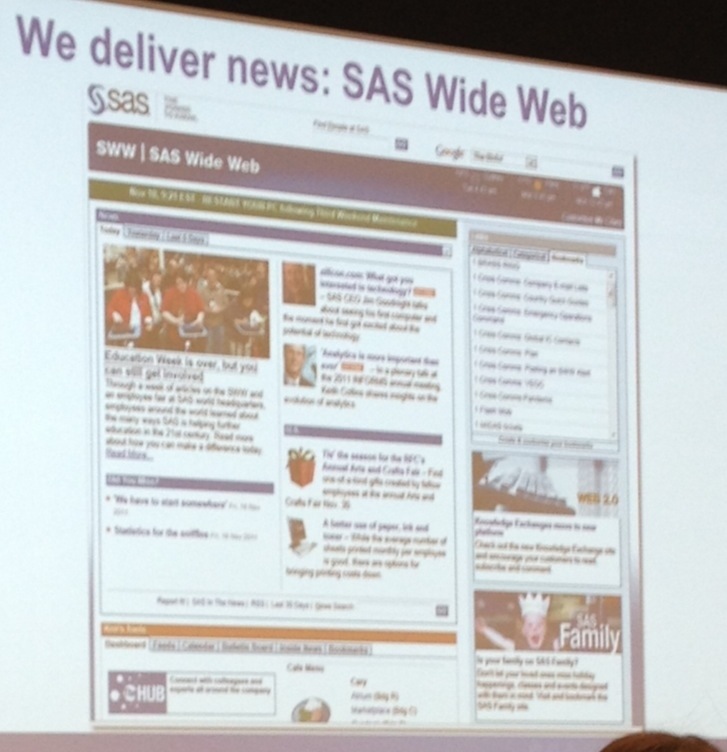
20121005-084707.jpgThey deliver news from the SAS Wide Web, the company’s intranet portal, as well as to other country’s mirror portal sites. Some countries adopt this, others don’t, it’s not forced to pull corporate content.

They focus on engaging employees through:

Customization – They utilize RSS feeds to deliver customized content to the portal page.

Inclusion – They handle the SAS Family Site, which provides information externally to spouses/families of the employees.

Participation – They allow comments on every story they post, as well as lots of blogs (from individuals and groups/departments).  They also engage employees through photos and videos – asking employees to submit them.

Contests – Conducted a photo contest among employees, and got over 25,000 submissions (that’s more than 2 per employee). They had employees vote on the best.

Polls & Quizzes – Give people a chance to give you their thoughts, and quizzes to see if communication or training has been effective.

Report it! – Borrowed idea from CNN and other news outlets, it lets employees can submit stories and articles to the internal communication team.

Connect employees to Leadership – Conversations over coffee (like a town hall format), executive update webcasts (deliver message and answer questions in town hall format, and in addition, have live interactions via chat stream on their social hub during webcast), executive blogs, Leadership Live (one-on-one conversation with a leader), Meals (managers met with employees over breakfast, and the CEO might just show up and participate like any other employee).  Also got execs to participate in employee programs  – like “Leanest Loser,” a corporate flash mob, and “Camp Chill” (an event where they brought in snow and road down the hill with their kids).

Connect employees to each other – This includes different kinds of profiles of employees on their news site, post responses to questions with names attached.

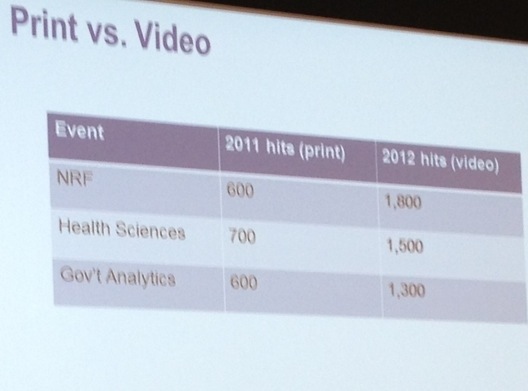
Stay on the cutting edge – They have invested in equipment to shoot their own video, and have found better success with engagement and viewership than they have with print articles (see photo to right).

Keep the Corporate Culture – Internal communications is the voice of the company to show everything the company does, who the people are, and the values they hold.

Have fun – Highlighted things like “Talk Like a Pirate Day” and “Pi” Day with executive involvement.

Results – Regularly ranked in top 3 of best places to work, and employee surveys rate communications and satisfaction highly.

Connecting Internally Using Video

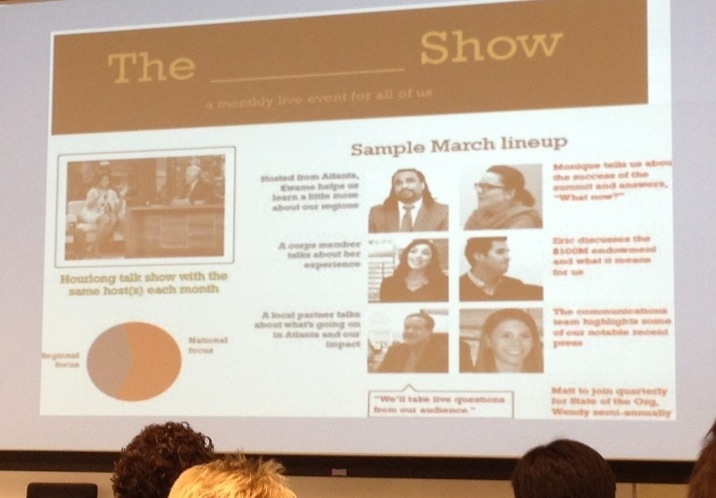
Justin FongHow to create buzz and excitement with employee communications—from a stale monthly newsletter to an energizing monthly talk show

Justin Fong (@jgfong), Vice President of Internal Communications, Teach For America

Had an organization newsletter, until around February 2010, with notes from senior leaders and some other news items. Readership was poor, and at the same time, video was exploding.

Why video?

  • Richer media form
  • Brings people closer to the action
  • Greater ability to convey tone and emotion – brings people to life.

20121004-151418.jpg

Benefits of live video?

  • Minimal production time
  • Unscripted, real, human
  • Interactive
  • Event excitement

Change Management

  • Being honest about what’s not working – newletter results (10% readership)
  • Getting buy in from senior leadership
  • Appealing to the masses
  • Pilot and test

Goals:

  • Entergizing our people and create excitement about the work
  • Liberates people to laugh more
  • Broadens understanding of their work

Discussions Behind the Scenes

  • Talk about diversity
  • Discuss the narrative, what’s the story and who will deliver it?
  • Talk about wordrobe
  • Feedback from the audience
  • Tone/feeling of each show

Growth

Phase I

  • $300 camera, WebEx (audio via phone)
  • Host and co-host
  • Multiple cameras (another $300 camera) with feeds from other cities
  • Video was only so-so, audio-video out of sync, and could only do it live.

Phase II

  • Mix live shots with recorded segments
  • Livestream.com @ $350/month
  • Chat Functionality – to create event excitement
  • New equipment: $2500 camera, microphones, lights
  • Travel expenses are the bulk of cost
  • Streaming relies on internet connection

Phase III

  • Highest production quality, all pre-taped
  • Studio shots and segments from the field
  • Team of four travels to produce
  • Video quality is usually external-grade
  • Audience misses the excitement of a live event

Attracting an audience

  • Attendance is about 50-60% of the organization
  • Trailers, posters, and Yammer promote the show
  • Groups watch the show together as a ritual
  • Create a brand around the show – with a logo for each show
  • Focus on the quality of the program
  • Weaving the fabric of the organization’s culture – creating tradition, ritual, rhythm with Year in Review and Back to School Tour

Lessons:

  • Stick with it
  • Pilot – by not committing too much, being flexible, leaving space for innovation
  • Constantly evolve – the first show looks drastically different than today’s
  • Think expansively about the potential impact of internal communications
  • Don’t be afraid you can do it

Guiding Senior Leaders

Diana Kowalsky Libby Catalinich

Support a strong corporate culture by guiding your senior leaders to speak with authenticity and transparency
Diana Kowalsky (@dianakowalsky), Internal Communications Manager
Libby Catalinich (@lcatali), Director of Corporate Communications, REI

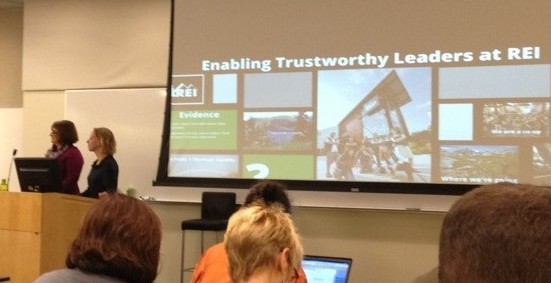
REI has 123 stores in 30 states, with 10,500 employees and has over $2 billion in sales. The have a co-op ownership – anyone can become a member for as little as $20. Pay dividends of around 10% each year. Because they are not a shareholder owned company, they tend to be more transparent and open. However, when you tell everyone, everything, you need to be more focused on being strategic about messages. The company has many long-tenured employees and it has traditionally been a smaller company. Now, as they are growing, the culture is changing and growing which is a bit uncomfortable for many. Two-thirds of employees don’t even have a company email address, making connecting with employees a bit difficult. Therefore, leaders are the source of information, especially since research indicates their leaders are the best source of information.

2 Types of Leaders at REI:

  • Day-to-day leaders – lots of direct contact with employees
  • Strategic leaders – Set long-term vision and direction of the company

3 Characteristics of trustworthy leadership

  1. Honesty – Leaders need to tell it like it is, and mean what they say.
  2. Humility – Leaders are open to feedback and learning from employees.
  3. Humanity – Leaders speak from the heart and make personal connections with employees.

Honesty

They accomplish this by encouraging conversations – The leadership team visits every store, every year to do this. The CEO and other leaders also stay connected by living among employees – at lunch, in the vanpool, at service projects, etc.

They also connect online, using various social media – recently built www.aroundthecampfire.mobi as an employee portal (built on WordPress). In the first month, they’ve had over 200 comments, and average use is 5 minutes.  CEO and other senior leaders blog here, no filters.

They learned that leaders weren’t necessarily prepared to blog, and they’ve had to teach them what to talk about and give them direction. Make sure you keep it real, prepare leaders for what to expect, and be consistent.

Humility

Make sure you ask for feedback.  Get data and act on it.  They give each leader feedback on themselves.  They’ve also focused on sharing ideas, and recently created REIdea, a SharePoint community to share ideas between store managers.

They learned that feedback isn’t always easy to get or give, but you can drive it by telling stories with examples of how change was driven by feedback.  Most the time, if you want to know, just ask.

Humanity

You need to focus on cultivating personality, having fun, and being real.  Focus on making leaders accessible and doing things to bring out their personality.

They’ve learned it’s about incremental change.  You need to start small – suggest they talk about something other than business on their blog.  Mix in personal learnings and illustrations with your talks and erase the corporate speak.

Case Studies

  • Marriage Equality – CEO came out on blog and gave reasons for the change in the company.
  • Layoffs – Prepared information for local leaders, so they had consistent speaking points and knew how to handle situations.

Results

People stick around when they have leaders they trust, like and believe in.  They’re ranked as one of the best companies to work for, and have record retention of employees in the retail industry.

Enhancing Employee Engagement Online

Kristin Graham Mark Schmitt

Come on, get happy: How Expedia enhances employee engagement online
Kristin Graham, Vice President, Engagement & Communications, Expedia, Inc.
Mark Schmitt, Senior Communications Manager, Employee Programs, Expedia, Inc.

The Culture Connection

Every company has a culture, but there’s also subcultures, and there are occasional cultural disconnects. Culture is the defining element of the company (the personality that makes it unique). The sub-culture is how an individual or group experiences the culture. Companies have both. The right combination can:

  • Improve company performance – increased retention and engagement
  • Enhance the customer experience
  • Inspire intense passion for the product
  • Drive innovation

Mission: To revolutionize travel through the power of technology

Cultural elements needed to be defined, so they came up with Supporting Values:

  • Passionate about travel – love travel and making it easier and better.
  • We are Innovative – use intelligence and technology to create and simplify.
  • We are Enterprising – seek out opportunity, take risks and act with speed.

20121004-125217.jpg

Engagement Expectations

Employees want (based on feedback):

  • Leaders who are “available”
  • Personal development
  • Ongoing, specific feedback
  • Sense of community
  • Flexibility
  • Reasonable compensation (Money & More)

Key to success/general goals:

  • Set a few expectations that match your culture and meet every one
  • Build employee trust: what you do vs. what you say
  • Communicate: early and often
Examples/Case Studies
  • Visible Leadership– Includes a CEO blog with an “Ask the CEO” page where employees can ask questions and he’ll respond on the blog within a week. Tjhey have a quarterly town hall on video, and a Leader Travel Blog
    Quarterly town hall on video.
    Leader Travel blog – how they experience the brand and experience as a consumer
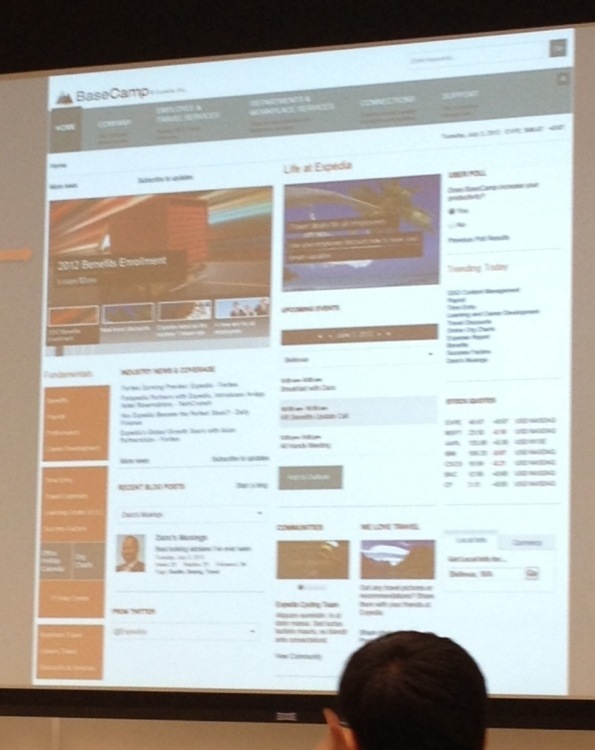
  • Personalizaation – Company News Your Way – Create a new Intranet portal that showcase local interest, make coverage scalable, leverage employee sentement, and creates 2-way communication (see photo).
  • Segmentation – GO! site a wellness program – targeted users based on a matrix by age, motivation type, hourly/salaried, and global (cultural similarities and benefits offerings) with information that was likely most relevant to them.
  • Philanthropy – Global Day of Caring – A day off to give your time.  Everyone registered on a website with what they were doing and then asked for photos.
  • Technology – We love travel internal site – Employee travel site with tips, advice, recommendations and allows users to post photos, comments, etc.  The external website folks asked to post the employee photos on the public facing site.

Results

  • Segmentation engages folks by making it about them.
  • People look for community – real or virtual
  • Technology can make communication more personal, local and relevant
  • Feedback isn’t optional anymore (internal feedback) – incorporate it into what you’re doing
  • “Fun” is a strategic element – if you’re not having fun or enjoying it, they won’t enjoy it or be engaged

Change Management vs Communications

Tobin Burgess Microsoft’s Aquisition of Skype and Change Management
Tobin Burgess
is Senior HR Business Partner

Tobin lead Microsoft’s acquisition of Skype, the largest in the company’s history, and talks about the success of change management vs communications.

Skype (by the numbers)

  • 25% of all international calls are done through Skype
  • 300 Billion minutes of voice and video calls
  • 200,000,000 active users (over 100 minutes a month)
  • 40% Growth Rate

Challenges:

  • Big & Expensive – Largest company acquisition ever ($8.5 Billion).
  • Truly Global – In 10 countries with no headquarters.
  • Stand Alone Division – On it’s own, and has the first president that’s not in Redmond.
  • Change fatigue – Leadership changed frequently, and most employees tenure was less than 2 years.
  • Brand, consumer base, and culture – Strong engineering culture were critical to preserve

20121004-111908.jpg

How do you win their hearts?

They started with a communcation plan, built a team, and made tools to carry out their plan. After a few months, they didn’t win their hearts and minds – 2/3 were negative about the acquisition. So, they gave them XBoxs and Microsoft Phones – but you can’t buy love. So they changed their strategy, and learned, it’s not just about communications, it’s about change management.

Created a change roadmap – Included communications, training, leadership, invovlement based on leadership levels.

  • Leader lead communication – Utilized the CFO because he was trusted (CEO hadn’t been there that long to be trusted)
  • Make a big splash – They had a very interactive culture, and everyone had a voice. They used the company meeting as a platform for kicking things off. They picked 27 of the most influential people to help carry the flame (everyone from new employees to executives) – flew them in and did a week long series of meetings for dialogue (not push, truly a dialogue). Also created a change managment leadership team by supplementing the 27 people with more senior level folks, as well as key stakeholders (based on feedback). They reviewed Skype chats and saw the tone change based on the influence of these individuals.
  • Integrate Milestone Videos – Show and emotional and emersive view of the changes taking place.
  • Let them Help Themselves – Homepage for information about the acquisition.

Survey at the end showed 75% of employees surveyed felt the change was good, and 90% felt they had enough information, and most importantly, production didn’t suffer and product continues to grow.

Ultimately, communications is just a part of a overall change management strategy. It’s important to remember how collaborative and wholistic approach you must take.

Moving Employees to Action

Caitlin DuffyEmployee communications tactics for an ADD world: How to engage, collaborate and motivate employees
Caitlin Duffy (@duffycait), Managing Editor of MSW, Microsoft

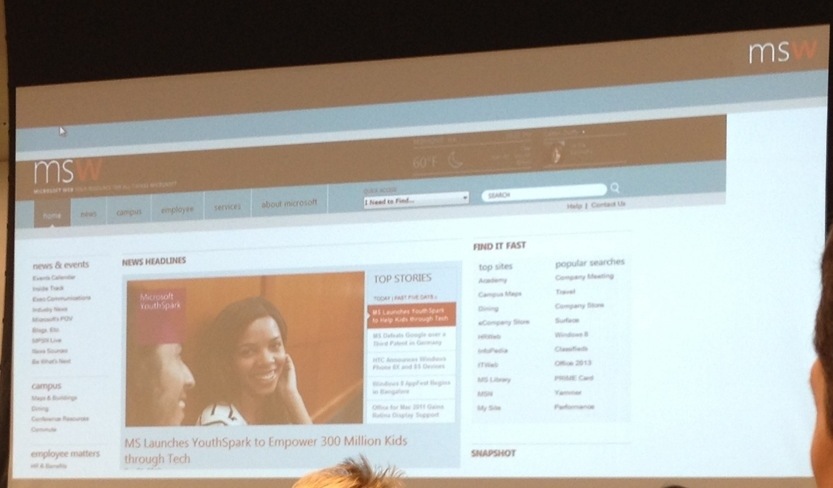
MSW is Microsoft’s internal portal site, includes news and information, as well as links to company resources.  They have a five person editorial team, and a vendor who built the site and manages placing the content.  They handle enterprise-level topics, and localized information is handled separately.  Their sections include – Articles (1 daily editorial story and external story responses), employee submission of stories, snapshot (employee submitted photos), and a few others.  They let people choose their own homepage/portal and don’t force this site on them.  They still have a very high awareness and readership rate.

5 lessons for employee engagment:

  1. Skate to where the puck is going

    Microsoft MSW

    Microsoft’s MSW is their internal portal – a source for news and links to company intranet resources.

    People want information wherever/whenever, want shorter bursts of information, and they expect to be able to interact.  They created “The Pulse” as an extension for their MSW internal brand.  It’s a place for microblogging and interaction in order to engage in conversations.  They can use this to monitor employee sentiment and change internal perceptions around certain issues.

    Similarly, mobile is critical – there’s often more participation due to accessibility of content whenever/wherever – so they’ve developed all these tools on a mobile app.  Mobile is so critical, they’ve eliminated their mass email program to free up resources to implement the mobile aspect of the site.

    What didn’t work – “Submit a Question” – surveys revealed people wanted to ask executives questions.  So they developed a tool to let people post questions and vote them up based on popularity.  Failed because questions that came in often related to secret information that wasn’t ready to be discussed.  They failed to work together with departmental communications managers to be prepared for the questions coming in.

  2. Make it Easy for People to Act
    Infographics make it easy to explain content in a simple way, and can be utilized both internally and externally.  What doesn’t work: A complicated call to action.
  3. Make your Events Social
    Utilized their social platform to socialize events.  There were some minor issues with employee submissions, they were prepared and acted on it.
  4. Make it Real
    Don’t force participation, highlight events, meetings, employee retail deals, etc. to give them what they want and may not be aware of them.
  5. Involve them in Big Moments
    This includes product launches, acquisitions, company meetings, and other big changes impacting the company.  This can be used as a focus group to determine employee sentiment and engagement.


Changing Nature and Pace of Communications

Frank ShawStrategies for the changing nature and pace of communicationsFrank X Shaw (@FXShaw), Corporate Vice President of Corporate Communications, Microsoft
Trends impacting communications:

  • Tech trends – personal computing, cloud computing, social computing.
  • Consumer trends – multi device world, your stuff – everywhere, social networking
  • Marketing trends – Social media marketing, multi channel marketing, video, Interactivity

Nature and pace of communications has changed in the following ways:

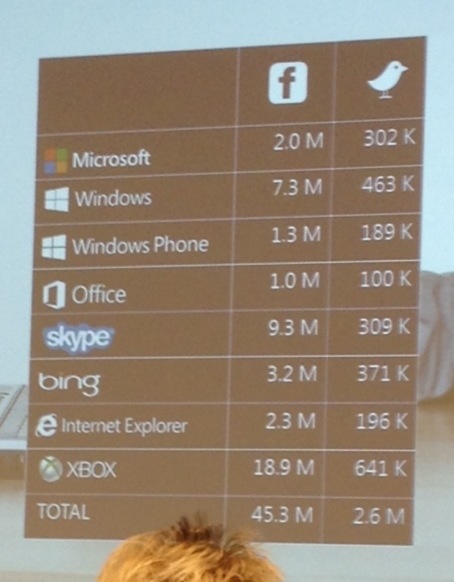
  • 20121004-095150.jpgPublishing explosion – Technology tools make it easier and faster than ever for everyone to publish.
  • Influencers are dynamic – Microsoft now watches and develops relationships with blogging influencers. They are literally scouting the up and coming influencers on industry blogs.
  • Direct storytelling drives action– You can now tell your story as a brand without having to go through anyone else. Microsoft created a News Center to tell their story directly. Internally, they created a news center (includes social features) – it has 5 million page views/month and reachs about 85% of employee base on a monthly basis. They also utilize their corporate Facebook page and have learned, images and tone is everything. People engage most frequently with images. Tone has to be light, some humor, invites conversation, and there’s almost no selling.
  • Engaging invites attention – Before engaging, Microsoft asks the following questions.

    • Do you have the right resources to engage or respond?
      It’s not cheap. You need a dedicated resource to engage. An example: Smoked by Windows Phone – It has a lower cost as a campaign, but it requires a dedicated resource.  They’ve invested in resources because it has great ROI.
    • Does engaging align to your goals?
      Engagement should support a goal. Example: Microsoft Lost Decade – respond, but didn’t want to draw attention to source article, so they responded on TechCrunch article.
    • What is the value you can deliver or contribute?
      On internal surveys, they discovered that external press coverage is one of their most influential things which impacts their employees’ view of the company. Now, when they run a story from the media on their News Central site about the company, they run an accompanying article to tell employees their point of view and give them message points for responding. This clearly adds value to their employees view of company. Externally, goals have clearly defined marketing goals and are usually part of a larger campaign.
    • Will you shift the conversation in your favor?
      Anticipate debate and issues, and share your company’s point of view to help shift the conversation. After a conversation emerges, always discuss whether or not to engage in the conversation. Then when you decide to, track the conversation.
    • Does the risk out weigh the reward?
      If results are going to be negative, what is the impact? Think about it from a short term vs long term – if there’s long-term gain, that will be the focus. Also examine legal/shareholder responsibility and potential impact. Brand, customer, and employee implications need to be reviewed. Finally, personal/professional reputation is examined.

Using Video and Storytelling

Drew KellerHow organizations need to use video and storytelling to create and protect their brand


Drew Keller (@DrewKeller), Owner, StoryGuide

Your brand is a structure – organization and clarity – under which people can define, talk about, identify your company.

Why manage brand in social enterprise video?

Content – either internal or external – is going to be shared – that’s social, so consider how it’ll be distributed or syndicated.  There’s a lot of video out there (70 hours of video is uploaded every minute, and there are over 700 tweets linking to videos every minute), so you need to make sure your audience can find what you want them to find.

Brand Storytelling

Always start with 3 questions when considering a video:

  1. What are the expectations?  It should be an emotional response the audience gives (not views/hits/likes)
  2. What is your story?  Create a narrative structure
  3. Who is your audience?  Choices you make should be driven by the reaction/response/needs of the type of person you’re trying to reach.

Keep it short and to the point (see the chart)

What video gets watched & shared?

  • Tastemakers drive awareness
  • Communities of participation
  • Surprise – the unexpected

A mix of unexpected, short, and transparent – if all 3, creates engagement.

3 biggest people challenges to manage video branding

  1. Corporate cowboy – No clue there are brand guidelines, creates content that dilutes the brand.
  2. Design renegade – Think they are smarter than the organization and want to do their own thing.
  3. Turf builder – Create brand identity for their team/area, and has little to do with the organization.

When Brand Videos Go Awry

Going for the laugh – The problem with comedy is always contextual and cultural. The paradigm is usually as sane person surrounded by lunatics, or the lunatic surrounded by sanity.  The viewer is an observer of someone acting out.  There’s a complicated rhythm and cadence to comedy that’s really an art form.  Corporate video, which goes for funny, almost always makes fun of a stereotype – the easy joke.   Be careful… any content you create, even internally, you have to imagine that it’s going to show up on YouTube.

This is an example from Microsoft of a video created in Europe, illustrating how cultural differences in comedy/taste can impact the brand.

Beware of Unmanaged Team Videos

  • Often created with the best intentions
  • Usually reflect team values/culture, not necessarily company values
  • Can confuse market base with non-aligned message – not consistent with company image
  • Tend to leverage unlicensed media
  • Can create firestorm when local cultural values are not shared by wider audience

Mitigate this by educating people on the values of the brand and brand associations.  All video – internally and externally – should reflect the brand message and should be reviewed by the brand managers.

Branding Too Much?

A recent Harvard Business Review Article points out that you can use too much branding in your video.  Specifically, a study discovered that the more prominent or intrusive the logo, the more likely visitors will stop watching.  They suggest using “Brand Pulsing” where you weave logo and other brand elements into the video that is logical, integrated it into content.  This technique has ben shown to increase viewership and retention by 20 percent.

Takeaways

  • Be consistent – Internal & External
  • Unique, creative and compelling story
  • Tone of message fits the company’s values
  • All brand assets must fit brand identity
  • Respond quickly to challenges – have a plan in place
  • Sweat the details

Check out the excellent series on video and storytelling by StoryGuide.

Ragan’s Coverage of this session.

Maximize the Impact when an Executive Communicates

Leadership communications: How a communicator in the social media world can support and maximize the impact when an executive communicates

Mark Schumann (@dmarkschumann), past Chair, ABC
http://re-communicate.com

The first half of the presentation focused on leadership communications in the social world, while this section focused on the anchors of executive communication.

6 Anchors to helping leaders become better communicators:

  1. Candor – Nothing is more important than making sure people feel like you’re telling the truth.  You can do this by telling people something they don’t know, sharing insights, and giving them something they haven’t heard before.  We always have to find something new – people tend to believe it must be the truth if it’s something new. Tips – share something that surprised you – for example, tie it to something that happened today (hold up the iPad to look cool), people believe it’s more candid and timely if you talk about what’s going on in the news. Likewise, they’re going to believe more if you tell them something that’s not on a PowerPoint slide (seems less rehearsed).  Finally, tell me what you want me to remember, and if you do that, you need to look me in the eye.
  2. Clarity – It’s so easy to get caught up in a convoluted narrative. Be direct (candor) and summarize your message to provide better clarity. Remember the message. There’s always a clearer way to explain it, and never stop at trying to make the message simpler.
  3. Curiosity – Contributes to an image of caring. Connect with people and have a human moment. Walking the halls is a huge opportunity to illustrate this. Leaders shouldn’t just hurry past them on way to meetings. Everyone has a story, and the more a leader can demonstrate an interest in the people they’re speaking with, the more open they’ll be to listening. Begin your talk with a question to learn what people have to say, and then speak to those questions.
  4. Caring – Find me something that will touch my heart, and I’ll show you how it changes my point of view.
  5. Content – The punchline must be heard. People need to know what they need to remember and what they should do with that information. Give the audience meat – always have great content or information.
  6. Conversation – Leaders need to be trained in having a conversation, not a speech. A speech should be nothing more than a conversation with a whole bunch of people.

“I can say anything (as a leader) as long as people believe I’m being candid, clear, and caring.”

Tip: Never say “but” ever again – it makes people defensive. Say “and” – it makes people feel inclusive.

Strengthen a Leader’s Candor

What gets in the way:

  • Truth – Especially when the truth hurts, it can’t always be delivered so directly.
  • Spin – Too much explaination and details looks suspicious.
  • Fear – Often people are afraid of what they’re about to hear, and then they’re afraid of what they didn’t say.
  • Lawyers – have a great relationship with this area, understand the rules – what can and can’t be said.
  • Media – not talking directly with people – recorded messages.
  • Pride – Sometimes leaders let their pride get in the way

Things to consider:

  • What do you need to communicate? Use the CEO sparingly, only when you need them.
  • How informal must we be?  They start with a comfort in formality.
  • How spontaneous can we be? Don’t kill questions by making people wait till the end. Questions are spontaneous.
  • Who else should we include? Have the people there who can answer the questions, but don’t make them look like they don’t know the answers.
  • How much conversation can we stage? Facilitate discussion between leaders, reveal how they work together. People want unscripted moments.

Reveal a Leader’s Caring

What gets in the way of caring:

  • Distance – Physically (higher floors) and on the org chart, leaders need to be connected to the real world at all times.
  • Uncertainty – Not knowing what to say.
  • Entourage – They have to break out of their comfort zone and involve others.
  • Formality – This keeps people at an arms length
  • Logistics
  • Timing

5 Reminders a leader must live by to be perceived as someone who cares:

  1. You are being watched – always – especially now with technology
  2. You are never alone – people are always watching, listening, etc.
  3. You only have a moment – reactions by individuals are a collection of small moments
  4. You can disappoint people – It’s easy when the expectations are great
  5. Social media doesn’t make you social – It’s about being human and opening up

Articulate a Leader’s Clarity

What gets in the way of clarity

  • Details – They know the topic and want to tell everyone everything.  People just need to understand the big picture and only include what’s necessary to illustrate this.
  • Voice – This is the way we say things.  They might use the company’s voice, not their own.
  • Lawyers – Certain ways we have to say things.
  • Editing – Being too close to the content.
  • Tradition – People may infer things based on past practices
  • Deadlines – Not enough time to craft the correct message.

6 things corporate communications must be able to tell their leader with a straight face:

  1. No one will understand you
  2. No one will believe you
  3. No one will follow you
  4. No one will care about what you are saying
  5. You would be behind in the polls (if you were running)
  6. Your head cheerleader is losing their cheer

Organize the content

Know your audience:

  • Who am I trying to reach?
  • What do they hunger for?
  • What must they understand, believe and do?
  • Who do they trust?
  • What do they hope for?
  • What disappoints them?
  • What angers them?
  • What do they want to get the message – video, live, phone?
  • How few words?
  • What will make me crazy?

Stimulate a Leader’s Curiosity

  1. Clarify and develop the communication competencies
  2. When you coach, support, advise, and nurture
  3. Capture and package the soul – people react to the person
  4. Protect the leaders from themselves

How to reinvent what others must see in a leader

Detox – Documentation of habits, discard certain things, deny them opportunity to go back to bad habits that get in the way

Declare – This is the kind of communicator I want to be (everyone wants to be better when they understand how important it is to their job) – discover, describe, develop – long term effort to be more effective

Deliver – Prepare, rehearse, focus on detail, delegate, and debrief

 Here’s Ragan’s coverage of the same session.

Leadership Communications in the Social World

Mark SchumannLeadership communications: How a communicator in the social media world can support and maximize the impact when an executive communicates
Mark Schumann (@dmarkschumann), past Chair, ABC
http://re-communicate.com

This is the first half of this discussion, as this excellent talk covered a long list of advice for corporate communications and speechwriters.  The role is not just to help executives communicate effectively, but also to educate them on effective communications.  One of the most important things it to help them understand that people react to the context, as well as the content of the message.

Why executive speechwriting is a tough job:

  • Preparing the leader so they reach a comfort and confidence in the message, tone, and approach.
  • Tone, not necessarily the message, is what people will react to the most.
  • Wearing a smile when the leader gets it wrong.
  • Accepting all of the blame and none of the credit.
  • Leading leaders isn’t easy or expected

Some communicators continue to fall into the trap of the traditional formality of corporate communications:

  • 20121003-144005.jpgFormality of message capture and delivery – Communications are now faster than ever, can be delivered in multiple formats, and captured with something as simple as a cell phone camera.
  • Formality of the setting – Communications used to be in person, in a big room.  Even if it’s a big room, speakers need to make the room smaller.  Take the opportunity to work the room and introduce themselves to people in advance to make it more intimate.
  • Formality of the responses – Feedback has often been limited, often because many people, in general, don’t like feedback.
  • Formality of the process – Preparation meetings often become formal events.  They don’t have to be.  Try more meetings with your speakers in 15 minute blocks.  You’ll often get more done, you’ll be efficient with your time, and the leader is more willing to give you 15 minutes than an hour.

5 Rules corporate communicators must live by:

  1. People memorize the tone – People remember the humanity of the voice and how it made them feel.  Be sure to organize content that contributes to the tone.  For example, begin with a story to set tone.  Even if it’s financial info… tell a story to help them remember it’s about accomplishing the goals of the company.
  2. People retell the stories – Stories help to humanize the situation, or make the message simpler. The only way to do this is to encircle the facts with something that’s appealing to the audience.
  3. People want humanity and humility – Ultimately, we’re helping leaders reveal their souls and using how they communicate to reveal who they really are. Step back from clinical messages to think about what the audience will remember.  Tip – have the leader talk about something they learned – from an employee, from their area, from the situation, etc.
  4. People ignore the facts – People will remember the things they want to remember, often what’s most relevant to them. What we can do is set the tone, create the voice, frame the content, manage the ego.
  5. Help people believe in how they are led – Perhaps the most important role of the corporate communicator.

5 things we have to acknowledge

  • Leaders think really big
  • Leaders have the capacity to act small
  • We have to educate leaders about the risks – what happens if… the Powerpoint breaks, an event occurs, etc.
  • We have to inspire leaders to want to be heard
  • We have to coach leaders to be believed

Dangers signs of leaders who may be difficult to work with, when they say:

  1. I was on the high school debate team – It typically means they like to argue.
  2. I like to wing it – It means they don’t listen, want feedback, or prepare for what they want to accomlish with a speech.
  3. I don’t need to rehearse – Everyone needs to prepare and rehearse. Spontaneous is too spontaneous to be prepared for.
  4. My spouse or partner coaches me – They aren’t ready to listen to you.
  5. I really like Power Point – They rely too much on it as a crutch, and often repeat what’s on the screen.
  6. I have a great sense of humor – Trying to be funny tends to get in the way of being genuine or caring.

One of the biggest challenges is to make leader feel like they’ve been a part of the process regarding their own communication. Find a way for them to help. Get them to write the first draft – you then get to see what is most important, and then you craft it.