Disaster: The Future of Crisis Communications

panicbuttonI followed this session via Twitter and huge thanks to live blogging/tweeting from Elysa Ellis.

Everyone now has the ability to be an immediate publisher, and we are in an age of “permissionless information.” People can post information immediately, with no filter. The real challenge is editorial – getting out information quickly, but getting out what’s most important and coordinating all the information so it becomes relevant and prevents clutter. Even the United States Air Force knows “speed is more important than security in a crisis.”

The real goal is to get the most amount of information out there, in the shortest amount of time. While everyone has the ability to be out there, you as a brand or company have to be out there too. If you’re not out there, speaking to your audience, someone else will do it for you. Audiences are looking for “verified” information, and as a brand or established company, you carry some credibility others don’t. However, as a brand, you need to be prepared for this and plan ahead:

  • Understand what you can and can’t say – build corporate/legal approvals – and TRUST – in advance
  • Establish boundaries and rules of engagement
  • Make sure you have the right technology to tell the story
  • Establish networks (police, fire, social media influencers, etc.) before events, so you can call on your network when you need to

Remember, things move fast, so you need to plan ahead, but be flexible and forgiving. If you make a mistake or do something wrong, admit it. Be flexible, be honest and genuine, and don’t be afraid to utilize/curate information from the hundreds or thousands of citizens on the ground gathering and sharing information.

Constantly review the tools in your toolbelt (blogs, photos, videos) and the sites you use, and make sure you’re ready to tell your story in the best way possible, because if you don’t have approval to use it, you’re at a disadvantage, because the average citizen doesn’t need it. That certainly doesn’t mean leaving out traditional media, it’s just that newer tools typically allow you to get out there quicker.


Creating Magical Experiences

Thomas SmithDisney Parks Social Media Content: Creating Magical Experiences
Thomas Smith (@ThomasSmith) is Social Media Director at Disney Destinations

It was obvious from the start of the presentation that Disney has a significant social media presence.  On Facebook alone, their properties have over 381 million fans.  They monitor (using Radian 6) and respond on their social media properties 24/7.  The Disney Parks blog is the hub of their social media strategy, and everything else is a spoke out from that central location.

The mission of the blog and social media focus is no different than the vision Walt Disney had for his theme parks – “A place for people to find happiness and knowledge.”  Their strategy is driven by the following goals:

  • Humanize Disney
  • Purposeful Storytelling
  • Remarkable Experiences
  • Curiosity = Ideas (Ask what if? and why not?)

They prioritize the blog the same way they do any of their other properties, and as Smith said, “We look at every day like a new ‘show’ on the blog,” and, utilizing a network of more than 75 bloggers and content contributors from across the company they prepare a lot of content on a daily basis.  This network of bloggers and contributors ranges from the CEO to managers in multiple departments throughout the company.  Their content strategy is made up of the following:

20121004-170007.jpg

  • Information
  • Data
  • Messaging
  • Context
  • Products
  • Passion

Because they treat their blog like a daily “show” they also plan content in advance and have a – in my position for releasing content (see photo on right).  For content, they also reflect on another quote from Walt Disney, “Always, as you travel, assimilate the sounds and sights of the world.”  Borrowing from Cirque de Soleil, they know they always need to “change the act” and are regularly updating, changing, and providing new content.  What’s been most successful has been giving people a peek behind the scenes.  For example, one thing they tested is a live chat with an Imagineer to release facts about the new Fantasyland, and they were overwhelmed with questions.

One thing they’ve discovered is the value of content as it lives on, particularly through search.  Most of their site traffic comes from content that’s more than 2 weeks old. Their SEO team even helped them discover when people began searching for certain things, such as Halloween at the theme parks.  Because people were planning their trips well in advance, they started using Google Trends to identify when to talk about certain things (see photo on right).  For example, they even started talking about things like Christmas trips to the park, in July.

He said he’s been most proud by his ability to give a voice to buisiness units that didn’t normally get very much attention.  For example, they posted an article for Disney Floral about sending Mom a bouquet (with a link to where you could buy them).  That was the first time Disney Floral sold out of a product. “That was the day the power of social media became real to us,” said the director of Disney Floral.  Another example he gave was being able to post the backstory of a Disney book (with a link to purchase the book).  Revenue projects for the book exceeded projections by 500%.

“You can’t be on the social media team unless you know how to tell a good story,” he said.  He gave several examples of using their blog to tell incredibly interesting and visual stories, including this cool video:


They are trying to utilize the power of their virtual relationships to bring people into the parks.  Through the blog, they’ve coordinated meetups with bloggers and passionate “friends” from the blog.  In these meetups, they offer experiences you can’t normally get in the park to help build buzz around the attractions.  Mobile is the next thing they are looking into, with a mobile version of the blog.

What they’ve learned to focus on:

  • People – It’s all about making a connection.
  • Storytelling – It’s in Disney’s DNA, and essential to what they do.
  • Experiences – Have to be memorable, etched into your brain.
  • Curiosity drives it all – “Ideas come from curiosity” – Walt Disney
  • Analytics are very important.  Everything is tracked, but results sometimes results trickle in… you have to watch what happens over the long term.


Maximize Social Media Success

Deliver digital marketing success: Steps PR professionals can take to maximize social media

Dux Raymond Sy (@MeetDux), PMP Managing Partner, Innovative-e

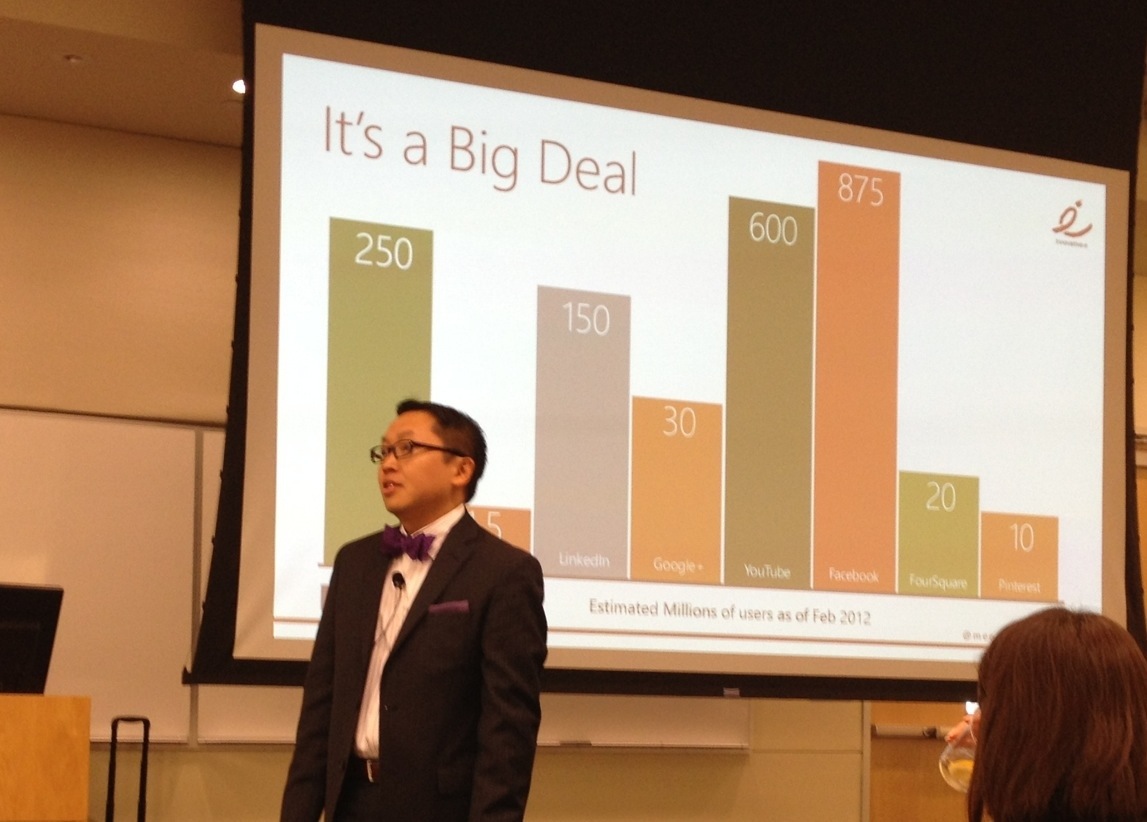
The presentation started out by talking about the recent “viral” phenomenon of “Gangnam Style” by the Korean artist Psy (if you’re not aware of it, see the video on the right).

We are in a social revolution, whether you like it or not. Here are 4 things that are happening today which will continue to increase:

  • BYOD – Bring your own device
  • Speed of Business
  • Do More w/ Less20121005-112355.jpg
  • Engagement

We’re moving from a transactional era, to one of engagement – it’s not social or traditional, it’s both.

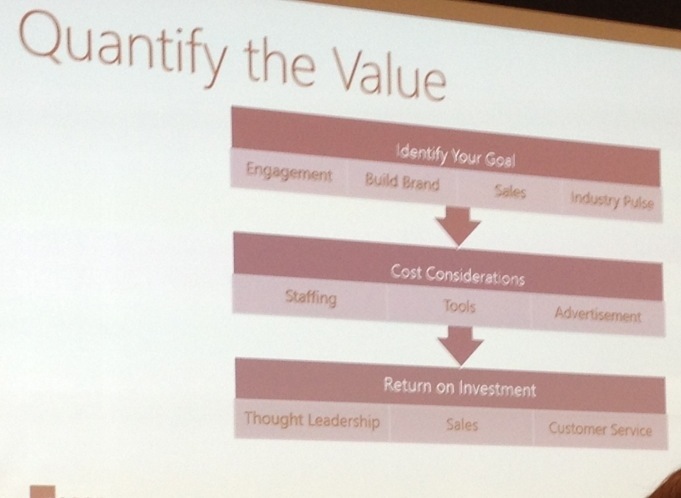
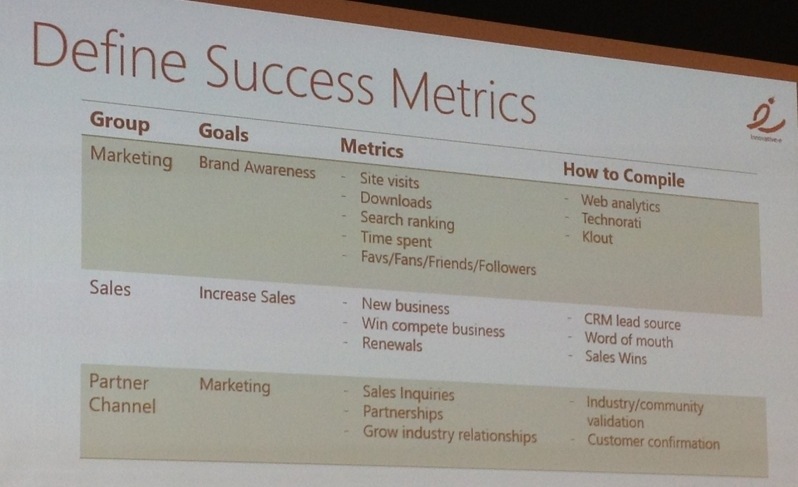
Define success criteria – Quantify the Value by the following steps:

  1. Identify the goal (i.e. engagement, build brand, sales, industry pulse)
  2. Cost considerations (i.e.Staffing, tools, advertisement)
  3. Return on Investment (i.e.thought leadership, sales, customer service)


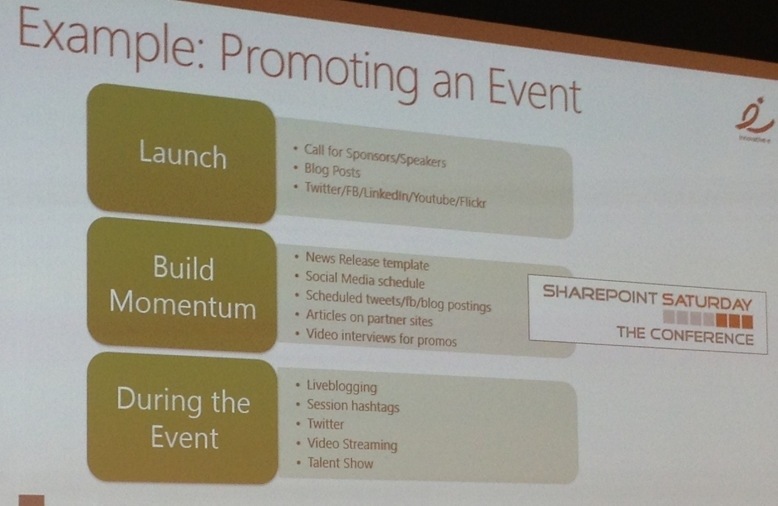
Then Integrate Business Strategy. (see image at right)

How not to be successful with social

  • Making it a corporate hobby
  • Purely selling vs engaging in social

Consistency is very important

  • It has to be part of your daily business
  • Scheduling social media activities helps a lot

Engagement must be both proactive and responsive.

Utilize Relevant Tools to Integrate and Synchronize:

  • Client apps – Hootsuite, Seesmic
  • Scheduling tools – socialoomph.com
  • Hashtags – Use and monitor these for relevant info.
  • Sharing tools – Bit.ly, RSS feeds (External RSS can feed into SharePoint)
  • Polls – Voting tool that works in PowerPoint – @votebytweet

Amplify

Maximize your “Echo” system – Influence influencers by connecting with them in social media

Big Finish by Dux…

Creating Dialogue at Best Buy

Andrew HokensonHow Best Buy provides a voice for its remote workforce using social media

Andrew Hokenson (@Andreux), Senior Specialist—Employee Communications, Best Buy

The culture of Best Buy – 167,000 employees worldwide, the largest electronics retailer in the world, average age of employees is 27 years old, and the average corporate age is 38.  Everyone says that employees are the center of their business, but at Best Buy they truly feel this way.

Creating a culture of dialogue

They’ve defined their department with the mission: Communications function for delivering information, gathering feedback and making decisions.

They knew they needed to get away from the top-down, cascading structure in order to create a dialogue where employees can connect.  Now, more than ever, their employees are connected – mobile, social networks, etc. – and they expect to have tools that can connect them and let them participate in conversations.

Traditionally, Best Buy relied on newsletters, email, direct mail, meeting cascades, etc. to connect with employees.  A few years ago, they created a message board to connect with employees.  The message board failed because they didn’t know how to facilitate communication (by very conservative moderation and editing).  It evolved to another message board, eliminating the moderation, giving them the ability to connect with leadership and other employees – simply asking them to “be as trusted online as they are in the stores.”  Employees started to adopt this, and the internal communication team started including news and information about the company.  They wanted things to fit the medium, and started creating content there that was more personal, encouraging more dialogue.

Communication isn’t just about pushing messages to your audience, it’s also about listening.  You let people know you are listening by responding to comments, answering questions, and engaging in real time.  It’s been critical to do this in real time, but was easy since it was the people who had posted the message who responded.

Communications is more than a department

The principles that now guide Best Buy’s internal communications:

  • Connect with your audience
  • Create an experience
  • Become human
  • Stop telling, start sharing

For example, when the new CEO started, he posted directly to the company’s message board – in his own words.  Employees then engaged with him as a person through comments.  Not only did he connect with them on the message board, but he went and worked in stores and shared his stories on the message board (sometimes asking people in the store to interview him and write stories).

As communicators – our competition are viral videos, weird photos, and all the bizarre things that get posted on Facebook pages and get a lot of traffic on the web.  How are we going to try to engage them on an equal level?  Here are the do’s and don’ts for doing so:

Don’t over-moderate – Lay down the rules (no cursing) and ask them to police themselves (let employees flag content). However, they have fun with their language filter, so profanity might show up as “What the {Pancake Bunny}!!!”

Don’t micromanage – Trust them online the same way you trust them with customers.

Use the data for good, not evil – It’s easy to look at what you want employees to stop doing, but you should focus on using the data to giving employees what they want.

Know the risks – Give them a protected venue to have conversations, and often employees will vent there, rather than taking it public.  However, there’s always risk in these conversations… BUT the conversations are happening anyway, and there’s also risk in not providing a venue for this dialogue (i.e. they take the conversation elsewhere, you’re missing out on feedback, etc.)

Finally, your social media policy should reflect the language most of your employees use… and most of your employees are not lawyers.

Question from audience: How do you manage getting hourly employees to participate?  Answer: Every employee is allotted training and development time, and they can log hours they spend on these tools to that.

Transform your corporate communications with SharePoint

Dux SyTransform your corporate communications with SharePoint Dux Raymond Sy (@meetdux), PMP Managing Partner, Innovative-e Dux, Author, “SharePoint for Project Management”
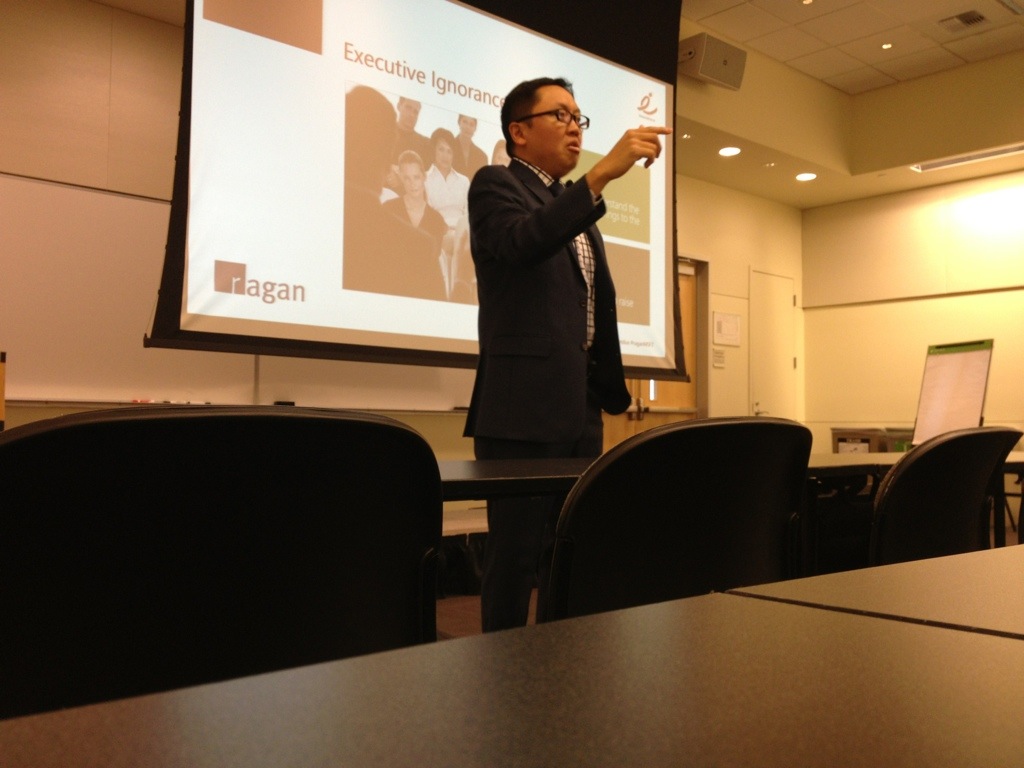
The #1 most used corporate communications tool is email – a 1973 technology – to facilitate corporate communications.

Why SharePoint?
The vision for SharePoint is that it democratizes productivity – it centralizes information, makes the right things available to the right people, and you don’t need IT’s help to do what needs to be done.

7 Ways to Maximize SharePoint for Corporate Communications

  1. Easily create a Collaboration Platform
    The best part of SharePoint is that you don’t need IT’s help to set it up.  The collaborative platform centralizes team artifacts (documents) and dialogue around projects.  In addition, SharePoint is connected to all the other tools people are already familiar with, including Outlook. For example, from Outlook, SharePoint calendars, documents, and other pieces are accessible and editable. You can actually use SharePoint without going to the project site, but just by working within Outlook.
  2. SharePoint transformEfficiently Manage Information
    With a centralized workspace, you can avoid playing “who saved the file last.”  In new versions of SharePoint, up to 4 people can work on a document simultaneously.  Version history, alerts, and organization manages records retention and allows users to customer how they want to work.
  3. Utilize Microsoft Office Integration
    Word, Excel, Outlook, Project, and other Microsoft products can sync files directly with SharePoint.  You can work with the tools you’re familiar with, and SharePoint simply helps connect and centralize the information. When everyone is working off the same set of information, you no longer have to take it all in and sort and combine data or information. For example, “Sync with Outlook” will move things like SharePoint discussions, documents, etc. to work with Outlook.
  4. Enhance Team Collaboration
    Two things can be used specifically to help team collaboration – Discussion Boards and Meeting Workspace.  Discussions are easy, and as mentioned, can be used just like email, by syncing with Outlook.  The meeting workspace provides a single place to store meeting information and record it.
  5. Effectively Automate Processes
    Common corporate communications processes and workflows are already in the tool out of the box – Approvals (stages/next steps or parallel), collect signatures, Disposition approval).  These are great for helping to document approvals, and ensure process and proceedures are followed.
  6. Generate Relevant Reports
    Sharepoint allows you to utlize the data within documents to build Dashboards with KPIs, charts, etc.
  7. Enable Mobile Access
    One Note – can be used to send things from a mobile device and then edit in Sharepoint.

How to Successfully Leverage SharePoint

Planning, executive support, educating your employees, and using the tools to solve problems is key.  SharePoint is more than just a glorified way to share and store documents, it’s a business enablement tool.  SharePoint has multiple capabilities, but you must take the approach of figuring out how to use it to solve your particular challenges.


Enabling New Experiences Through Check-ins

Dennis Crowley Founder of Foursquare and me

Dennis Crowley, Founder of Foursquare, and me.

Dennis Crowley – Foursquare & Pete Cashmore – Mashable

One of the big keynote presentations was with Dennis Crowley, the founder of Foursquare (he’s the one waving in the picture with me to the right).  He talked a lot about what it’s been like at Foursquare during their growth over the last year or two.  However, he also gave some interesting information about what they’ve learned and where they’re headed.

They currently have over 7.5 million users, and over 250,000 merchants who use their system.  These users provide them with a ton of data, since the average user has 3 checkins per day and gives back in the form of recommendations.

They have a ton of ideas about where they want to go, but there are only 50 people who currently work there, so they have to carefully prioritize what’s next for them.  They’re focused on providing badges to encourage positive behaviors, such as the gym-rat badge for checking into a gym 10 times a month, or the “I voted” badge during the elections.  Also, just before SXSW, they launched the “Explore” tab, which utilizes their rich data about you and your friends and provides “an amazon-like recommendation engine” about where you might want to shop, eat, etc.

Crowley feels that their future lies in their ability to “blow out the possibilities of the database of information” they have.  This means both providing information to users about what can help them, but also what it means for businesses who utilize Foursquare.  For example, imagine knowing the potential income for your business when someone walks in your location.  In addition, Foursquare has already proven to provide a lot of potential for small businesses who don’t have an organized loyalty program.  Foursquare has the potential to further become a more universal and amplified loyalty program that provides rich data for venue owners.  We’re seeing just the tip of this with the Foursquare/American Express partnership that’s part of SXSW.  By combining Foursquare checkin data with AMEX financial data, they’ll be able to show the exact amount you spent, where, when, how often, and more.

Along with the potential that lies in what’s already been mentioned, Foursquare has their eye on the future.  They’re looking at things like auto check-ins on new phones with technologies like near field communications (NFC) chips.  “How much easier is it to check in when all you have to do is tap or swipe.”  Not only are they focused on new devices and adapting to new technologies, they’re currently working with over 200 brands, and have their sights set on working with many more.  Much like Twitter, they “love it when people build stuff on top of” their service, and know that others’ innovations could fuel their success.

While most of the conversation felt like Cashmore was having a personal conversation with Crowley, which was off topic, and Crowley avoiding most probing questions, there were some hints at Foursquare’s future.  It was more obvious than ever that Foursquare’s future success lies in its database and the potential to grow it.  The ability for venue owners (businesses) to take advantage of deep, detailed knowledge on people who walk into their locations will help them better market to customers, and at the same time, enhance the customer relationship.

How to Personalize Without Being Creepy

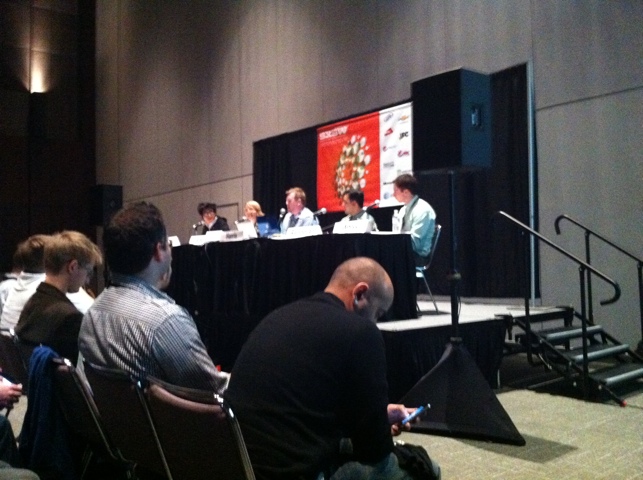
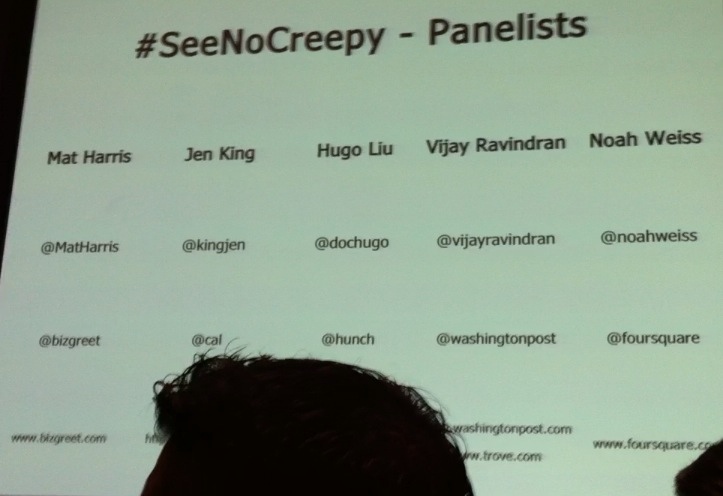
#seenocreepy panel SXSWPanel: Hugo Lin – Hunch, Jen King – PHD UC-Berkeley, Mat Harris – BizGreet, Vijay Ravidran – Washington Post, Noah Weiss – Foursquare
Hashtag: #SeeNoCreepy

The point of personalization is to put something more relevant, and therefore more delightful in front of you. In the opinion of the panelists – “Life is too short, and time is too valuable, to have something random/irrelevant in front of you.” However, there’s a fine line between giving you something you might like to see and knowing more about you and your habits than you want a website or company to know.

All of the panelists agreed that personalization is a dialogue you have with the user. It’s asking what information you’d like to have as a marketer, and letting the user decide what they want to share. Marketers have to also be transparent about why they are asking and set clear expectations about how they’ll use this information. In addition, you have to give the user control to decide if they want to withdraw that information or permission they’ve given you. “It’s like remembering to put fire exits in a building,” said one panlist. “Would you build a building without fire exits? Essentially that’s what you’re doing without an open, obvious exit for users.”

Personalize without being creepySimilar to Philip Kaplan’s beliefs in Getting People to Share Information at the Social Business Summit a couple days earlier (but not as extreme), the panelists believe that people are more willing than ever before to share information – especially if they know what benefit they’ll get from it. “Free isn’t free” said one panelist. “People know that they’re paying with their data.”

The WashingtonPost.com has been focusing on customization, and there’s a subtle difference between customization and personalization. Customization lets users choose what they want to see across a long tail of information, while personalization – implicitly or explicitly – takes the users information and automatically uses it to drive the customer experience.

Different than both of these is the idea of targeting – mostly advertising that appears in these locations. It’s effective because most users want information that is of value to them, and it’s a win-win for the customer and marketer. However, what makes it “creepy” is when it’s exposed that over 700 pieces of data about you, your family, web use, etc. may have gone into targeting you. As one panelist put it – “If you feel like, ‘I don’t want to have to explain that,’ you probably shouldn’t be doing it.” This is becoming an increasingly hot topic as many services, such as Facebook, have started using social validation, or adding your friends’ information to make recommendations to you.

personalize without being creepyAdditionally, marketers must consider the context in which their message or brand is being presented. In social media, the terms “Like” and “Follow” have taken on some interesting meanings. Unprovoked “following” of a user by a brand is almost as creepy as asking a user to “like” hemorrhoid cream on Facebook.

One suggestion is to understand the user experience so well, that the personalization is seen as a benefit. For example, YouTube recently created an algorythm for serendipity. Not only do they recommend videos that they think you’ll like (based on your other viewing), but they’ll now show you interesting videos that none of your friends have seen – Letting you be the first one one of your friends to send on that next viral video. This insight came from a YouTube focus group, and has been one of their most successful tools.

More than ever, it’s time for marketers to consider the impact of actions that appear “creepy” to the consumer. The FTC has said that targeted marketing raises “Questions of human dignity,” and have suggested the potential for a “do not track” list online.

Outsource Social Media?

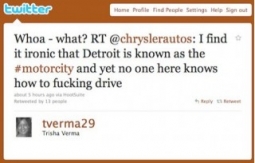
This wasn’t necessarily a presentation I attended at iMedia, the Social Business Summit, or SXSW, but among the many brand people I got to meet, it was an extremely hot topic of discussion.  The discussion was further fueled by something that happened the day before the Social Business Summit.  If you hadn’t seen the news, an employee from a company called New Media Strategies, accidentally dropped an f-bomb on behalf of their client, Chrysler’s twitter account.  As you can imagine, the employee was immediately fired and Chrysler let the agency go the following day.

Many of the brand people I met worked in various parts of the company, and something mentioned in the Ad Age article about the incident sparked a lot of discussion…

Turf battles over social media between marketing and communications have been an issue at the automaker — and other companies — for a few years. Early in the day after the tweet went out, Chrysler’s communications team was grappling to get hold of the details of the episode after bloggers and media began calling, in part because Chrysler’s marketing department controls Facebook and Twitter social-media accounts that are “consumer facing.” The communications department has separate Twitter, Facebook, YouTube and Flickr accounts that are meant to be “media facing.”

Many companies say the divide only serves turf and budget wars, not the brands. “All that has blurred, so it’s critical for communications and marketing to be coordinating and cooperating all the time,” said Stuart Schorr, VP-communications and public affairs at Jaguar-Land Rover North America. One of the issues creating the turf war, he noted, is which department gets the budget.

What I think we all discovered was social media is something that can’t be fit into a traditional box, as it has blurred the lines between paid and earned media, marketing and customer service, as well as transactional versus relational communications.  I’m not sure anyone has figured it out, but everyone expressed frustration about how this confusion was causing issues within their companies  (like the ones mentioned above).
The general perception is that social media is “cheap,” because sites like Twitter, Facebook, and YouTube don’t necessarily charge you to be there.  However, in order to do it right, you have to invest first in listening to conversations about your brand and industry… which isn’t easy, when there are over 1 billion tweets per week, 1 billion Facebook messages posted per day, or the 24 hours of video uploaded to YouTube every minute.  Imagine the resources it takes just to do this… and if you want to respond to any of these messages, that takes more resources – and as pointed out above, multiple resources across functions/silos.

Hopefully you can agree, at the very least, it takes a large amount of time and organization.  Generally, brands are already heavily committed to traditional media – and spending money to outsource this work to traditional media agencies – because the “push my message through a one-to-many framework” has been in place for so long.  Even more important, leaders aren’t yet prepared to organize new internal communications structures to deal with a “new” media which requires one-to-one relationships.

In the meantime, there are certain to be many, many more ethical debates (like this one – Should You Outsource Social Media?) about whether or not you should hire someone to manage customer relationships in social media on your behalf.  Please tell us what your take in this debate is by commenting on this post.

Content Creation and Curation

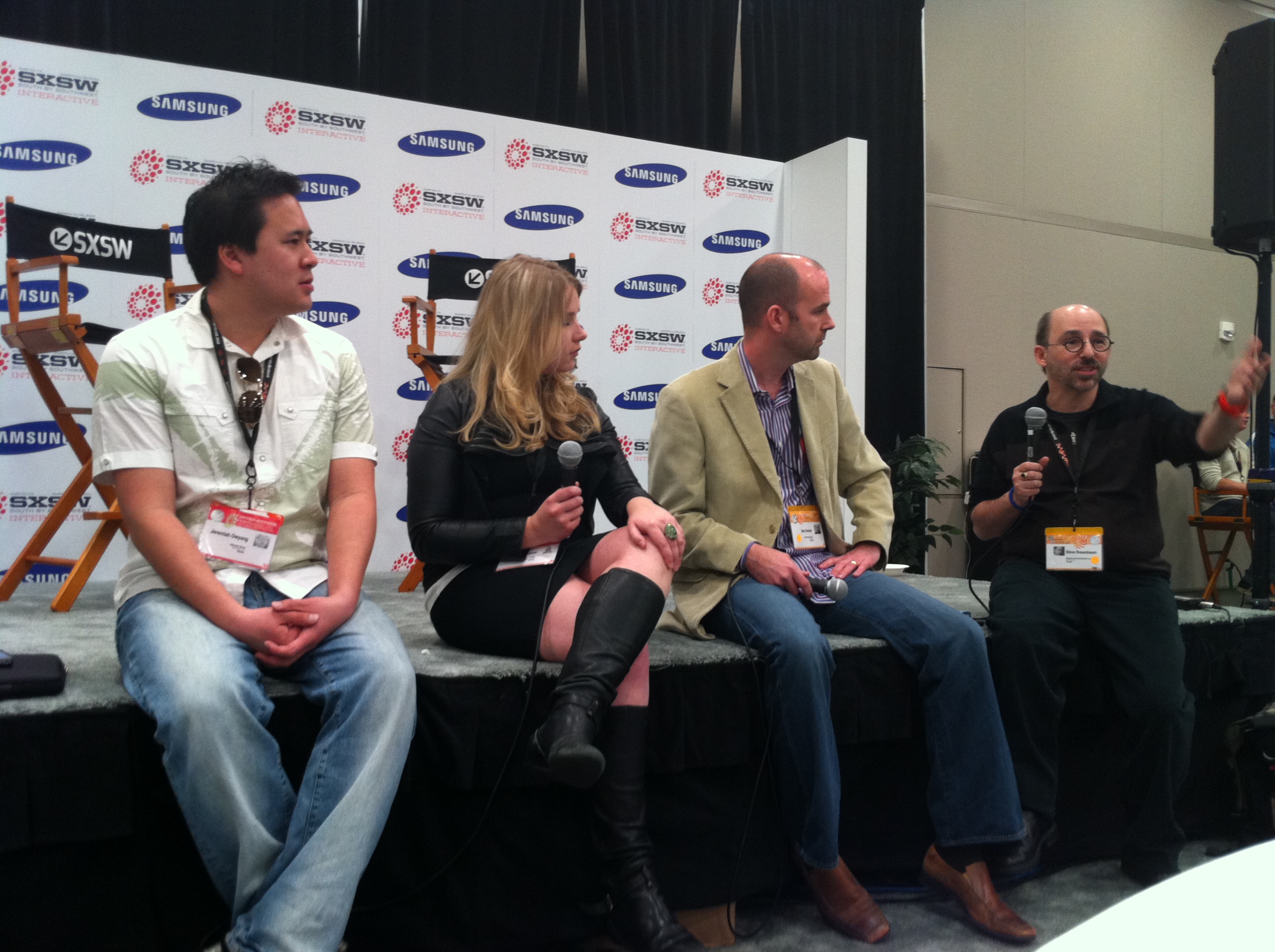
Samsung Blogger Lounge panelPanel: Jeremiah Owyang – Altimeter Group, Leslie Bradshaw – Jess3, Steve Rosenbaum, Sam Decker

One of the things I love about SXSW is serendipity.  I was a bit bummed, as I tried to go into 2 different sessions, and there were long lines at both.  I thought I’d head back to the Samsung Blogger Lounge to catch up on these blog posts.  I ended up hanging out with @redboypodcast and stumbling into this great panel discussion on content creation and curation.

One mistake sites often make is sending people off of their site to their social networks or other places to get to content.  The best thing you can do is to begin aggregating that content on your site.  You can curate content from all over the web and have people looking at it from within a context you are comfortable with and adds brand equity.

There was a bit of debate around the difference between a curator and an editor.  While nothing was decided, the thought was that a curator looks at different multi-sourced content and writers, whereas an editor pulls from a fixed group of resources.  It’s not all wonderful, as many people, especially writers see content curation and aggregation as leeching off of their content.  However, it seems to be an increasing acceptable method of getting content.


Tags

Related Posts

Share This

Banking on Big Brands/Celebs for the Web

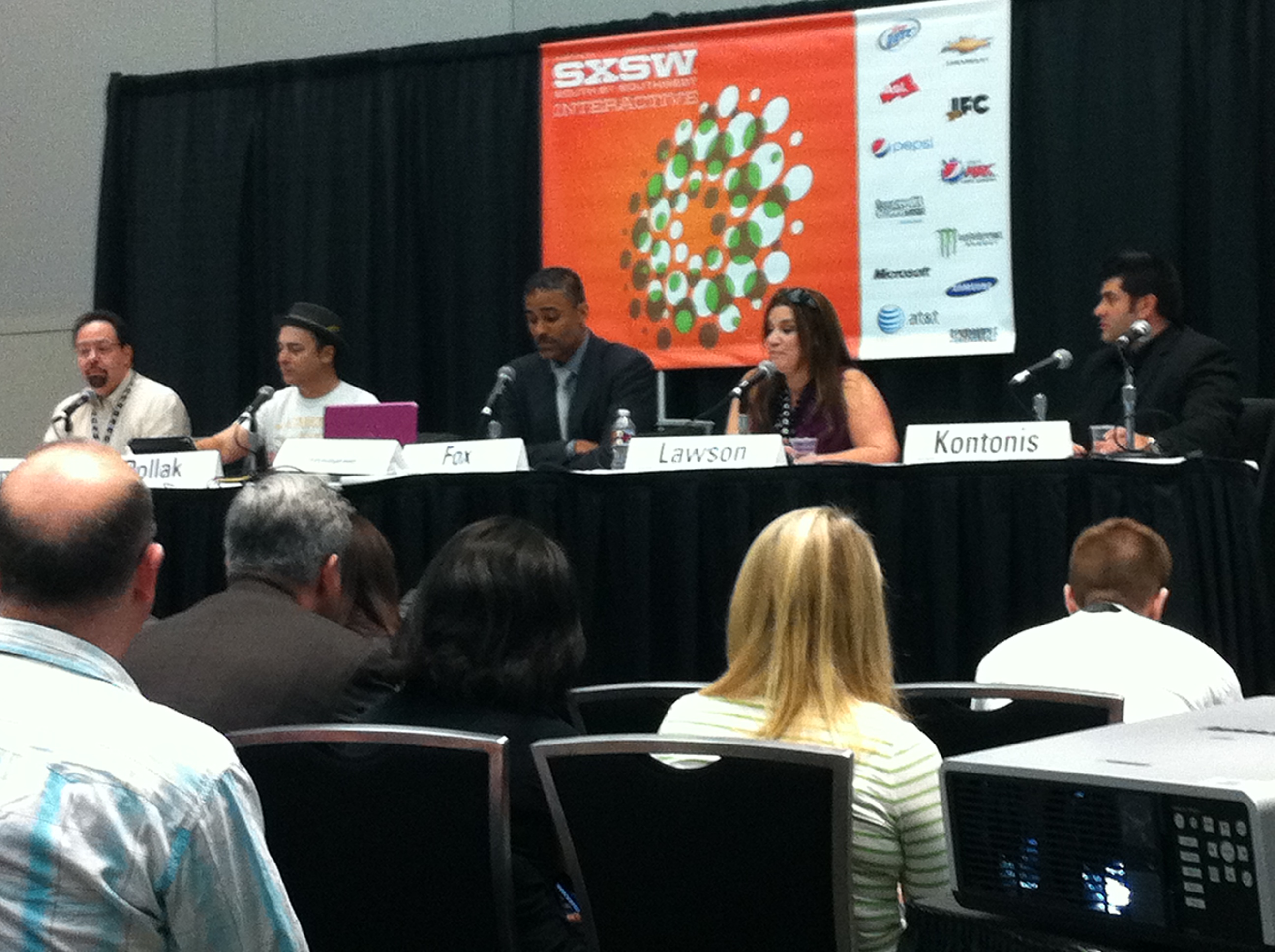
Panel: Amber J Lawson – Head of Original Programming, AOL, David Tochterman – Head of Digital Media, Innovative Artists, Rick Fox – NBA All star/Entertainer, Kevin Pollak – Actor, Paul Kontonis – Digitals
Hashtag: #sxswbigbrandsKevin Pollak and Rick Fox panel at sxsw

This panel discussed how traditional media is changing and how brands can get involved to take advantage of this shift.  In particular, two celebrities on the panel are taking slightly different approaches to this.

Actor Kevin Pollak, created Kevin Pollak’s Chat show – http://kevinpollakschatshow.com – because he said, “If you’re not creating your waiting.”  As an actor, you wait for the phone to ring for the next thing.  He felt that new media provided a tremendous opportunity to create his own content.  He used Felicia Day as another example of someone who created their own show to take their future and potential in their own hands.  He simply tries to create interesting content to draw an audience, as he said, “If you can earn an audience you can earn a living.”

Pollak gets brands involved from a very traditional perspective, through pre-roll advertising, display ads around the content, etc.  He feels that this helps big brands who may not be comfortable jumping into this area, get involved.  Therefore, they primarily use impressions as a way to sell the show to brands.

NBA all-star, and now entertainer, Rick Fox, takes a slightly different approach.  What’s important to him is telling a good story, and he looks for opportunities to integrate brands into the story.  For example, on one of his shows, you may see a basketball player having a Gatorade after a game.  It’s a bit like celebrity endorsements, but extends it by showing how the product is used and its benefits.  This takes cooperation between the celebrity/producer and the brand.

Working through partnerships like VuGuru/AOL, he can offer these product integrations, as well as non-traditional promotions.  He believes you are not only bring on a celebrity to use/endorse your product, but you’re also utilizing their Twitter followers and other social media “klout” to influence their fans.  And it’s not just the celebrities’ followers, but their personal networks.  For example, when Rick Fox was on Dancing with the Stars, he was able to get friends (Kobe Bryant and Shaq) to post messages to their followers asking for support.  This can get a little muddy when you’ve got multiple projects going on at the same time.

Debating Brands’ Role as Publishers

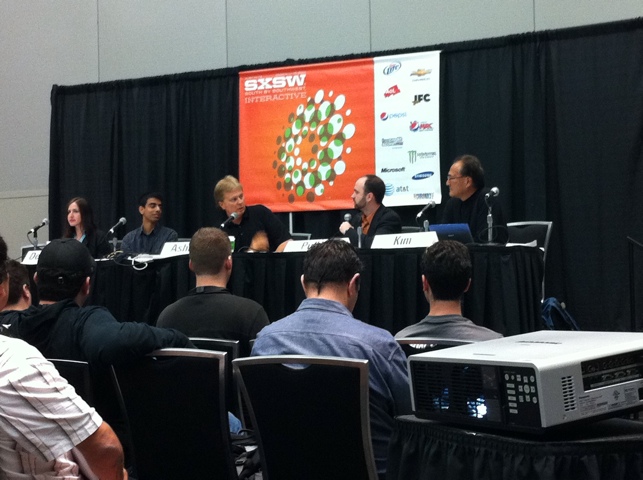
Panel: Tom Ashbrook – NPR, Lora Kolodny – TechCrunch, Pawan Deshpande – Hivefire, Gary Kim – Carrier Evolution, Joe Pulizzi – Junta42
brands as publishers sxswHashtag: #curatedebate

The purpose of journalism is to inform or educate, while the purpose of brands is to drive profitable customer action. The Internet allows for the democratization of information, but we’re also starting to see the corporatization of information.

People will make time for a good, relevant story, no matter who tells it. If brands can tell compelling, interesting stories on a regular basis, they can cut through the clutter (those 30 billion messages a day, as Shiv Singh discussed here). The more money that comes in from doing this, the more money there is to do this.

We are all media publishers, and all brands need to think of themselves as publishers.  They need to take a viewer/reader/listener centric approach that asks: What are their painpoints?  What keeps them up at night?  You have the ability to tell a story that shows how your brand can solve this issue. Content will be successful if it targets those customers painpoints. We now have the ability to communicate directly to consumers without having to go through another channel – advertising.

Even media companies are realizing a decrease in advertising and rise in “advertiser services” which essentially teach brand advertisers how to be content publishers.  One company on the panel – Hivefire – aggregates and curates content for brands on industry topics.  This allows these brands to continually publish information, and be a resource on industry topics.  Another example is P&G’s Home Made Simple.  It’s tremendously similar to Real Simple – providing nearly identical types of information, but Home Made Simple highlights their own products as examples within stories.

Brands need to make sure they are seen to be the trusted authority, and they need to be straightforward and honest about their perspective and motives.  As hard as it tries, journalism is not objective. Everyone has a perspective – and brands need to be up front about their motives.  Consumers get to decide who they pay attention to – journalists or branded content.  More importantly, social media allows for a broader application of the “Fourth Estate” among corporations, so they also need to be honest, or they’ll get called out on it.

Will it Blend?

A bonus that was not on the agenda at the Tweet House today was the addition of Blendtec’s Tom Dickson.  He spoke a bit about how they started and got to be as successful as they’ve been with their “Will it Blend?” series on YouTube.  Here’s a brief video of his presentation.


As a BONUS, I received a DVD of 50 Will it Blend videos as well as a behind the scenes video of how they make it.  I’m giving it away to one blog reader.  As usual if you comment on this post, I’ll select one commenter to give the DVD to.  Please make sure to include your email address when commenting.

Tags

Related Posts

Share This