Disaster: The Future of Crisis Communications

panicbuttonI followed this session via Twitter and huge thanks to live blogging/tweeting from Elysa Ellis.

Everyone now has the ability to be an immediate publisher, and we are in an age of “permissionless information.” People can post information immediately, with no filter. The real challenge is editorial – getting out information quickly, but getting out what’s most important and coordinating all the information so it becomes relevant and prevents clutter. Even the United States Air Force knows “speed is more important than security in a crisis.”

The real goal is to get the most amount of information out there, in the shortest amount of time. While everyone has the ability to be out there, you as a brand or company have to be out there too. If you’re not out there, speaking to your audience, someone else will do it for you. Audiences are looking for “verified” information, and as a brand or established company, you carry some credibility others don’t. However, as a brand, you need to be prepared for this and plan ahead:

  • Understand what you can and can’t say – build corporate/legal approvals – and TRUST – in advance
  • Establish boundaries and rules of engagement
  • Make sure you have the right technology to tell the story
  • Establish networks (police, fire, social media influencers, etc.) before events, so you can call on your network when you need to

Remember, things move fast, so you need to plan ahead, but be flexible and forgiving. If you make a mistake or do something wrong, admit it. Be flexible, be honest and genuine, and don’t be afraid to utilize/curate information from the hundreds or thousands of citizens on the ground gathering and sharing information.

Constantly review the tools in your toolbelt (blogs, photos, videos) and the sites you use, and make sure you’re ready to tell your story in the best way possible, because if you don’t have approval to use it, you’re at a disadvantage, because the average citizen doesn’t need it. That certainly doesn’t mean leaving out traditional media, it’s just that newer tools typically allow you to get out there quicker.


Bre Pettis Opening Remarks

brepettis

SXSW 2013 Opening Remarks

@Bre, Bre Pettis, Founder Makerbot

I’ve been following Makerbot the last several years, as my SXSW buddy John Biehler has been a big advocate and user of 3D printers (in fact, he’s got a session on the topic at SXSW this year). It’s really cool to see all of the things they can do, and can’t wait until the technology becomes more commonplace.

Here’s a bit of what Pettis shared with the audience:

  • In the same way Photoshop changed the way photography works, Makerbot is dedicated to helping change the playing field for innovative explorers.
  • They just announced a digital scanner which can help to scan existing 3D items to replicate them using 3D printing, as well as a partnership with AutoDesk which will allow designers to design and make things much more easily.
  • While the Makerbot primarily uses the extruder to melt plastic and form it into your design, you can use different types of extruders to make all sorts of things – from a syringe filled with icing or chocolate for cupcakes to metal and other things.
  • The vision is to have makerbots everywhere, from schools to homes.
  • Yes, you can build your own legos, but it takes quite a long time. It’s primarily used right now to help designers and inventors prototype items. Even Ford Motors is using 3D printers to design and prototype car parts.
  • They’ve grown Thingverse – a website for designs of various 3D printed items to over 40,000 items, with nearly a fourth of things submitted in just the last few months.

All in all, 3D printers are very cool and have the potential. It should be interesting to see what happens to things like the toy industry and how big an impact it can have on things like that. Much like Pettis, I think this has the potential to be huge for future inventors – in fact, most of the Kickstarter campaigns I’ve seen recently have used 3D printers to prototype their inventions. Imagine how this levels the playing field!


SXSW 2013

logoIt’s not to strong of me to say I love SXSW, it’s such an awesome event full of digital creatives. It’s a tremendous event to learn and network with thousands there to challenge thinking and try new things.

I’m not there, but I’m watching as much as I can live online and following twitter hashtags. I really want to be there, but will cover as much of it as I can right here, just as I have in previous years when I’ve attended.

If you want to watch some of the sessions streamed live, visit http://sxsw.com/live

And huge thanks to Oracle for making the live stream available.

Enabling New Experiences Through Check-ins

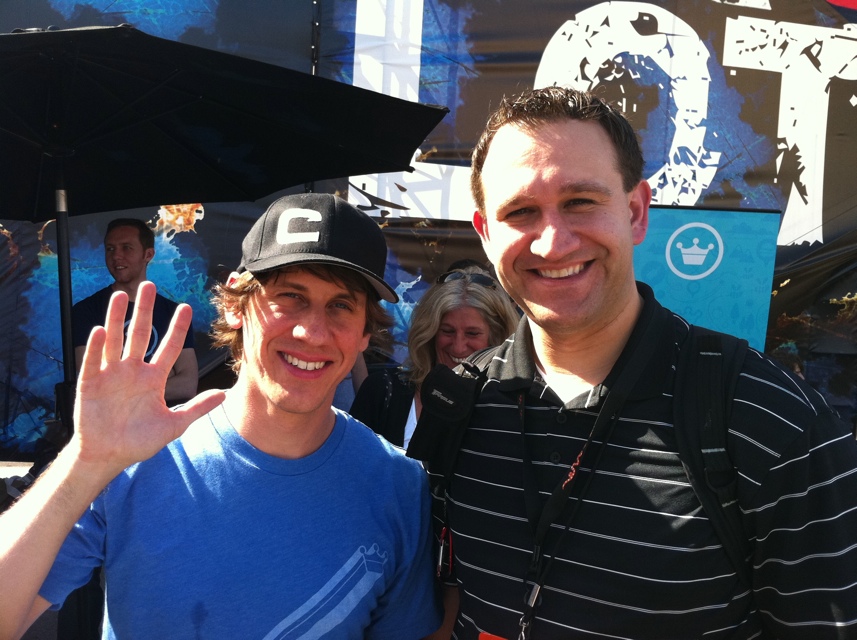
Dennis Crowley Founder of Foursquare and me

Dennis Crowley, Founder of Foursquare, and me.

Dennis Crowley – Foursquare & Pete Cashmore – Mashable

One of the big keynote presentations was with Dennis Crowley, the founder of Foursquare (he’s the one waving in the picture with me to the right).  He talked a lot about what it’s been like at Foursquare during their growth over the last year or two.  However, he also gave some interesting information about what they’ve learned and where they’re headed.

They currently have over 7.5 million users, and over 250,000 merchants who use their system.  These users provide them with a ton of data, since the average user has 3 checkins per day and gives back in the form of recommendations.

They have a ton of ideas about where they want to go, but there are only 50 people who currently work there, so they have to carefully prioritize what’s next for them.  They’re focused on providing badges to encourage positive behaviors, such as the gym-rat badge for checking into a gym 10 times a month, or the “I voted” badge during the elections.  Also, just before SXSW, they launched the “Explore” tab, which utilizes their rich data about you and your friends and provides “an amazon-like recommendation engine” about where you might want to shop, eat, etc.

Crowley feels that their future lies in their ability to “blow out the possibilities of the database of information” they have.  This means both providing information to users about what can help them, but also what it means for businesses who utilize Foursquare.  For example, imagine knowing the potential income for your business when someone walks in your location.  In addition, Foursquare has already proven to provide a lot of potential for small businesses who don’t have an organized loyalty program.  Foursquare has the potential to further become a more universal and amplified loyalty program that provides rich data for venue owners.  We’re seeing just the tip of this with the Foursquare/American Express partnership that’s part of SXSW.  By combining Foursquare checkin data with AMEX financial data, they’ll be able to show the exact amount you spent, where, when, how often, and more.

Along with the potential that lies in what’s already been mentioned, Foursquare has their eye on the future.  They’re looking at things like auto check-ins on new phones with technologies like near field communications (NFC) chips.  “How much easier is it to check in when all you have to do is tap or swipe.”  Not only are they focused on new devices and adapting to new technologies, they’re currently working with over 200 brands, and have their sights set on working with many more.  Much like Twitter, they “love it when people build stuff on top of” their service, and know that others’ innovations could fuel their success.

While most of the conversation felt like Cashmore was having a personal conversation with Crowley, which was off topic, and Crowley avoiding most probing questions, there were some hints at Foursquare’s future.  It was more obvious than ever that Foursquare’s future success lies in its database and the potential to grow it.  The ability for venue owners (businesses) to take advantage of deep, detailed knowledge on people who walk into their locations will help them better market to customers, and at the same time, enhance the customer relationship.

Themes at SXSW 2011

These are a few of the main themes I picked up on at SXSW 2011:

  1. Relationships – lead to serendipity, opportunities – you’ve got to give before you receive.
  2. Content creators write their own future – New technologies now enable content creators to sit in the drivers seat.  There are fewer limits for executing on their ideas.  Agencies are not necessarily needed and you can go straight to decision makers.  Brands can go direct to consumers.
  3. More and more content – There’s no shortage of content, or a thirst for more.  It’s all about the long-tail of content.
  4. Context – Conversations on social media is one on one, not 1 to many pushed messages.  Context is becoming more and more personal.
  5. Cross Platform thinking – You can no longer think of “campaigns” by media outlet or tactic.  You have to think about how the message can be carried in a multitude of ways, across many media and outlets.
  6. Outsourcing vs Insourcing – Do you handle your own social media or outsource it? Who’s better equipt to handle it, and is it genuine if outsourced?  The debate will continue.
  7. Employee Empowerment – As consumers have a direct connection, via multiple media, to front line and customer service functions, these employees must be empowered and trusted to respond in the right way.
  8. New Acquisition Funnel – Social media is about relationships.  How do you measure the strength or ROI of a relationship?  Also, it’s more than just customer acquisition now, it’s about the lifetime value of each potential customer.
  9. Death of Privacy – Just a few years ago, people wouldn’t get a Facebook account or participate on Foursquare for fear of privacy.  Obviously, the idea of privacy is quickly eroding .
  10. New Technologies – New technologies and applications of them are emerging every day.  The tough thing is trying to tell what will be adopted, and what’s just a gimmick.


How to Personalize Without Being Creepy

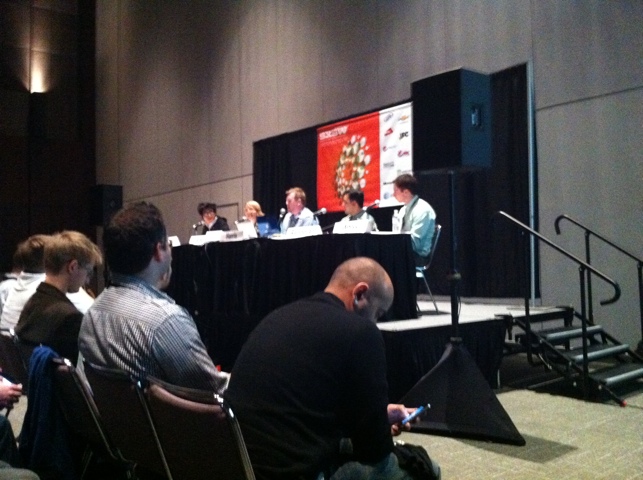
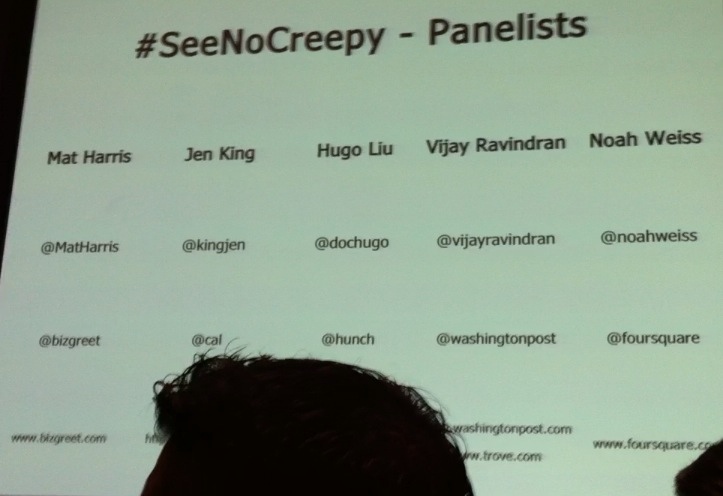
#seenocreepy panel SXSWPanel: Hugo Lin – Hunch, Jen King – PHD UC-Berkeley, Mat Harris – BizGreet, Vijay Ravidran – Washington Post, Noah Weiss – Foursquare
Hashtag: #SeeNoCreepy

The point of personalization is to put something more relevant, and therefore more delightful in front of you. In the opinion of the panelists – “Life is too short, and time is too valuable, to have something random/irrelevant in front of you.” However, there’s a fine line between giving you something you might like to see and knowing more about you and your habits than you want a website or company to know.

All of the panelists agreed that personalization is a dialogue you have with the user. It’s asking what information you’d like to have as a marketer, and letting the user decide what they want to share. Marketers have to also be transparent about why they are asking and set clear expectations about how they’ll use this information. In addition, you have to give the user control to decide if they want to withdraw that information or permission they’ve given you. “It’s like remembering to put fire exits in a building,” said one panlist. “Would you build a building without fire exits? Essentially that’s what you’re doing without an open, obvious exit for users.”

Personalize without being creepySimilar to Philip Kaplan’s beliefs in Getting People to Share Information at the Social Business Summit a couple days earlier (but not as extreme), the panelists believe that people are more willing than ever before to share information – especially if they know what benefit they’ll get from it. “Free isn’t free” said one panelist. “People know that they’re paying with their data.”

The WashingtonPost.com has been focusing on customization, and there’s a subtle difference between customization and personalization. Customization lets users choose what they want to see across a long tail of information, while personalization – implicitly or explicitly – takes the users information and automatically uses it to drive the customer experience.

Different than both of these is the idea of targeting – mostly advertising that appears in these locations. It’s effective because most users want information that is of value to them, and it’s a win-win for the customer and marketer. However, what makes it “creepy” is when it’s exposed that over 700 pieces of data about you, your family, web use, etc. may have gone into targeting you. As one panelist put it – “If you feel like, ‘I don’t want to have to explain that,’ you probably shouldn’t be doing it.” This is becoming an increasingly hot topic as many services, such as Facebook, have started using social validation, or adding your friends’ information to make recommendations to you.

personalize without being creepyAdditionally, marketers must consider the context in which their message or brand is being presented. In social media, the terms “Like” and “Follow” have taken on some interesting meanings. Unprovoked “following” of a user by a brand is almost as creepy as asking a user to “like” hemorrhoid cream on Facebook.

One suggestion is to understand the user experience so well, that the personalization is seen as a benefit. For example, YouTube recently created an algorythm for serendipity. Not only do they recommend videos that they think you’ll like (based on your other viewing), but they’ll now show you interesting videos that none of your friends have seen – Letting you be the first one one of your friends to send on that next viral video. This insight came from a YouTube focus group, and has been one of their most successful tools.

More than ever, it’s time for marketers to consider the impact of actions that appear “creepy” to the consumer. The FTC has said that targeted marketing raises “Questions of human dignity,” and have suggested the potential for a “do not track” list online.

Another Giveaway – You Might be a Zombie Book

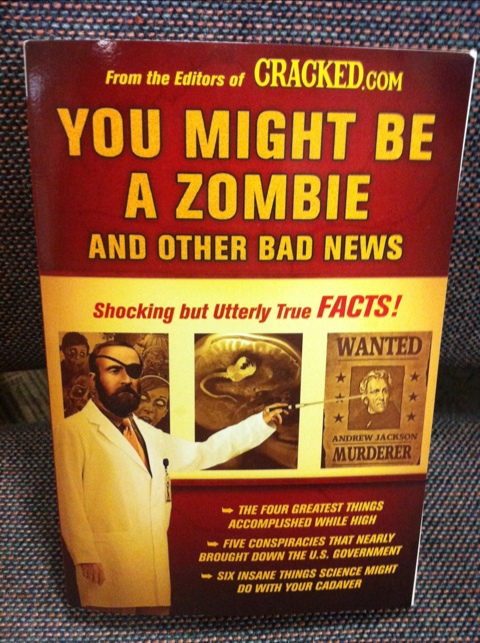
You Might be a Zombie Book giveawayI haven’t forgotten about all the giveaways I promised! You still have time to enter these giveaways – Flipboard T-Shirt, the Will it Blend? DVD, the Square device, the Delivering Happiness Book, and the Eyeballs Out book.  I will select the winners near the end of the month.

Now you have a chance to win You Might be a Zombie and Other Bad News from the editors of Cracked.com.  The book is rated 4.5 stars on Amazon.com, and appears to be a great book.  I just don’t have time to read it and wanted to give it away to one lucky reader of this blog.

To enter, simply click the comments link at the top of this post and make a comment.  Make sure to include your email address so I know how to contact you to send you the book.

Good luck and thanks for reading.  Keep an eye out for more giveaways to  come!

Augmented Reality for Marketers

Presenters: Lynne D Johnson – R/GA, John Havens – Porter Novelli
Hashtag: #arsxsw

There’s been a lot of talk over the last few years about augmented reality (AR), and the increasing adoption of smartphones and portable devices has accelerated predictions about its possibilities.  In fact, Juniper Research expects global revenue of AR to reach $1.5 billion in 2015.  Much of this is currently being driven by location based apps.  Those which have been successful for consumers have focused on utility and ease of use, and marketers have used it successfully for awareness and tracking ROI.

There are many, many different things that qualify as AR on this spectrum:

<–  SMS/QR codes – Web/Hologram – Location-Based – POS – Real World Applications –>

Here are a few examples of these types of AR:

QR Codes,  Webcam/Holigram example  – Dabs Acer Augmented Reality ad, Tissot watches (experience of how watch would look on you, and in store sales of watches grew by 85%), Location based examles: Le Bar Guide, Quiznos Layar, Yelp Monocle, Ebay Classifieds, Point of Service example with Legos Kiosk.

In order to move beyond the hype, AR must move beyond simple experimentation, gimmicks, and unnatural behaviors to things that are more useful, natural, and have advanced utility.  We’re only now moving toward real world applications that make life easier and will ultimately increase its adoption.  Examples include Google’s GogglesWord LensBMW’s extension of reality for mechanics, Converse Sampler App (try shoe on virtually to see how it looks), and General Motors augmented reality windshield.

Right now, augmented reality is limited to certain devices, however, as it matures, and people see the utility in it and begin to view it as a virtual “GPS” for their lives, the next step are glasses, contacts, and eye tracking cameras that provide facial recognition.   Examples of things people already see this type of value in includes displaying nutritional information about food at restaurants and in dating – displaying web information about a person using facial recognition.

You can imagine that these types of things bring up interesting concerns, from individual privacy to “virtual air rights.”  The virtual air rights are a concern because, as the world around you is literally manipulated, it must be determined who can put what, where.  For example, can Pepsi pay to literally prevent you from seeing Coke machines?

Other interesting visions of what the future holds inlcudes:

TagWhat Augmented Reality network – lets you tag the virtual world, creating a virtual scrapbook at locations for you or your friends.

Virtual graffiti (seen here)

Bump (the iPhone app) – The next phase is to automatically send your information to other people in the same room, based entirely on certain criteria, such as their number of twitter followers.

Checking into products – Such as Stickybits – Illustrates that community management goes beyond online and into the world of virtual reality – listening to what consumers are saying in this new place.

Products checking in to you, through Facebook sponsored stories

Kraft – Anonymous Video Analytics (AVA) – At the point of purchase, the machine looks at you, estimates your age, sex, health, etc, and provides you with a unique ad/offer based upon your estimated demographics.

Activity Interference –  Jon Froehlich, at the University of Washington uses a microphone in the ear to detect when you are eating (with 99% accuracy).  He uses it to pick up on eating patterns and health, but this could be used in the future to help you track your eating habits, or even sound an alarm when you eating when you aren’t supposed to.

Facial recognition – allows you to see more information on the people you are with.  For example, Viewdle is a facial recognition program that shows you the most recent tweet, Facebook post, etc. of the people you are with.  It lets you identify who you may want to talk to in a social context, or in a business context, screen the people you are around to get more information on them.  Similarly, some companies are giving Facebook and Twitter credibility scores (such as Klout), which could allow you to scan the influential people in the room.

This same technology lets police now scan a crowd with a phone and see, through a tag in their phone, who the former criminals are in a crowd.  It’s good because it allows police to find people with a criminal history quickly, but bad because of potential implications of viewing – or blocking – people.  For example, a person might choose to not view any homeless people laying on the street, changing their perspective on the world.

As mentioned earlier, there are definite concerns with virtual air rights and virtual advertising rights.  For example, Bing can block out existing advertising and resell the rights to those ad spaces within their Streetview platform.

As you can see, the world of augmented reality is incredibly interesting, and it will only be a matter of time before we see the tipping point on many of these cutting edge technologies.


Outsource Social Media?

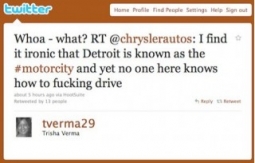
This wasn’t necessarily a presentation I attended at iMedia, the Social Business Summit, or SXSW, but among the many brand people I got to meet, it was an extremely hot topic of discussion.  The discussion was further fueled by something that happened the day before the Social Business Summit.  If you hadn’t seen the news, an employee from a company called New Media Strategies, accidentally dropped an f-bomb on behalf of their client, Chrysler’s twitter account.  As you can imagine, the employee was immediately fired and Chrysler let the agency go the following day.

Many of the brand people I met worked in various parts of the company, and something mentioned in the Ad Age article about the incident sparked a lot of discussion…

Turf battles over social media between marketing and communications have been an issue at the automaker — and other companies — for a few years. Early in the day after the tweet went out, Chrysler’s communications team was grappling to get hold of the details of the episode after bloggers and media began calling, in part because Chrysler’s marketing department controls Facebook and Twitter social-media accounts that are “consumer facing.” The communications department has separate Twitter, Facebook, YouTube and Flickr accounts that are meant to be “media facing.”

Many companies say the divide only serves turf and budget wars, not the brands. “All that has blurred, so it’s critical for communications and marketing to be coordinating and cooperating all the time,” said Stuart Schorr, VP-communications and public affairs at Jaguar-Land Rover North America. One of the issues creating the turf war, he noted, is which department gets the budget.

What I think we all discovered was social media is something that can’t be fit into a traditional box, as it has blurred the lines between paid and earned media, marketing and customer service, as well as transactional versus relational communications.  I’m not sure anyone has figured it out, but everyone expressed frustration about how this confusion was causing issues within their companies  (like the ones mentioned above).
The general perception is that social media is “cheap,” because sites like Twitter, Facebook, and YouTube don’t necessarily charge you to be there.  However, in order to do it right, you have to invest first in listening to conversations about your brand and industry… which isn’t easy, when there are over 1 billion tweets per week, 1 billion Facebook messages posted per day, or the 24 hours of video uploaded to YouTube every minute.  Imagine the resources it takes just to do this… and if you want to respond to any of these messages, that takes more resources – and as pointed out above, multiple resources across functions/silos.

Hopefully you can agree, at the very least, it takes a large amount of time and organization.  Generally, brands are already heavily committed to traditional media – and spending money to outsource this work to traditional media agencies – because the “push my message through a one-to-many framework” has been in place for so long.  Even more important, leaders aren’t yet prepared to organize new internal communications structures to deal with a “new” media which requires one-to-one relationships.

In the meantime, there are certain to be many, many more ethical debates (like this one – Should You Outsource Social Media?) about whether or not you should hire someone to manage customer relationships in social media on your behalf.  Please tell us what your take in this debate is by commenting on this post.

Family Emergency

I had a family emergency and had to leave SXSW yesterday. I still have several blog posts that need to be edited for posting. I’ll get to them as soon as possible, so please check back over the next week or two. In the meantime, please pray for my mom.

Talk with Paul Ruebens / Pee Wee Herman

Like last year, I’ll periodically attend a session that’s a little more self indulgent (like the Booze and Blogging session I attended last year).  This year, it was attending this session.  It was an interesting perspective in several ways.  I learned about his background a bit, but also a little about what it takes to make it.

Pee Wee Herman Paul Reubens SXSW

Ruebens started with the Groundlings, an improve troupe, and developed the character of Pee Wee because in a performance one night, he had to play a bad comedian.   It all came out that night – suit, bowtie, voice (based on an earlier character), behaviors (based on kids he knew).  He wrote a play based on the character in 1981.  He said he was an up and comer in comedy and missed out on his shot at SNL (to Gilbert Gottfried).  So on the way home from the audition, he wrote the show in a bit out of a panic of what to do with his life.  He said, “It was a bit of a ‘let me show you.'”

One piece of advice he gave was to learn how to write, as he said that if you a good writer and can tell stories, you can write your future.  In fact, he said he had to read a book on screenwriting to write Pee Wee’s Big Adventure.  In fact, the storyline followed the guide in the book almost directly.

He also gave some insights on a conversation he had with fellow comedian, Phil Hartman.  Hartman felt that Reubens was throwing away other great characters from his Groundlings days to concentrate on this one.  However, he said he had a gut feeling about this character.

He fully committed to it, almost never going out in public, except as Pee Wee.  To him it was performance art, but others started to see he as being just like the character.  He feels that it was what made his arrest an even bigger issue.  Since then, he been acting and rewriting his play to include his work from Pee Wee’s playhouse.  He’s in the process of shooting an HBO special as well.  Early on Pee Wee was sweet, but he got a bit snarkier over time. Snarky Pee Wee was what most people liked, so he’s headed a bit in that direction.  He also said he’s working on a new movie with Jud Apatow, but can’t reveal yet what it is – “2011 and the internet has changed everything, you can’t do anything in secret anymore.”

He provided some other insights, such as how Tim Burton became the director of Pee Wee’s Big Adventure.  The studio approached him with their choice and he didn’t like it.  He stuck to his guns and was told he had a week to find someone who was available, affordable, and approvable. He found Tim Burton through a friend on the groundlings, and loved his attention to art direction.

He also said the most fun he had was writing Pee Wee’s playhouse – especially when they would think of something that they knew was successful for a 6 year old – it was the most gratifying for him.  The first season of the show, he had 5 writers, working together to write all 13 episodes.   After that, he would hire a couple or a duo and together they write the season – putting in long, long days.

Overall, it was interesting to learn a little more about his background and get his perspective on what it took to succeed.

Thank You Mapquest and @GaryVee

I had a great evening tonight and in the spirit of @Garyvee‘s new book, I just wanted to say, thank you! First, I enjoyed an great night at The Salt Lick in Lockwood, TX thanks to @Mapquest. Then I came back in to downtown Austin and had a great time at Gary Vaynerchuk’s SXSW 2011 Secret Wine Party. Secret Wine Party? As the legend goes… A few years ago, Gary, from tv.winelibrary.com was hanging out in the lobby of the Residence Inn and decided to grab a box of wine. Fueled by Twitter, a spontaneous party broke out and people started showing up. Last year, he showed up at the Silicon Prairie party and started serving wine. So, after a couple of years of this, many, many folks at SXSW were wondering when the “Secret Wine Party” would be this year.

I was wondering around downtown looking for friends when I saw Gary’s tweet that he would announce his party at midnight. fortunately for me, when he announced the party tonight at The Phoenix, I was right across the street. Within a span of about 10 minutes, the line in front of The Phoenix grew from about 20 of us to about 300. It was a virtual flash mob of activity as soon as Gary tweeted the location of the event. When I got into the party, I got a chance to meet Robert Scoble, and get served by Gary himself. I enjoyed Gary’s Presentation last year and hope to catch him again this year.