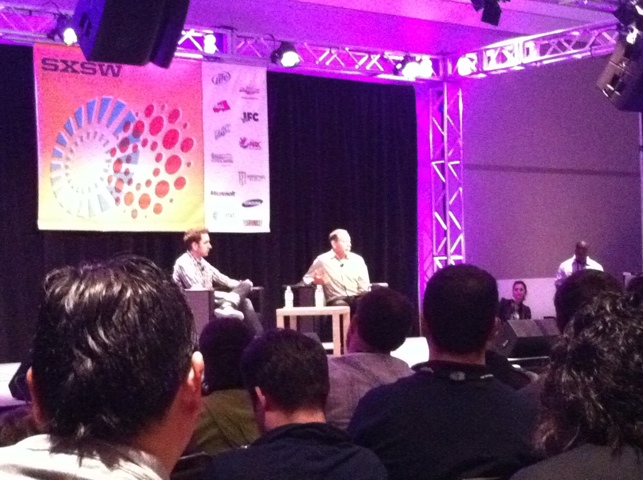
Enabling New Experiences Through Check-ins
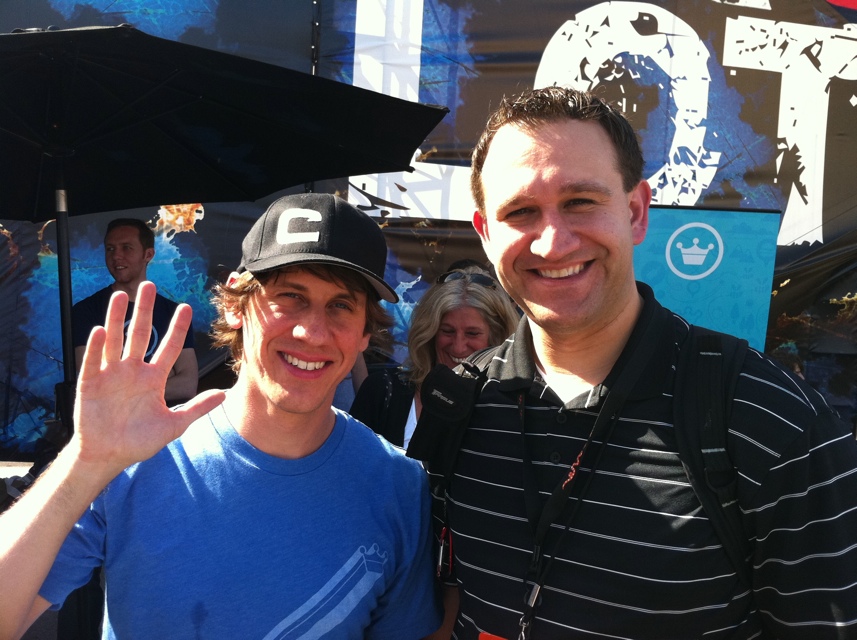
Dennis Crowley Founder of Foursquare and me

Dennis Crowley, Founder of Foursquare, and me.

Dennis Crowley – Foursquare & Pete Cashmore – Mashable

One of the big keynote presentations was with Dennis Crowley, the founder of Foursquare (he’s the one waving in the picture with me to the right).  He talked a lot about what it’s been like at Foursquare during their growth over the last year or two.  However, he also gave some interesting information about what they’ve learned and where they’re headed.

They currently have over 7.5 million users, and over 250,000 merchants who use their system.  These users provide them with a ton of data, since the average user has 3 checkins per day and gives back in the form of recommendations.

They have a ton of ideas about where they want to go, but there are only 50 people who currently work there, so they have to carefully prioritize what’s next for them.  They’re focused on providing badges to encourage positive behaviors, such as the gym-rat badge for checking into a gym 10 times a month, or the “I voted” badge during the elections.  Also, just before SXSW, they launched the “Explore” tab, which utilizes their rich data about you and your friends and provides “an amazon-like recommendation engine” about where you might want to shop, eat, etc.

Crowley feels that their future lies in their ability to “blow out the possibilities of the database of information” they have.  This means both providing information to users about what can help them, but also what it means for businesses who utilize Foursquare.  For example, imagine knowing the potential income for your business when someone walks in your location.  In addition, Foursquare has already proven to provide a lot of potential for small businesses who don’t have an organized loyalty program.  Foursquare has the potential to further become a more universal and amplified loyalty program that provides rich data for venue owners.  We’re seeing just the tip of this with the Foursquare/American Express partnership that’s part of SXSW.  By combining Foursquare checkin data with AMEX financial data, they’ll be able to show the exact amount you spent, where, when, how often, and more.

Along with the potential that lies in what’s already been mentioned, Foursquare has their eye on the future.  They’re looking at things like auto check-ins on new phones with technologies like near field communications (NFC) chips.  “How much easier is it to check in when all you have to do is tap or swipe.”  Not only are they focused on new devices and adapting to new technologies, they’re currently working with over 200 brands, and have their sights set on working with many more.  Much like Twitter, they “love it when people build stuff on top of” their service, and know that others’ innovations could fuel their success.

While most of the conversation felt like Cashmore was having a personal conversation with Crowley, which was off topic, and Crowley avoiding most probing questions, there were some hints at Foursquare’s future.  It was more obvious than ever that Foursquare’s future success lies in its database and the potential to grow it.  The ability for venue owners (businesses) to take advantage of deep, detailed knowledge on people who walk into their locations will help them better market to customers, and at the same time, enhance the customer relationship.

Talk with Paul Ruebens / Pee Wee Herman

Like last year, I’ll periodically attend a session that’s a little more self indulgent (like the Booze and Blogging session I attended last year).  This year, it was attending this session.  It was an interesting perspective in several ways.  I learned about his background a bit, but also a little about what it takes to make it.

Pee Wee Herman Paul Reubens SXSW

Ruebens started with the Groundlings, an improve troupe, and developed the character of Pee Wee because in a performance one night, he had to play a bad comedian.   It all came out that night – suit, bowtie, voice (based on an earlier character), behaviors (based on kids he knew).  He wrote a play based on the character in 1981.  He said he was an up and comer in comedy and missed out on his shot at SNL (to Gilbert Gottfried).  So on the way home from the audition, he wrote the show in a bit out of a panic of what to do with his life.  He said, “It was a bit of a ‘let me show you.'”

One piece of advice he gave was to learn how to write, as he said that if you a good writer and can tell stories, you can write your future.  In fact, he said he had to read a book on screenwriting to write Pee Wee’s Big Adventure.  In fact, the storyline followed the guide in the book almost directly.

He also gave some insights on a conversation he had with fellow comedian, Phil Hartman.  Hartman felt that Reubens was throwing away other great characters from his Groundlings days to concentrate on this one.  However, he said he had a gut feeling about this character.

He fully committed to it, almost never going out in public, except as Pee Wee.  To him it was performance art, but others started to see he as being just like the character.  He feels that it was what made his arrest an even bigger issue.  Since then, he been acting and rewriting his play to include his work from Pee Wee’s playhouse.  He’s in the process of shooting an HBO special as well.  Early on Pee Wee was sweet, but he got a bit snarkier over time. Snarky Pee Wee was what most people liked, so he’s headed a bit in that direction.  He also said he’s working on a new movie with Jud Apatow, but can’t reveal yet what it is – “2011 and the internet has changed everything, you can’t do anything in secret anymore.”

He provided some other insights, such as how Tim Burton became the director of Pee Wee’s Big Adventure.  The studio approached him with their choice and he didn’t like it.  He stuck to his guns and was told he had a week to find someone who was available, affordable, and approvable. He found Tim Burton through a friend on the groundlings, and loved his attention to art direction.

He also said the most fun he had was writing Pee Wee’s playhouse – especially when they would think of something that they knew was successful for a 6 year old – it was the most gratifying for him.  The first season of the show, he had 5 writers, working together to write all 13 episodes.   After that, he would hire a couple or a duo and together they write the season – putting in long, long days.

Overall, it was interesting to learn a little more about his background and get his perspective on what it took to succeed.

Thank You Mapquest and @GaryVee

I had a great evening tonight and in the spirit of @Garyvee‘s new book, I just wanted to say, thank you! First, I enjoyed an great night at The Salt Lick in Lockwood, TX thanks to @Mapquest. Then I came back in to downtown Austin and had a great time at Gary Vaynerchuk’s SXSW 2011 Secret Wine Party. Secret Wine Party? As the legend goes… A few years ago, Gary, from tv.winelibrary.com was hanging out in the lobby of the Residence Inn and decided to grab a box of wine. Fueled by Twitter, a spontaneous party broke out and people started showing up. Last year, he showed up at the Silicon Prairie party and started serving wine. So, after a couple of years of this, many, many folks at SXSW were wondering when the “Secret Wine Party” would be this year.
I was wondering around downtown looking for friends when I saw Gary’s tweet that he would announce his party at midnight. fortunately for me, when he announced the party tonight at The Phoenix, I was right across the street. Within a span of about 10 minutes, the line in front of The Phoenix grew from about 20 of us to about 300. It was a virtual flash mob of activity as soon as Gary tweeted the location of the event. When I got into the party, I got a chance to meet Robert Scoble, and get served by Gary himself. I enjoyed Gary’s Presentation last year and hope to catch him again this year.

Banking on Big Brands/Celebs for the Web

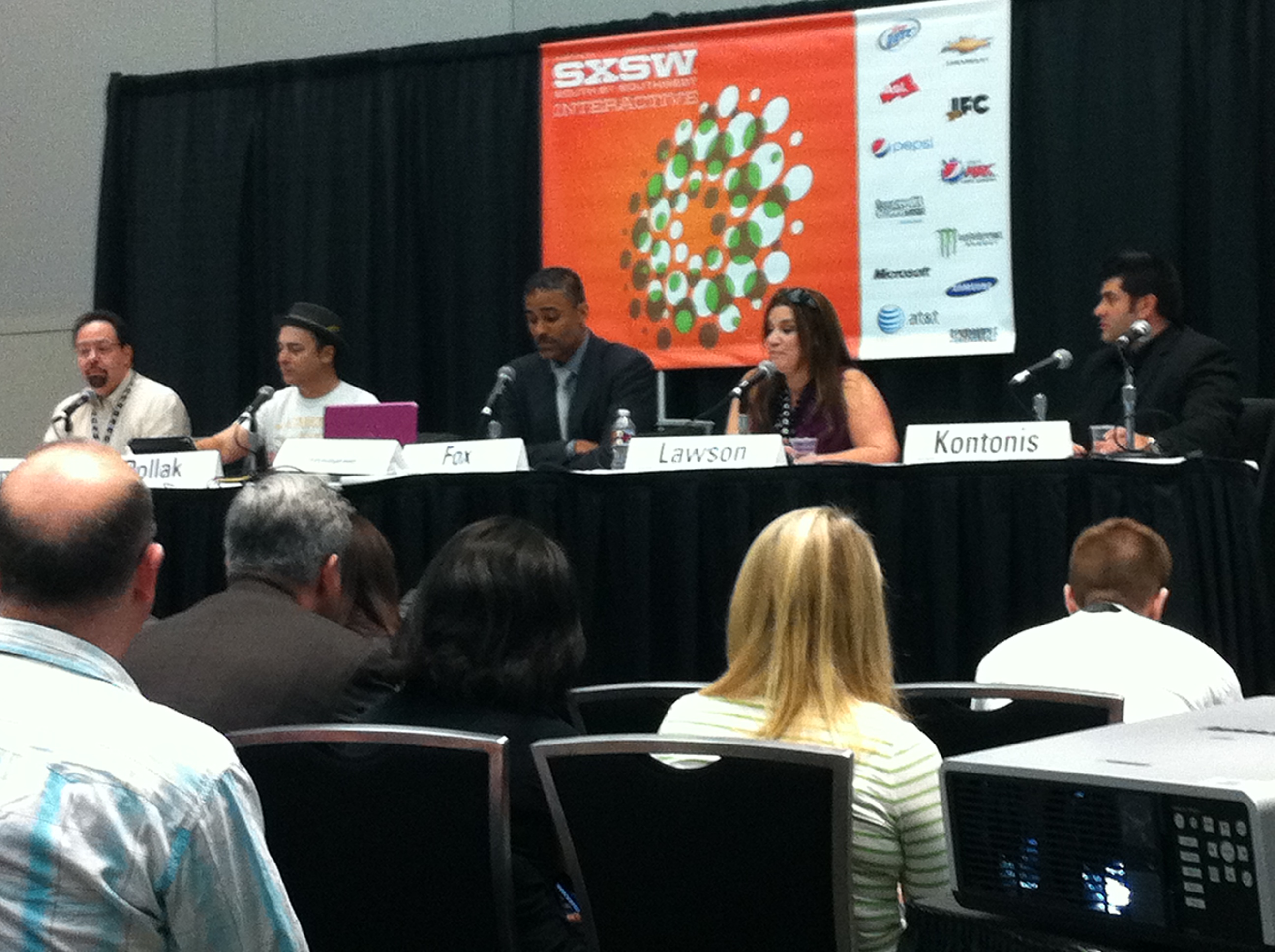
Panel: Amber J Lawson – Head of Original Programming, AOL, David Tochterman – Head of Digital Media, Innovative Artists, Rick Fox – NBA All star/Entertainer, Kevin Pollak – Actor, Paul Kontonis – Digitals
Hashtag: #sxswbigbrandsKevin Pollak and Rick Fox panel at sxsw

This panel discussed how traditional media is changing and how brands can get involved to take advantage of this shift.  In particular, two celebrities on the panel are taking slightly different approaches to this.

Actor Kevin Pollak, created Kevin Pollak’s Chat show – http://kevinpollakschatshow.com – because he said, “If you’re not creating your waiting.”  As an actor, you wait for the phone to ring for the next thing.  He felt that new media provided a tremendous opportunity to create his own content.  He used Felicia Day as another example of someone who created their own show to take their future and potential in their own hands.  He simply tries to create interesting content to draw an audience, as he said, “If you can earn an audience you can earn a living.”

Pollak gets brands involved from a very traditional perspective, through pre-roll advertising, display ads around the content, etc.  He feels that this helps big brands who may not be comfortable jumping into this area, get involved.  Therefore, they primarily use impressions as a way to sell the show to brands.

NBA all-star, and now entertainer, Rick Fox, takes a slightly different approach.  What’s important to him is telling a good story, and he looks for opportunities to integrate brands into the story.  For example, on one of his shows, you may see a basketball player having a Gatorade after a game.  It’s a bit like celebrity endorsements, but extends it by showing how the product is used and its benefits.  This takes cooperation between the celebrity/producer and the brand.

Working through partnerships like VuGuru/AOL, he can offer these product integrations, as well as non-traditional promotions.  He believes you are not only bring on a celebrity to use/endorse your product, but you’re also utilizing their Twitter followers and other social media “klout” to influence their fans.  And it’s not just the celebrities’ followers, but their personal networks.  For example, when Rick Fox was on Dancing with the Stars, he was able to get friends (Kobe Bryant and Shaq) to post messages to their followers asking for support.  This can get a little muddy when you’ve got multiple projects going on at the same time.

Will it Blend?

A bonus that was not on the agenda at the Tweet House today was the addition of Blendtec’s Tom Dickson.  He spoke a bit about how they started and got to be as successful as they’ve been with their “Will it Blend?” series on YouTube.  Here’s a brief video of his presentation.


As a BONUS, I received a DVD of 50 Will it Blend videos as well as a behind the scenes video of how they make it.  I’m giving it away to one blog reader.  As usual if you comment on this post, I’ll select one commenter to give the DVD to.  Please make sure to include your email address when commenting.

Tags

Related Posts

Share This

Meeting with Josh Bernoff

Josh BernoffAfter getting a chance to see Josh Bernoff from Forrester speak at the Social Business Summit yesterday, we got a chance to sit down with him this morning to dig a little deeper into a few topics.  It was really a special opportunity to pick his brain about social media applications and organizational structures to deal with empowered consumers.  He shared some great insights and advice regarding the use of Facebook and organizing to be able to respond in real-time to consumers.

I was really interested in what could be done to collaborate in an environment which might be fractured into various silos with slightly overlapping responsibilities. We discussed the need to bring these groups together on a very regular basis to have discussions regarding monitoring, strategies, and execution. He brought forward a case study from Dell, mentioning how they bring together all of their social media folks for a weekly phone call to discuss these issues. Further, he mentioned the importance of challenging each other on these topics as well – making sure strategies are in place and metrics are being monitored. All areas need to be aware of what each other are seeing and doing in order to most effectively execute in this space.

Unfortunately, and understandably, he wasn’t very excited for me to video record parts of our meeting, but thanks again to Josh for taking the time out of his busy schedule to talk with us!

Delivering Happiness

Presenters: Tony Hsieh, CEO of Zappos.com

tony Hsieh Delivering HappinessZappos focus is on the customer experience, to an almost fanatical extent.  In pursuit of customer service, they’ve coined the term, “Delivering Happiness” to describe their mission.  Much like he describes in his book of the same name, Hsieh talked about how they focus on culture.  It’s their #1 priority, and he feels that if they can create the right culture and focus on customers, the results will follow.

Hsieh has done a lot of research in his own pursuit of happiness, and outlined a framework for happiness.  It requires these elements:

  1. Perceived control
  2. Perceived progress
  3. Connectedness
  4. Vision/meaning (being part of something bigger)

They use these concepts to select the right employees and focus on growing them from a job to a career, to eventually making it a calling.  Additionally, there are 3 types of happiness

  1. Pleasure – chasing the next high (Rock star)
  2. Engagement – time flies – flow
  3. Meaning/higher purpose – being part of something bigger than yourself

Therefore, in order to build a great business, Hsieh focused on ensuring the culture provided employees with pleasure, passion, and purpose.  They hire for the culture and won’t hire someone who is great if they don’t fit in.  Many have heard of their $2000 offer, where they offer new employees a bonus for leaving the company after training if they don’t feel they are a fit.  Things like connecting employees with twitter have helped improve all of those areas, as well as a sense of connectedness.  Ultimately, the culture is about commitable core values.  It’s not just “a meaningless plaque on the wall,” it’s about being willing to hire and fire based on those values.  In fact, if you Google any one of Zappos core values, their site will appear #1 in the rankings.

Most of the presentation covered things he talked about in his book, Delivering Happiness.  At the end of the talk, Hsieh gave everyone a copy of his book.  Since I’ve already read the book  I’m giving away a copy of Delivering Happiness to 2 blog readers.  Simply click on the comments above and send us a note (be sure to include your email address), and we’ll select 2 winners to receive a copy of the book!

Also, don’t forget about my other book giveaway from the iMedia Brand Summit.


Real Time Marketing

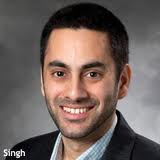
Presenter: Shiv Singh, PepsiCo
This was easily the best and most practical presentation of the day, providing a very clear outline for building a company structure to take advantage of a real-time environment.  The recent revolution in in Egypt highlighted the power of real-time communication and timeliness of information. Businesses can utilize social media for real time marketing, but there are six elements that need to be in place to execute effectively:

  • Real-time Insights – It’s most important to be aware and know what your customers are thinking and doing in real-time.  The listening tools must be in place to provide a stream of updates.
  • Real-Time Response – When you know what your customers are saying, you need to be in a place to act immediately.  A response only has meaning if it’s timely, so having staff who can respond in real-time provides an answer or response immediately.
  • Real-Time Content Studio – Not only do you need to be able to respond immediately, but you need content and creative experts organize to be able to produce content in the moment.
  • Real-Time co-creation – We can work together within the organization and with the consumer to develop the message and let it evolve.
  • Real-Time Distribution – As a brand, the tools should be there to allow you to talk directly to consumers without having to go through your agency or a middle-man.
  • Real-Time Engagement – Interacting and engaging with customers in real time creates engagement and trust.

All of this fits within a pop culture frame, meaning an awareness of the environment and what’s going on in the world at that moment.  The way we think and process information is changing, and new media technologies are literally addictive says psychologist Susan Weinschenk, fueling a “dopamine induced loop of seeking behavior and instantanious reward.”

There are 30 billion Facebook updates a month and a brand’s marketing message is competing for attention with all those status updates.  Therefore, brands need to think like a content company, regularly producing relevant content that cuts through the clutter.  During fashion week, Pepsi launched its new skinny can with a campaign called “Get the Skinny.”  During fashion week, they set up a content center for information on culture and fashion, essentially acting as a small news organization for the week.  It resulted in over 90,000 new Facebook fans and a large amount of engagement online with the brand.

Brands must be aware of culture and what the general public is thinking in order to take advantage of real-time opportunities.  During the BP disaster in the Gulf, Pepsi took the opportunity to expand the Pepsi Refresh Project.  They decided to give away and extra $1.3 million to fund reat ideas to help fund Gulf communities.  Because they were structured as outlined above, within a couple days, they got the idea, had it approved, and launched the site.  The next phase of the Pepsi Refresh Project will take advantage of consumer generated videos, allowing organizations who would like the grants to make a case to consumers via video.

Overall, in order to make this happen, Singh suggests that all of the following are needed to make it happen

  1. Be able to ride “glocal” culture trends as they’re shaped by consumers.  Your company must be organized to communicate in real time, both on a global and local basis.
  2. Target your brand loyalists and let them spread your message, but to do so you need to know who they are and have a relationship with them.
  3. The ability to engage in real-time, meaningfully.  It’s about engagement, not just broadcasing your message, but if you’re able to do so, your message will be amplified by others.
  4. Have a content studio to operate as a media organization in real-time.
  5. Build your own distribution network.
  6. Organize to be able to go from strategy to execution in seconds.
  7. Don’t limit this to digital – make everything addressable, targeted, and instant.
  8. Acknowledge real-time marketing has no geographic boundaries.

I got a question via twitter from @kellythul who asked what KPIs or metrics Singh utilizes for measuring success.  Singh suggested something he helped to develop while at Razorfish – the SIM Score.  The SIM Score for a brand is the ‘Net Sentiment’ for that brand in social media divided by ‘Net Sentiment’ for the industry.  Net Sentiment is defined by Razorfish as “Net Sentiment for the Brand = (Positive + Neutral Conversations – Negative Conversations) / Total Conversations for the Brand.”  He suggested looking at your real time score and comparing it to competitive brands within your industry.  He says that he has definitely seen a correlation with changes in SIM score and sales, mostly in CPG type industries.


Only Empowered Employees Can Serve An Empowered Customer

Presenter: Josh Bernoff, Forrester

In his new book, Empowered: Transformed by Social Technologies, he talks about the importance of enabling your HEROs, because only an empowered worker can serve and empowered customer – can’t run company top down anymore.  HERO stands for Highly empowered and resourceful operative.

The sales funnel has been extended, and it no longer ends with customers.  Here’s the new flow – Eyeballs -> Awarness -> consideration ->preference purchase -> Customers -> Supported ->Empowered -> Delighted -> Fan -> Broadcaster – the message then goes to others and starts over again.

Social participation has grown, which only highlights the importance and impact of this new model:

Year Creators Conversationalists Critics Collectors Joiners Spectators Inactives
2007
18%
25%
12%
25%
48%
44%
2010
23%
31%
33%
19%
59%
68%
19%

Bernoff believes there are four technologies empowering consumers: Smart mobile devices, Social technology, Pervasive video, and Cloud computing services.

How frequently do people tell others about products and services?  They looked at various social media and counted how often people told others about a product or service they were using.  They found 500 billion impressions, and during the same time period, total advertising impressions were 2 Trillion.  That means social media had 1/4 of the total number of impressions about products and services.  Which impressions do you think had more of an impact – referrals from friends and others on social media or advertising messages?

We need to start to treat our customers as a channel – they are another group which share our message.  The process for accomplishing this is – IDEA: Identify your mass influencers, Delivering groundswell customer service, Empowering with Mobile Information, and Amplifying fan activity.  Identifying the influencers is important because a small percentage of people control 80% of the influence online.  Delivering groundswell customer service requires reaching out and engaging in social media channels, such as Best Buy’s Twelpforce.  This requires empowered employees who can directly respond to customers. Empower people with mobile information, as the use of immediate information is most important.  Amplifying fan activity means enabling your fans to share their messages with others.  He used an example of a highly regulated health industry providing a way for customers to share their own testimonials on their site.

How do you run your organization to make this work? 3 groups that have to work together:

  1. HEROs – know customer needs, use tech to serve customers, operate safely
  2. Managers – Make innovation a priority, support Heros, work with IT to manage risk
  3. IT dept  – Support Heros with technology, scale up solutions, provide tools to manage risk

You must embrace these new technologies, because HEROs will find a way around your controls.  A recent study showed that despite blocking technologies employees said this, they:

– use smartphone for work – 8%
– Download and use apps on work comp – 12%
– use tools to find access to blocked sites while at work – 27%

Resistance is futile, spend your time empowering your employees.  This requires encouraging experimentation, committing to collaboration systems, and using tools to share best practices across the company.


Dachis Group Social Business Summit

At the iMedia Brand Summit, several of us were talking about whether or not we were going to be attending SXSW. A few of us are, and I found out that Robert Freeman, from Michaels was staying at the same hotel as well. As we got to talking, he mentioned that he and his boss were planning to attend the Dachis Group Social Business Summit. Well, as it turns out, Robert’s boss wasn’t able to make it into town in time for the Social Business Summit, and since they aren’t able to refund his fee, Robert invited me to attend.

I had seen this earlier, but after iMedia and SXSW, there was no way I was going to be able to talk to my boss about footing the tab for yet another conference on this trip. I’m really excited about being able to attend this, particularly because one of the speakers will be Tony Hsieh, CEO of Zappos.com, and I just finished his book Delivering Happiness.  There are some other tremendous speakers on the agenda, including Josh Bernoff of Forrester, Shiv Shingh of Pepsi (got to see him speak last year at work when he was with Razorfish), and Jesse Thomas of JESS3, a data visualization group.  I’m certain the other speakers will be great, and the topics on the agenda look awesome.  As you would expect, I’ll be tweeting and blogging from there as well.

iMedia Brand Summit Marketers Only Meeting

Today was the first day of the iMedia Brand Summit, and it’s only for brand marketers.  There are a ton of great folks here from brands like Dell, Procter & Gamble, Target, Bank of America, JetBlue, and more.  The discussions have been great, centering around how brands are utilizing Facebook to how their companies are organizing their structures to handle social and interactive media.

I walked away with several good insights, tips, and quotes.  I had a chance to talk with the person from JetBlue about their recent entry into location based deals and geo-fencing efforts with AT&T’s Placecast technology.  I got some tips on who were some great vendors for Facebook and mobile app development, as well as vendors for Facebook Fan generation.  The discussion made me think about the “Facebook Fan Funnel” and what to do with them after they “like” your brand.  Some great quotes included:

“Your Facebook page is like a store in the mall.  You need to staff accordingly and have people involved who are empowered to handle everything from customer service issues to marketing and sales, and are knowledgeable about your products and services.”

“Getting customers to share your content on Facebook is important, because you can block me, but you can’t block your momma.”

And as promised, I’m planning to do a lot more videos and photos.  Please excuse the shakiness of the video, it’s all shot and edited on my iPhone, so I can get this up and out to you as quick as possible.

Tired of “Transparency” Yet?

Ran into Evan Williams while out at SXSW.

During his keynote conversation, Evan Williams, CEO of Twitter (@ev), discussed recent conversations the company was having about its identity.  Like any young company, they are strugging to define their culture and principles.  One thing that resonated with me was his discussion about “transparency.”

We’ve all heard or used the word, probably fairly recently, and we can all agree it’s becoming a bit cliché.  During his discussion, Williams talked about Twitter’s philosophy of not being focused on transparency, but rather openness.  He used the analogy of a door, “It can be transparent and you can see through it, but when it’s open, it’s about getting in, shaping it, and defining it.”

So many, especially brands, struggle to provide “transparency,” and are unwilling to lose control of their brand or message.  As the world evolves, audiences will expect openness (more than just transparency), and they’llhave to let go of a little control to succeed (See “New Rules of Marketing & PR” post about David Meerman Scott’s presentation).

Twitter encourages users and developers to take their APIs and create new things built upon their service.  While they may not be thrilled with all of the uses (Williams noted that they’ve recently sent several cease and desist letters, mostly to Twitter spam services), they know that its been the company’s openness that has allowed it to succeed.  Similarly, it was Facebook’s openess to application developers which also helped it to leave MySpace in the dust and even pass Google as the most visited site on the web.

While most brands are still working on “being transparent,” those who will succeed in this new world will be those who focus on being open.