Outsource Social Media?

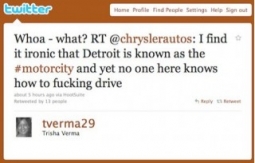
This wasn’t necessarily a presentation I attended at iMedia, the Social Business Summit, or SXSW, but among the many brand people I got to meet, it was an extremely hot topic of discussion.  The discussion was further fueled by something that happened the day before the Social Business Summit.  If you hadn’t seen the news, an employee from a company called New Media Strategies, accidentally dropped an f-bomb on behalf of their client, Chrysler’s twitter account.  As you can imagine, the employee was immediately fired and Chrysler let the agency go the following day.

Many of the brand people I met worked in various parts of the company, and something mentioned in the Ad Age article about the incident sparked a lot of discussion…

Turf battles over social media between marketing and communications have been an issue at the automaker — and other companies — for a few years. Early in the day after the tweet went out, Chrysler’s communications team was grappling to get hold of the details of the episode after bloggers and media began calling, in part because Chrysler’s marketing department controls Facebook and Twitter social-media accounts that are “consumer facing.” The communications department has separate Twitter, Facebook, YouTube and Flickr accounts that are meant to be “media facing.”

Many companies say the divide only serves turf and budget wars, not the brands. “All that has blurred, so it’s critical for communications and marketing to be coordinating and cooperating all the time,” said Stuart Schorr, VP-communications and public affairs at Jaguar-Land Rover North America. One of the issues creating the turf war, he noted, is which department gets the budget.

What I think we all discovered was social media is something that can’t be fit into a traditional box, as it has blurred the lines between paid and earned media, marketing and customer service, as well as transactional versus relational communications.  I’m not sure anyone has figured it out, but everyone expressed frustration about how this confusion was causing issues within their companies  (like the ones mentioned above).

The general perception is that social media is “cheap,” because sites like Twitter, Facebook, and YouTube don’t necessarily charge you to be there.  However, in order to do it right, you have to invest first in listening to conversations about your brand and industry… which isn’t easy, when there are over 1 billion tweets per week, 1 billion Facebook messages posted per day, or the 24 hours of video uploaded to YouTube every minute.  Imagine the resources it takes just to do this… and if you want to respond to any of these messages, that takes more resources – and as pointed out above, multiple resources across functions/silos.

Hopefully you can agree, at the very least, it takes a large amount of time and organization.  Generally, brands are already heavily committed to traditional media – and spending money to outsource this work to traditional media agencies – because the “push my message through a one-to-many framework” has been in place for so long.  Even more important, leaders aren’t yet prepared to organize new internal communications structures to deal with a “new” media which requires one-to-one relationships.

In the meantime, there are certain to be many, many more ethical debates (like this one – Should You Outsource Social Media?) about whether or not you should hire someone to manage customer relationships in social media on your behalf.  Please tell us what your take in this debate is by commenting on this post.

5 Key Ingredients for Digital Display Marketing

This presentation was put on by PointRoll, a company which makes interactive banner advertising.  Here were their 5 ingredients for digital display marketing:

1. Audience
– Research your audience and know what they’re looking for
– Consider more than just demographics, think about context and how they use the web

2. Data
– Using your audience data and knowledge to determine who and how to target ads
– Come up with at least 3 Key Performance Indicators to evaluate success

3. Creative
– The Meijer case study included circular ads within the banner ad
– They are now trying to port viewer data out to billboard.  For example, if people are looking at snow shovels on the ad, they’ll use snow shovels on a digital billboard.
– Dynamically generated ads based on user data, which give them a reason to engage

4. Distribution
– Deliver messages across media
– More retail outlets are creating a social shopping experience

5. Performance
– Measure success and give proper credit to display and search – track if people see display ads and then search for item.

iMedia Brand Summit Wrap Up


The Power of Brand Relationships

The presenter was Donna Sturgess of Buyology, and she discussed the importance of understanding how non-conscious thinking impacts relationships, and ultimately whether or not someone buys your product. These non-conscious things include influencers, such as memories and values, intuition, wants, desires, and reflexes.

Her company uses neuromarketing tools to dig into how these non-conscious influencers impact buying decisions. There are 10 key brand relationship drivers:

  1. Symbols
  2. Rituals
  3. Sense of belonging
  4. Sensory appeal
  5. Evangelism
  6. Storytelling
  7. Power of the enemy
  8. Mystery
  9. A clear vision
  10. Grandeur

They evaluated many different brands on these areas, and looked at how they differed in how they connected with people on a non-conscious basis. For example, people tended to like Apple because of sensory appeal, symbols, and storytelling.book

She then dug into a case study about Mattel’s new campaign for Barbie and Ken, utilizing memories and nostalgia among those who might be buying the toys for their kids or grandkids. At the same time, they’re bringing to life the story of Babie and Ken for a new generation. They’re running across many different channels – Facebook and Twitter, out of home, and PR placements.

Buyology has also developed a way to measure the type and strength of a brand’s relationship with its consumers with 4 Neurotypes of non-conscious relationships – Awe, Exploration, Superiority, and Harmony.  These insights should be used by brands to look at the impact of its marketing and utilize them to strengthen their relationships with customers.

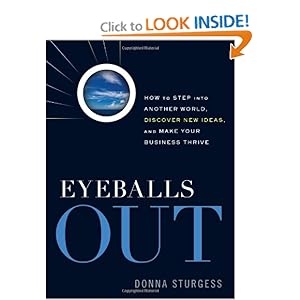
BONUS: Donna was giving away copies of her book after the presentation.  I was able to secure a couple extra copies for readers of this blog!  I’ll select 2 names from anyone who comments below and send you a copy of Donna’s book – Eyeballs Out: How To Step Into Another World, Discover New Ideas, and Make Your Business Thrive – upon my return from SXSW.

Beyond Reach: Aligning with a Changing Consumer Decision Journey

Presenter: David Edelman, Partner & Co-Leader, Global Digital Marketing Strategy Practice, McKinsey & Company

consumer decision journey

It starts with a complete story across the Customer Decision Journey.  I know the chart here is hard to see, but it involves the following customer decisions: Consider – Evaluate – Bond (middle) – buy – experience – advocate.

In the course of McKinsey’s research across across brands in the consumer electronics, financial services, and telcom industries, they found that 75% of their budgets focused only on the “consider” and “buy” portion of the journey.

He used a McKinsey case study from electronics maker LG to illustrate why businesses need to look at other parts of the consumer decision journey.  LG believed that Amazon.com was simply an sales channel.  Research indicated that Amazon.com actually influenced 64% of sales made in physical stores as well.  It was actually its most important marketing touchpoint.

Adapting to this took a serious supply chain redesign, as they had to get all content regarding all their different TVs into a consistent format across all potential media – in store and online.  They had to quickly mobilize for content development rather than “traditional marketing” and, it required more focus on media and content development as well as alignment across silos.  New customers were immediately drawn into ongoing dialogue about the brand, fostering engagement, and ultimately a huge sales increase.

A case study from Progressive Insurance illustrated the potential to use your own data as content.  They aggregate competitor quotes both as a service to customers and potential customers, as well as making a strategic decision driver.  However, they’ve flipped the process around and have the ability evaluate the data on how consumers adjust their rates to impact the price.  Thousands of times an hour, they can see exactly what tradeoffs people are making to get the prices they want.  This knowledge has given them more insights to target certain types of consumers, bringing them a lower cost per acquisition than GEICO.

A final case study focused on how Comcast is turning service issues into advocacy content.  They receive 40-50 PR threats posted on blogs each day.  They reply via phone or email, spurring new posts with positive comments.  This often leads to the removal of posts and sites bashing the brand.  In addition, they monitor about 1000 tweets per day.  It turns out that 80% of service issues are resolved by other customers, and then becomes content for Comcast’s own bulletins.  Their sentiment scores have risen and they are in a better position to fend off growing competition from telcos.

The key is to reconstruct the Consumer Decision Journey for your advantage – distribute your presence, integrate the core, and activate the engaged.  In summary, ask yourself these questions:

1. Are your marketing plans focused on push, or on shaping the customer decision journey?

2. Do you have plans and budget for new roles, such as content, software, and product meta-data management?

3. Do you know which battlegrounds to co-opt?

4. Are you building the virtuous loops to fuel data and content?

5. Does your marketing organization reflect new roles and goals?


Data Driven Buying

This was a really hard presentation to take notes on, since a lot of it included charts and graphs.  Fortunately, iMedia put a recap online, so here you go…


The Shakespeare Brand & What it Teaches Marketers in 2011

After a break for lunch and a very interesting presentation by Google regarding their display advertising capabilities, there was a session by @BradBerens, Chief Content Officer, Digital Marketing Sector.

He started out by illustrating that Shakespeare created one of history’s most powerful brands.  He was able to do this because of the resources and skills available to him.  He was an actor, sharer, theatre owner, and writer/dramatist.  By understanding the environment, and owning the Globe Theater, he was able to move from simple meaning transmission to environment cultivation.

Berens condensed Shakespeare’s marketing brilliance and methodology into his use of space, time, and identity:

  • Space – Context is critical, and Shakespeare created a different kind of emersion – a “theater in the round” – which created a unique viewing experience for participants.
  • Time – He compared watching The Globe Theater  to watching a football game today. It was powered by the presence of other people and their shared emotion.
  • Identity –  Shakespeare divided his audience into “first timers” and “loyal customers,” writing dynamic storylines where he created a sense of discovery for first timers, and a sense of expertise for repeat viewers.

He broke down the foundation to friction and frames.  Friction leads to satisfaction, whereas framing is how you experience the context of the message.  His stories created friction, and The Globe Theatre created the context.

Marketers have the ability to use marketing experiences and technologies to create deeper bonds with and between people and to give them more richly satisfying experiences in relation to our brands.

Brands should strive to create an environment where consumers contribute, get to be creative, and feel like experts using Shakespeare’s techniques.

Brand as Channel/API

Brand as Channel/API at iMedia Brand Summit 2011

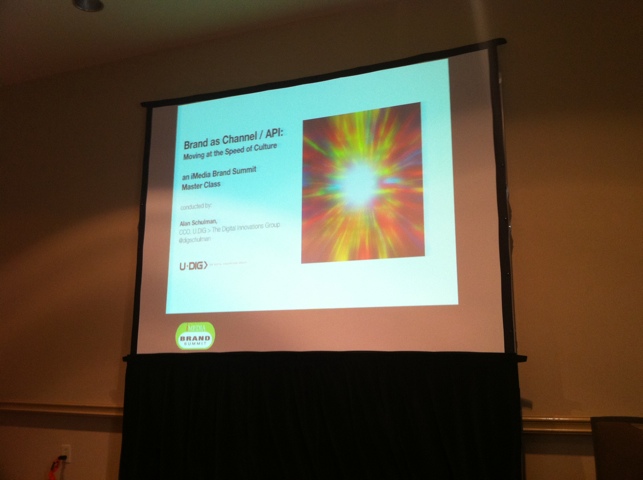
A week or so ago, I was asked if I could sit on this panel discussion about how some brands are starting to create their own content in lieu of, or along with, traditional advertising. The discussion was led by Alan Schulman, Chief Creative Officer at U.DIG – The Digital Innovations Group, and included myself and Scott Koehler, VP, OPEN Digital Prospect Media & Marketing, American Express.

Alan pointed out that API’s or “Application Programming Interface, was simply a mechanism for distributing content persistently – or having “always on” messaging. As a brand, it requires a change in how you message, going from a campaign mindset to a brand reinforcing content ecosystem. This is important because of consumers growing intolerance to traditional media – they are over-saturated with messages and becoming increasingly fragmented. So as a brand, you need to become a realtime content creator, curator, app developer, content distributor, content syndicator,and brand storyteller, instead of an “advertiser.” He used examples from several companies, including American Express and State Farm.

We discussed the importance of telling the brand story consistently, across all forms of media, not just in a TV campaign. After he shared the When Love is in the Air, State Farm is There video, and I talked about the importance of utilizing our agents and zones to find out and help tell the brand story. Scott shared his experiences with the OPEN Forum for small businesses, requiring the ability to handle editorial type responsibilities in-house to generate and curate the content on the site. We both talked about the importance of agency partnerships, as well as internal resources, to generate as much content as possible, while at the same time, making sure it’s on message and reaching an increasingly fragmented audience. Overall, it really made me feel very fortunate to have the skill and resources we have available throughout the company to help tell our brand story in unique and interesting ways.

What Marketers Can Learn from Bing Case Study

The second speaker of the day was Natalie Bowman of MSN to discuss what Bing has done as a “challenger brand” to try to attract users.  She indicated that they were looking to “Break the habit of people using Google.”  In order to do so, they knew they had to do 4 things:

Be disruptive
They started with a big advertising campaign to grab people’ attention, attempting to make it disruptive and capture people’s attention.

Be different
They attempted to do this, not only through their disruptive and different advertising, but also through unique online features, such as their travel, restaurant, Q&A, and Map features.

Be data driven
They utilize metrics and measurement to see how they were doing.  She said, “We’re an engineering organization, so Microsoft doesn’t do anything unless we can track or measure it.”

Be dangerous
They had key sponsorship activations around the Sundance film festival and Jay Z’s new book launch.  They used some celebrities at Sundance and decisions they had to make, to show how their “decision engine could help.”  They took a risk with Jay Z’s book launch, turning every page of his book into something physical and symbolic that could be found somewhere around the globe.   Fans had to use Bing to decode and find the items in the real world.  If they were the first person to find it in the real world, they would get a signed copy of the book.  They had over a half million people participate.  It provided a lot of out of home opportunities for co-promotion.

Personally, I think the Bing advertising was very disrupting and gained a pretty good amount of traction.  I also believe they did a pretty good job of trying to develop some unique offerings in travel, dinning, etc. to differentiate themselves… and, no doubt track and measured the heck out of it.  However, I can’t say that sponsorships with celebrities is all that “risky” as the speaker claimed, or “dangerous.”  All in all, it was an interesting perspective on how Bing tried to gain some traction.

iMedia Opening

The summit opened with a quick introduction from Dave Morgan of Simulmedia. Since the theme of the conference is storytelling beyond advertising, he briefly discussed the importance of thinking beyond the computer. He touched on Bill Joy’s Six Webs. He envisioned:

imedia summit opening

  • Far web – the typical TV viewer experience
  • Near web – desktop computing
  • Here web – mobile devices with personal information one carried all the time
  • Weird web – voice recognition systems
  • B2B web – business computers dealing exclusively with each other
  • D2D web – intelligent buildings and cities

Joy sees these as the foundation for how the internet will continue to change. He predicted the “here” web would be most prominent due to its portability. Morgan points out that despite the fact that Facebook represents 25 percent of all page views on the internet, if its audience size were compared directly to a TV network, it would be equivalent to being PBS. He showed numbers to illustrate that Facebook’s “viewership” paled in comparison to that of CBS. So there’s a long way to go to get to the “here” web, but conferences like this help to bring to light the importance of designing content for the evolution we are in the midst of.

Following Morgan was a presentation by Claudia Batten, the COO of Victors & Spoils, an ad agency that uses crowdsourced production. Your brand is whatever consumers say it is, so you might as well engage them in helping you to establish what the brand is and stands for. Her agency worked with WD-40 to generate ideas for innovating the brand. Here’s what they got: 336 ideas submitted, 26 investigated, 10 validated, 5 awarded, 1new ownable platform. This outside perspective gave the brand some freshing thinking, and provide for endless stimuli for internal ideation. Similarly, Starbucks idea submission campaign had 70,000 ideas submitted in its first year with over 100,000 total submitted. A team of 40 people reviewed the ideas, and they implemented about 100 of them.

Her advice was to engage these fans and audiences who want to contribute to your brand, but you must be prepared for it. To do so, you must be prepared for the worst, not everything goes perfectly; you must be a collaborator, and not an intruder in these discussions and brainstorming; you must be transparent and willing to share your problems/challenges; you must spread the word and promote it, targeting key influencers and advocates. If you’re able to do this, you’ll get solutions to some of your biggest challenges, as well as a way to connect with consumers and tell your brand story.


iMedia Brand Summit Marketers Only Meeting

Today was the first day of the iMedia Brand Summit, and it’s only for brand marketers.  There are a ton of great folks here from brands like Dell, Procter & Gamble, Target, Bank of America, JetBlue, and more.  The discussions have been great, centering around how brands are utilizing Facebook to how their companies are organizing their structures to handle social and interactive media.

I walked away with several good insights, tips, and quotes.  I had a chance to talk with the person from JetBlue about their recent entry into location based deals and geo-fencing efforts with AT&T’s Placecast technology.  I got some tips on who were some great vendors for Facebook and mobile app development, as well as vendors for Facebook Fan generation.  The discussion made me think about the “Facebook Fan Funnel” and what to do with them after they “like” your brand.  Some great quotes included:

“Your Facebook page is like a store in the mall.  You need to staff accordingly and have people involved who are empowered to handle everything from customer service issues to marketing and sales, and are knowledgeable about your products and services.”

“Getting customers to share your content on Facebook is important, because you can block me, but you can’t block your momma.”

And as promised, I’m planning to do a lot more videos and photos.  Please excuse the shakiness of the video, it’s all shot and edited on my iPhone, so I can get this up and out to you as quick as possible.

iMedia Brand Summit – Austin, TX


A short video of my trip to Austin, and the Lost Pines Resport and Spa where the iMedia Brand summit is being held.