Enabling New Experiences Through Check-ins

Dennis Crowley Founder of Foursquare and me

Dennis Crowley, Founder of Foursquare, and me.

Dennis Crowley – Foursquare & Pete Cashmore – Mashable

One of the big keynote presentations was with Dennis Crowley, the founder of Foursquare (he’s the one waving in the picture with me to the right).  He talked a lot about what it’s been like at Foursquare during their growth over the last year or two.  However, he also gave some interesting information about what they’ve learned and where they’re headed.

They currently have over 7.5 million users, and over 250,000 merchants who use their system.  These users provide them with a ton of data, since the average user has 3 checkins per day and gives back in the form of recommendations.

They have a ton of ideas about where they want to go, but there are only 50 people who currently work there, so they have to carefully prioritize what’s next for them.  They’re focused on providing badges to encourage positive behaviors, such as the gym-rat badge for checking into a gym 10 times a month, or the “I voted” badge during the elections.  Also, just before SXSW, they launched the “Explore” tab, which utilizes their rich data about you and your friends and provides “an amazon-like recommendation engine” about where you might want to shop, eat, etc.

Crowley feels that their future lies in their ability to “blow out the possibilities of the database of information” they have.  This means both providing information to users about what can help them, but also what it means for businesses who utilize Foursquare.  For example, imagine knowing the potential income for your business when someone walks in your location.  In addition, Foursquare has already proven to provide a lot of potential for small businesses who don’t have an organized loyalty program.  Foursquare has the potential to further become a more universal and amplified loyalty program that provides rich data for venue owners.  We’re seeing just the tip of this with the Foursquare/American Express partnership that’s part of SXSW.  By combining Foursquare checkin data with AMEX financial data, they’ll be able to show the exact amount you spent, where, when, how often, and more.

Along with the potential that lies in what’s already been mentioned, Foursquare has their eye on the future.  They’re looking at things like auto check-ins on new phones with technologies like near field communications (NFC) chips.  “How much easier is it to check in when all you have to do is tap or swipe.”  Not only are they focused on new devices and adapting to new technologies, they’re currently working with over 200 brands, and have their sights set on working with many more.  Much like Twitter, they “love it when people build stuff on top of” their service, and know that others’ innovations could fuel their success.

While most of the conversation felt like Cashmore was having a personal conversation with Crowley, which was off topic, and Crowley avoiding most probing questions, there were some hints at Foursquare’s future.  It was more obvious than ever that Foursquare’s future success lies in its database and the potential to grow it.  The ability for venue owners (businesses) to take advantage of deep, detailed knowledge on people who walk into their locations will help them better market to customers, and at the same time, enhance the customer relationship.

12 Slides, 3 Writers – Different Approaches to Writing

Presenters: Jim Coudal, Michael Lopp, and John Gruber

As a writer, I’ve learned that anyone can write, but it’s your approach that sets you apart. In this presentation, three different writers walk through the same set of 12 slides. Each explains their approach to getting started, editing, getting unstuck, and understanding when they’re finished. The only way to really illustrate this presentation is with the video here…


Tags

Related Posts

Share This

Themes at SXSW 2011

These are a few of the main themes I picked up on at SXSW 2011:

  1. Relationships – lead to serendipity, opportunities – you’ve got to give before you receive.
  2. Content creators write their own future – New technologies now enable content creators to sit in the drivers seat.  There are fewer limits for executing on their ideas.  Agencies are not necessarily needed and you can go straight to decision makers.  Brands can go direct to consumers.
  3. More and more content – There’s no shortage of content, or a thirst for more.  It’s all about the long-tail of content.
  4. Context – Conversations on social media is one on one, not 1 to many pushed messages.  Context is becoming more and more personal.
  5. Cross Platform thinking – You can no longer think of “campaigns” by media outlet or tactic.  You have to think about how the message can be carried in a multitude of ways, across many media and outlets.
  6. Outsourcing vs Insourcing – Do you handle your own social media or outsource it? Who’s better equipt to handle it, and is it genuine if outsourced?  The debate will continue.
  7. Employee Empowerment – As consumers have a direct connection, via multiple media, to front line and customer service functions, these employees must be empowered and trusted to respond in the right way.
  8. New Acquisition Funnel – Social media is about relationships.  How do you measure the strength or ROI of a relationship?  Also, it’s more than just customer acquisition now, it’s about the lifetime value of each potential customer.
  9. Death of Privacy – Just a few years ago, people wouldn’t get a Facebook account or participate on Foursquare for fear of privacy.  Obviously, the idea of privacy is quickly eroding .
  10. New Technologies – New technologies and applications of them are emerging every day.  The tough thing is trying to tell what will be adopted, and what’s just a gimmick.


How to Personalize Without Being Creepy

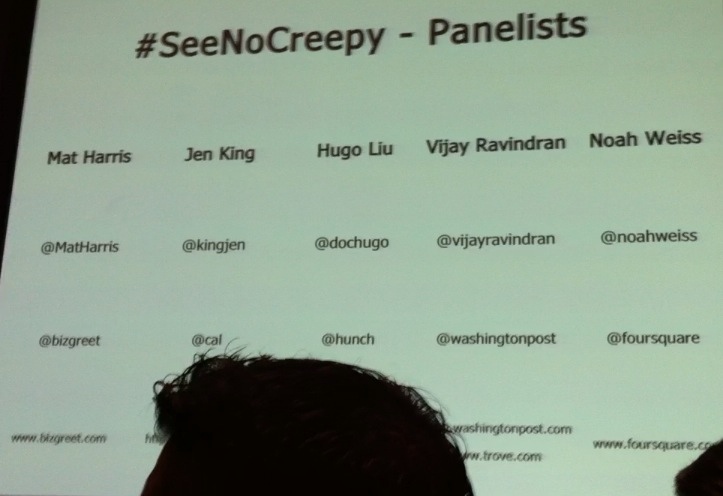
#seenocreepy panel SXSWPanel: Hugo Lin – Hunch, Jen King – PHD UC-Berkeley, Mat Harris – BizGreet, Vijay Ravidran – Washington Post, Noah Weiss – Foursquare
Hashtag: #SeeNoCreepy

The point of personalization is to put something more relevant, and therefore more delightful in front of you. In the opinion of the panelists – “Life is too short, and time is too valuable, to have something random/irrelevant in front of you.” However, there’s a fine line between giving you something you might like to see and knowing more about you and your habits than you want a website or company to know.

All of the panelists agreed that personalization is a dialogue you have with the user. It’s asking what information you’d like to have as a marketer, and letting the user decide what they want to share. Marketers have to also be transparent about why they are asking and set clear expectations about how they’ll use this information. In addition, you have to give the user control to decide if they want to withdraw that information or permission they’ve given you. “It’s like remembering to put fire exits in a building,” said one panlist. “Would you build a building without fire exits? Essentially that’s what you’re doing without an open, obvious exit for users.”

Personalize without being creepySimilar to Philip Kaplan’s beliefs in Getting People to Share Information at the Social Business Summit a couple days earlier (but not as extreme), the panelists believe that people are more willing than ever before to share information – especially if they know what benefit they’ll get from it. “Free isn’t free” said one panelist. “People know that they’re paying with their data.”

The WashingtonPost.com has been focusing on customization, and there’s a subtle difference between customization and personalization. Customization lets users choose what they want to see across a long tail of information, while personalization – implicitly or explicitly – takes the users information and automatically uses it to drive the customer experience.

Different than both of these is the idea of targeting – mostly advertising that appears in these locations. It’s effective because most users want information that is of value to them, and it’s a win-win for the customer and marketer. However, what makes it “creepy” is when it’s exposed that over 700 pieces of data about you, your family, web use, etc. may have gone into targeting you. As one panelist put it – “If you feel like, ‘I don’t want to have to explain that,’ you probably shouldn’t be doing it.” This is becoming an increasingly hot topic as many services, such as Facebook, have started using social validation, or adding your friends’ information to make recommendations to you.

personalize without being creepyAdditionally, marketers must consider the context in which their message or brand is being presented. In social media, the terms “Like” and “Follow” have taken on some interesting meanings. Unprovoked “following” of a user by a brand is almost as creepy as asking a user to “like” hemorrhoid cream on Facebook.

One suggestion is to understand the user experience so well, that the personalization is seen as a benefit. For example, YouTube recently created an algorythm for serendipity. Not only do they recommend videos that they think you’ll like (based on your other viewing), but they’ll now show you interesting videos that none of your friends have seen – Letting you be the first one one of your friends to send on that next viral video. This insight came from a YouTube focus group, and has been one of their most successful tools.

More than ever, it’s time for marketers to consider the impact of actions that appear “creepy” to the consumer. The FTC has said that targeted marketing raises “Questions of human dignity,” and have suggested the potential for a “do not track” list online.

The Legal Ramifications of Saying “I’m Sorry”

Panel: Chris Morran – Senior Editor, Consumerist.comDaniel Goldman – Legal Counsel, Mayo Clinic, Fred Taylor – Sr Mgr, Southwest Airlines, Margaret DiBianca – Young Conaway Stargatt & Taylor, and Moderator:  Paula Berg – Digital Media Leader, Linhart PR

The Legal Ramifications of saying I'm SorryWorking in a highly regulated industry, I was very interested in this presentation.  The panel was incredible, with folks from the medical and airline fields, as well as a commentator from The Consumerist.com, and I was very excited about all of the panel members openness in the discussion.
Often, saying “I’m sorry,” means that you are admitting guilt, and subjecting yourself and your brand to the (legal) consequences of doing so.  Most members of the panel felt that you have to be purposeful and careful about the words you choose, expressing regret for the situation, without admitting wrongdoing.

Fred Taylor of Southwest Air said it’s important to apologize for their situation, not necessarily for why it happened.  However, their company is guided by the Golden Rule, and he feels it is important to say “sorry” because it’s the right thing to do, not just to appease the customer.  “It must be consistent, conversational, sincere,” Taylor says.   It can’t be a form letter or anything other than a personal, genuine apology.

Taylor continued, suggesting that in order to accomplish this, there must be a good internal structure, and good internal relationships to make this happen.  They need to quick and efficiently find out what happened, which often requires the assistance of individuals in several different areas of the company, across several different geographic locations.  Once they determine how to fix it, the action must be swift, also requiring the coordination of many people in many locations.  At Southwest Airlines, they had to establish internal communications channels to quickly communicate with everyone.

The challenges are similar for Daniel Goldman, legal counsel at the Mayo Clinic.  However, in a highly regulated environment, they have to be transparent with information without revealing any patient information.  This can be a challenge for the 4-5 people on their social media staff who communicate with patients who want to talk about their situations in a social media forum.  They try to take the conversation “offline,” into more secure environments.  However, they’ll use their corporate blog to give a more complete story of “common situations,” without personally identifiable information.  However, they are very transparent that they are doing this to hide personally identifiable information.

Many of the panelists found that people wanted to air their grievances in public, but they don’t want to have the conversation to resolve it there.  Our Twitter and Facebook society is changing the culture of customer complaints, says Chris Morran of The Consumerist.com.  He says, today, everyone just wants to go out there and complain, and companies used to be able to put people in one of two categories – “nut cases” (who will never be happy) and “legitimate, serious complaints” (which can be resolved).  Now, as more people just want to post in a moment of frustration, it’s hard for companies to tell what kind of resolution the person is hoping for.

Morran felt that companies should, by default, begin with an apology.  He followed up with the question, “how many complaints actually result in a lawsuit?”  Taylor said the point for Southwest Airlines is to keep them as a customer, not to stay out of a courtroom.  Southwest has found that this attitude has lead to a majority of customers who complained, actually came back and flew with them again.  Taylor felt that it’s important for companies to track the longer term results of saying “I’m sorry.”  Often times brands try to protect themselves from a lawsuit to the detriment of their brand.  As one panelist pointed out – “Is it better to lose a million dollar lawsuit or lose money from the bad press a situation could cause? (see speculative example from The Consumerist.com here)

It’s also important to react to a complaint as quickly as possible.  Southwest’s research has shown that the quicker you can contact them and resolve the issue, the better the person responds.  This research helped to build the case for the internal communications structure they required, mentioned earlier.  In fact, according to Taylor, he doesn’t believe customers should contact Southwest.  He wants their system/infrustructure to be so effective that they can respond proactively.  He used Netflix as an example – when they proactively offered a refund to customers when their streaming service was going to be down for upgrades.  It turned into positive press for the company.

While addressing customer complaints quickly is important, you have to be very careful – especially in social media – about the  expectation that you set about resolving complaints.  “Don’t set an expectation that you can’t deliver on,” says Taylor.  “Under promise and over deliver – always. ”

One thing all the panelists could agree on, is the importance of hiring the right people, training them appropriately, and empowering them to deal with situations immediately.  At Southwest, they make sure to hire “people, peole,” train them, and empower them to follow the golden rule.  According to Taylor, “Our values teach people how to deal with situations.”  Be genuine, avoid scripts, and train your front line people.  Everyone has to be prepared to deal with customer situations.

Other important lessons from the panelists included:

  • Avoid taking down information, even if it seems harmless.  Even the Consumerist.com has been accused by readers of trying to “cover up” things.
  • Be sure to clearly post your standards and explain, in advance, what will and won’t be taken down.  When things are taken down, explain the policy which was violated.
  • It’s OK to respond right away with a “give me a little bit to go look into it,” but you have to actually do it.
  • A few times a year, be a customer of your own company… the lessons will help you relate to the customer.

Another Giveaway – You Might be a Zombie Book

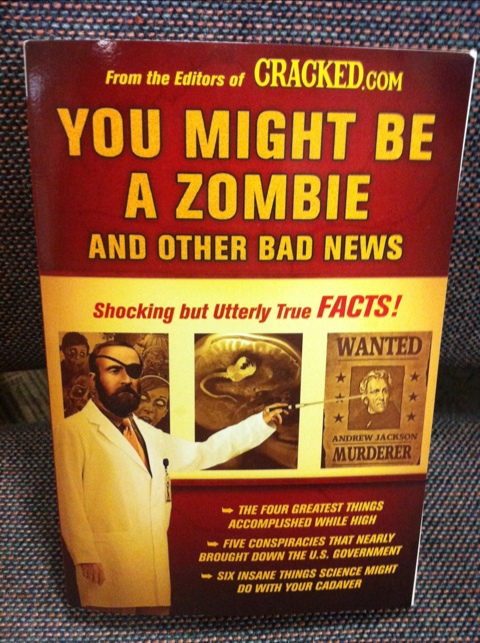
You Might be a Zombie Book giveawayI haven’t forgotten about all the giveaways I promised! You still have time to enter these giveaways – Flipboard T-Shirt, the Will it Blend? DVD, the Square device, the Delivering Happiness Book, and the Eyeballs Out book.  I will select the winners near the end of the month.

Now you have a chance to win You Might be a Zombie and Other Bad News from the editors of Cracked.com.  The book is rated 4.5 stars on Amazon.com, and appears to be a great book.  I just don’t have time to read it and wanted to give it away to one lucky reader of this blog.

To enter, simply click the comments link at the top of this post and make a comment.  Make sure to include your email address so I know how to contact you to send you the book.

Good luck and thanks for reading.  Keep an eye out for more giveaways to  come!

Augmented Reality for Marketers

Presenters: Lynne D Johnson – R/GA, John Havens – Porter Novelli
Hashtag: #arsxsw

There’s been a lot of talk over the last few years about augmented reality (AR), and the increasing adoption of smartphones and portable devices has accelerated predictions about its possibilities.  In fact, Juniper Research expects global revenue of AR to reach $1.5 billion in 2015.  Much of this is currently being driven by location based apps.  Those which have been successful for consumers have focused on utility and ease of use, and marketers have used it successfully for awareness and tracking ROI.

There are many, many different things that qualify as AR on this spectrum:

<–  SMS/QR codes – Web/Hologram – Location-Based – POS – Real World Applications –>

Here are a few examples of these types of AR:

QR Codes,  Webcam/Holigram example  – Dabs Acer Augmented Reality ad, Tissot watches (experience of how watch would look on you, and in store sales of watches grew by 85%), Location based examles: Le Bar Guide, Quiznos Layar, Yelp Monocle, Ebay Classifieds, Point of Service example with Legos Kiosk.

In order to move beyond the hype, AR must move beyond simple experimentation, gimmicks, and unnatural behaviors to things that are more useful, natural, and have advanced utility.  We’re only now moving toward real world applications that make life easier and will ultimately increase its adoption.  Examples include Google’s GogglesWord LensBMW’s extension of reality for mechanics, Converse Sampler App (try shoe on virtually to see how it looks), and General Motors augmented reality windshield.

Right now, augmented reality is limited to certain devices, however, as it matures, and people see the utility in it and begin to view it as a virtual “GPS” for their lives, the next step are glasses, contacts, and eye tracking cameras that provide facial recognition.   Examples of things people already see this type of value in includes displaying nutritional information about food at restaurants and in dating – displaying web information about a person using facial recognition.

You can imagine that these types of things bring up interesting concerns, from individual privacy to “virtual air rights.”  The virtual air rights are a concern because, as the world around you is literally manipulated, it must be determined who can put what, where.  For example, can Pepsi pay to literally prevent you from seeing Coke machines?

Other interesting visions of what the future holds inlcudes:

TagWhat Augmented Reality network – lets you tag the virtual world, creating a virtual scrapbook at locations for you or your friends.

Virtual graffiti (seen here)

Bump (the iPhone app) – The next phase is to automatically send your information to other people in the same room, based entirely on certain criteria, such as their number of twitter followers.

Checking into products – Such as Stickybits – Illustrates that community management goes beyond online and into the world of virtual reality – listening to what consumers are saying in this new place.

Products checking in to you, through Facebook sponsored stories

Kraft – Anonymous Video Analytics (AVA) – At the point of purchase, the machine looks at you, estimates your age, sex, health, etc, and provides you with a unique ad/offer based upon your estimated demographics.

Activity Interference –  Jon Froehlich, at the University of Washington uses a microphone in the ear to detect when you are eating (with 99% accuracy).  He uses it to pick up on eating patterns and health, but this could be used in the future to help you track your eating habits, or even sound an alarm when you eating when you aren’t supposed to.

Facial recognition – allows you to see more information on the people you are with.  For example, Viewdle is a facial recognition program that shows you the most recent tweet, Facebook post, etc. of the people you are with.  It lets you identify who you may want to talk to in a social context, or in a business context, screen the people you are around to get more information on them.  Similarly, some companies are giving Facebook and Twitter credibility scores (such as Klout), which could allow you to scan the influential people in the room.

This same technology lets police now scan a crowd with a phone and see, through a tag in their phone, who the former criminals are in a crowd.  It’s good because it allows police to find people with a criminal history quickly, but bad because of potential implications of viewing – or blocking – people.  For example, a person might choose to not view any homeless people laying on the street, changing their perspective on the world.

As mentioned earlier, there are definite concerns with virtual air rights and virtual advertising rights.  For example, Bing can block out existing advertising and resell the rights to those ad spaces within their Streetview platform.

As you can see, the world of augmented reality is incredibly interesting, and it will only be a matter of time before we see the tipping point on many of these cutting edge technologies.


Unwritten Rules: Brands, Social Psychology and Social Media

Presenters: Ben McAllister – Sr Strategist, frog design, Kate Canales – Creative Director, frog design

3 types of relationships

1. Authoritative

2. Exchange – Look at what’s fair

3. Communal – open, not concerned with what’s fair

Theory is that these are separate, but in reality, these all overlap a bit.

If you don’t navigate it right it’s awkward

Each has its own rules, and it’s awkward if you don’t know what type of relationship you’re in or what balance do you have.

Which are you going to follow?

You’re boss says, it would be great if… (several things going on in that statement)  Authoritative, yet trying to make it a different type of relationship

Stephen Pinker book quoted

Online, this all falls apart.  Social media makes all of these relationships communal… so when brands get into this space, it’s awkward… mainly because we’ve always interacted with brands in a transactional manner.  A lot of brands are there for self promotion, so that makes it awkward.  You can’t be friends with a brand, but you can have a relationship that’s meaningful

How do brands make the transition from exchange to communality?

Brand building through behavior.  Humanizing brands through interactions

1 pull back the curtain – give access – example best buy twelpforce

2. stop selling and start sharing – self promotion is awkward – violating rules of the space -sharing not just own content but others’ as well – sharing conversations

3. stop talking and start listening – lot of concern about whats going out, but not about whats coming in – use this info – the stakes don’t have to be high to do something meaningful

Unwriten rules of social media:
– rules of communality – brands need to abide by rules of this type of relationship

what are you going to bring to the partry?

healthcare facility – they can’t necessarily give advice – so they did a video series with a couple doctors having conversations about topics – there may not be a clear cut answer


Tags

Related Posts

Share This