
How to Personalize Without Being Creepy
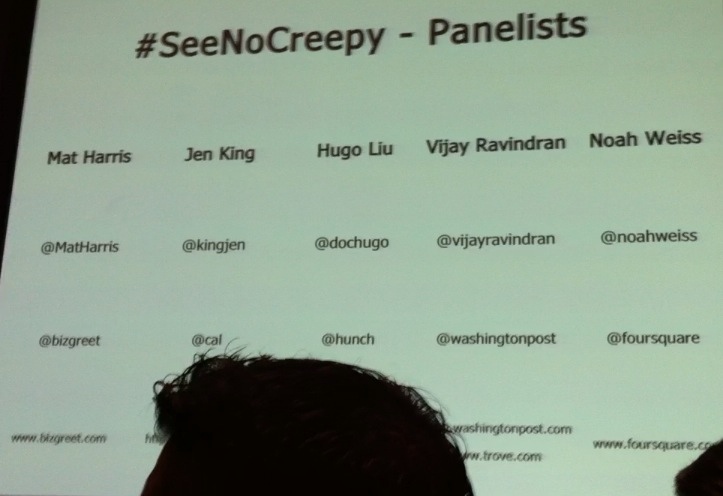
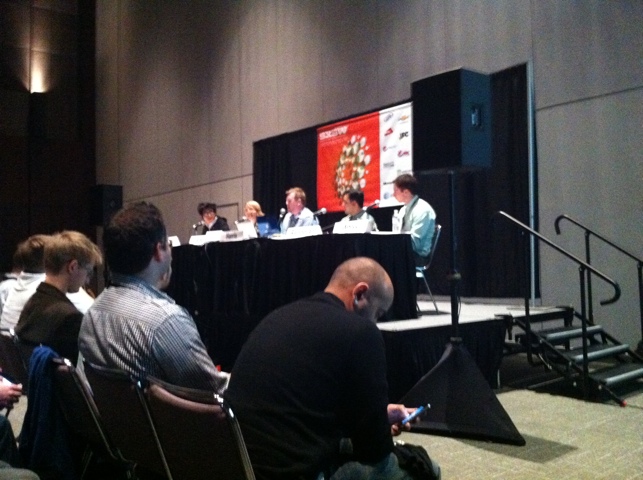 Panel: Hugo Lin – Hunch, Jen King – PHD UC-Berkeley, Mat Harris – BizGreet, Vijay Ravidran – Washington Post, Noah Weiss – Foursquare
Hashtag: #SeeNoCreepy
The point of personalization is to put something more relevant, and therefore more delightful in front of you. In the opinion of the panelists – “Life is too short, and time is too valuable, to have something random/irrelevant in front of you.” However, there’s a fine line between giving you something you might like to see and knowing more about you and your habits than you want a website or company to know.
All of the panelists agreed that personalization is a dialogue you have with the user. It’s asking what information you’d like to have as a marketer, and letting the user decide what they want to share. Marketers have to also be transparent about why they are asking and set clear expectations about how they’ll use this information. In addition, you have to give the user control to decide if they want to withdraw that information or permission they’ve given you. “It’s like remembering to put fire exits in a building,” said one panlist. “Would you build a building without fire exits? Essentially that’s what you’re doing without an open, obvious exit for users.”
 Similar to Philip Kaplan’s beliefs in Getting People to Share Information at the Social Business Summit a couple days earlier (but not as extreme), the panelists believe that people are more willing than ever before to share information – especially if they know what benefit they’ll get from it. “Free isn’t free” said one panelist. “People know that they’re paying with their data.”
The WashingtonPost.com has been focusing on customization, and there’s a subtle difference between customization and personalization. Customization lets users choose what they want to see across a long tail of information, while personalization – implicitly or explicitly – takes the users information and automatically uses it to drive the customer experience.
Different than both of these is the idea of targeting – mostly advertising that appears in these locations. It’s effective because most users want information that is of value to them, and it’s a win-win for the customer and marketer. However, what makes it “creepy” is when it’s exposed that over 700 pieces of data about you, your family, web use, etc. may have gone into targeting you. As one panelist put it – “If you feel like, ‘I don’t want to have to explain that,’ you probably shouldn’t be doing it.” This is becoming an increasingly hot topic as many services, such as Facebook, have started using social validation, or adding your friends’ information to make recommendations to you.
 Additionally, marketers must consider the context in which their message or brand is being presented. In social media, the terms “Like” and “Follow” have taken on some interesting meanings. Unprovoked “following” of a user by a brand is almost as creepy as asking a user to “like” hemorrhoid cream on Facebook.
One suggestion is to understand the user experience so well, that the personalization is seen as a benefit. For example, YouTube recently created an algorythm for serendipity. Not only do they recommend videos that they think you’ll like (based on your other viewing), but they’ll now show you interesting videos that none of your friends have seen – Letting you be the first one one of your friends to send on that next viral video. This insight came from a YouTube focus group, and has been one of their most successful tools.
More than ever, it’s time for marketers to consider the impact of actions that appear “creepy” to the consumer. The FTC has said that targeted marketing raises “Questions of human dignity,” and have suggested the potential for a “do not track” list online.
Tags
Related Posts
Share This




 Subscribe via email