I take it back Chromecast, I hate Comcast

downloadLast year, I wrote a post about the announcement that HBO was incorporating Chromecast into their app. I’d like to say that, to an extent, I take back. I own 2 Chromecasts, and I wish more apps had casting capabilities.

What I’ve found is the major flaw, are the licensing agreements networks have with the cable companies. Unfortunately, it’s nearly impossible to watch most major network programming without a subscription to a cable or dish service.

I look forward to the day when I can subscribe to individual shows or networks, instead of having to go through an intermediary like a cable company. It’s amazing in this day in age – when technology is eliminating so many intermediaries, particularly in the retail space – that companies like these aren’t just surviving, but thriving.

When I moved into a new home this summer, we attempted to “cut the cord” and only have a Comcast cable internet subscription (they thew in basic cable & HBO free for a year). After trying an Apple TV and a few other devices, I settled on 2 Chromecasts, a Roku, and 2 XBox 360s for our 3 TVs. What’s unsettling is that even if you subscribe to Comcast, they prevent you from using their services (and the networks, like HBO, you subscribe to through them) on pretty much everything but the XBox (they can’t stop the Chromecast, but do prevent viewing their channels on Roku, Apple TV, etc.).

I apologize to Chromecast for my ignorant remarks, as I now wish even more networks (read this ESPN, AMC, A&E, Discovery, HGTV, and others) enabled Chromecast on their apps. I realize now that it’s Comcast and the other cable/dish providers that are really the ones preventing progress in the entertainment space.

Indiegogo Kreyos Smart Watch Disaster

kreyos-meteor-smartwatchLast year, I wrote a blog post entitled, “Kickstarter Buyer Beware,” and I talked about the delays with two projects I backed on crowdfunding platforms – The iExpander and the the Kreyos smartwatch.  I won’t go into detail here on the iExpander, but a year after the post and 2 years since the Kickstarter campaign… I still don’t have an iExpander. I thought I’d give you an update on the Kreyos smartwatch I tried funding via Indiegogo.

Much like other campaigns, it started with the announcement of a few delays… and then a few more. However, the folks at Kreyos were pretty good about showing video of their prototypes in action. So, my confidence in it was building… until it came completely crashing down when they finally announced they were shipping the device.

The creators of the device posted a long blog post about how it all came crashing down, but here’s how I managed to narrowly avoid an $175 loss:

There were not signs of issues with the smartwatch when it started shipping – other than the fact that the shipping was extremely disorganized (but that was no surprise for a startup).  I was disappointed, because I moved this summer, and they shipped it to my old address. I was told by their terrible customer service (again, I thought this wasn’t too big of a deal, since they were a startup) that I’d have to wait for the watch to get declined by the new owners of my home, returned to Kreyos, and then it could be shipped to my new address.

At first, there seemed to be a lot of complaints about people not receiving the correct items. Again, I thought this wasn’t too big a deal, since the startup was using incompetent Chinese labor. Then, people began complaining about how the watch was taking on water simply from showering (it was supposed to be completely waterproof, which they revised to say it would be waterproof to 10 meters). Then everything came completely crashing down and the company completely folded up with the blog post I referenced earlier.

It appeared that Indiegogo immediately backed away from the problem, stating that they were essentially just an intermediary. It made me want to boycott Indiegogo completely. I still hadn’t received my Kreyos, so I contacted my credit card company and disputed the charge from Indiegogo. Since I never received the item, my credit card company removed the charge (except for the PayPal surcharge – but being out $5, is better than being out $175).

Again, I urge you to avoid these sites. No matter what kind of discount I might receive for funding something on Kickstarter or Indiegogo, it simply isn’t worth the risk of the item coming out late, faulty, or never at all. I think there’s a place in the market for a crowdfunding site that has more oversight and insurance from such issues… and hope one comes out soon. As for me, from now on, I’m going to wait until a product hits the open market and is tested before I buy.

How to Personalize Without Being Creepy

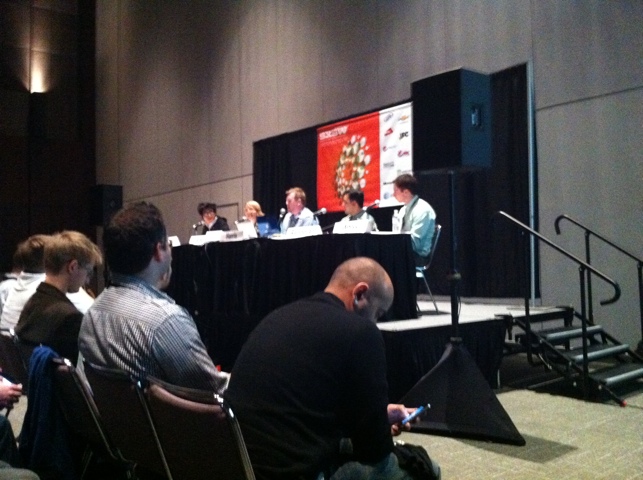
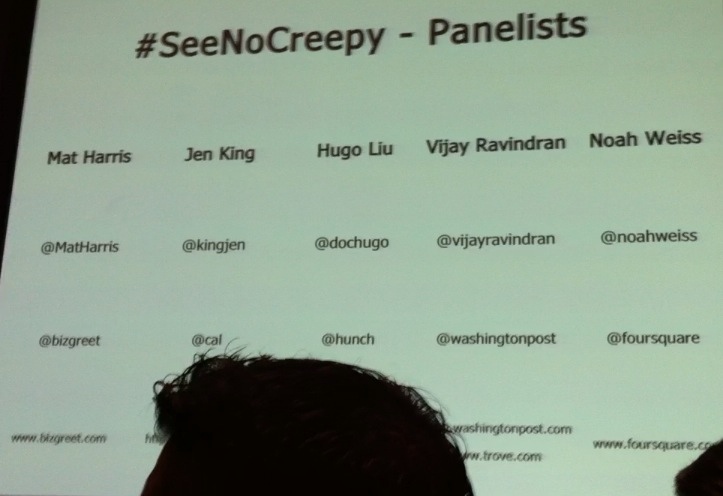
#seenocreepy panel SXSWPanel: Hugo Lin – Hunch, Jen King – PHD UC-Berkeley, Mat Harris – BizGreet, Vijay Ravidran – Washington Post, Noah Weiss – Foursquare
Hashtag: #SeeNoCreepy

The point of personalization is to put something more relevant, and therefore more delightful in front of you. In the opinion of the panelists – “Life is too short, and time is too valuable, to have something random/irrelevant in front of you.” However, there’s a fine line between giving you something you might like to see and knowing more about you and your habits than you want a website or company to know.

All of the panelists agreed that personalization is a dialogue you have with the user. It’s asking what information you’d like to have as a marketer, and letting the user decide what they want to share. Marketers have to also be transparent about why they are asking and set clear expectations about how they’ll use this information. In addition, you have to give the user control to decide if they want to withdraw that information or permission they’ve given you. “It’s like remembering to put fire exits in a building,” said one panlist. “Would you build a building without fire exits? Essentially that’s what you’re doing without an open, obvious exit for users.”

Personalize without being creepySimilar to Philip Kaplan’s beliefs in Getting People to Share Information at the Social Business Summit a couple days earlier (but not as extreme), the panelists believe that people are more willing than ever before to share information – especially if they know what benefit they’ll get from it. “Free isn’t free” said one panelist. “People know that they’re paying with their data.”

The WashingtonPost.com has been focusing on customization, and there’s a subtle difference between customization and personalization. Customization lets users choose what they want to see across a long tail of information, while personalization – implicitly or explicitly – takes the users information and automatically uses it to drive the customer experience.

Different than both of these is the idea of targeting – mostly advertising that appears in these locations. It’s effective because most users want information that is of value to them, and it’s a win-win for the customer and marketer. However, what makes it “creepy” is when it’s exposed that over 700 pieces of data about you, your family, web use, etc. may have gone into targeting you. As one panelist put it – “If you feel like, ‘I don’t want to have to explain that,’ you probably shouldn’t be doing it.” This is becoming an increasingly hot topic as many services, such as Facebook, have started using social validation, or adding your friends’ information to make recommendations to you.

personalize without being creepyAdditionally, marketers must consider the context in which their message or brand is being presented. In social media, the terms “Like” and “Follow” have taken on some interesting meanings. Unprovoked “following” of a user by a brand is almost as creepy as asking a user to “like” hemorrhoid cream on Facebook.

One suggestion is to understand the user experience so well, that the personalization is seen as a benefit. For example, YouTube recently created an algorythm for serendipity. Not only do they recommend videos that they think you’ll like (based on your other viewing), but they’ll now show you interesting videos that none of your friends have seen – Letting you be the first one one of your friends to send on that next viral video. This insight came from a YouTube focus group, and has been one of their most successful tools.

More than ever, it’s time for marketers to consider the impact of actions that appear “creepy” to the consumer. The FTC has said that targeted marketing raises “Questions of human dignity,” and have suggested the potential for a “do not track” list online.

Augmented Reality for Marketers

Presenters: Lynne D Johnson – R/GA, John Havens – Porter Novelli
Hashtag: #arsxsw

There’s been a lot of talk over the last few years about augmented reality (AR), and the increasing adoption of smartphones and portable devices has accelerated predictions about its possibilities.  In fact, Juniper Research expects global revenue of AR to reach $1.5 billion in 2015.  Much of this is currently being driven by location based apps.  Those which have been successful for consumers have focused on utility and ease of use, and marketers have used it successfully for awareness and tracking ROI.

There are many, many different things that qualify as AR on this spectrum:

<–  SMS/QR codes – Web/Hologram – Location-Based – POS – Real World Applications –>

Here are a few examples of these types of AR:

QR Codes,  Webcam/Holigram example  – Dabs Acer Augmented Reality ad, Tissot watches (experience of how watch would look on you, and in store sales of watches grew by 85%), Location based examles: Le Bar Guide, Quiznos Layar, Yelp Monocle, Ebay Classifieds, Point of Service example with Legos Kiosk.

In order to move beyond the hype, AR must move beyond simple experimentation, gimmicks, and unnatural behaviors to things that are more useful, natural, and have advanced utility.  We’re only now moving toward real world applications that make life easier and will ultimately increase its adoption.  Examples include Google’s GogglesWord LensBMW’s extension of reality for mechanics, Converse Sampler App (try shoe on virtually to see how it looks), and General Motors augmented reality windshield.

Right now, augmented reality is limited to certain devices, however, as it matures, and people see the utility in it and begin to view it as a virtual “GPS” for their lives, the next step are glasses, contacts, and eye tracking cameras that provide facial recognition.   Examples of things people already see this type of value in includes displaying nutritional information about food at restaurants and in dating – displaying web information about a person using facial recognition.

You can imagine that these types of things bring up interesting concerns, from individual privacy to “virtual air rights.”  The virtual air rights are a concern because, as the world around you is literally manipulated, it must be determined who can put what, where.  For example, can Pepsi pay to literally prevent you from seeing Coke machines?

Other interesting visions of what the future holds inlcudes:

TagWhat Augmented Reality network – lets you tag the virtual world, creating a virtual scrapbook at locations for you or your friends.

Virtual graffiti (seen here)

Bump (the iPhone app) – The next phase is to automatically send your information to other people in the same room, based entirely on certain criteria, such as their number of twitter followers.

Checking into products – Such as Stickybits – Illustrates that community management goes beyond online and into the world of virtual reality – listening to what consumers are saying in this new place.

Products checking in to you, through Facebook sponsored stories

Kraft – Anonymous Video Analytics (AVA) – At the point of purchase, the machine looks at you, estimates your age, sex, health, etc, and provides you with a unique ad/offer based upon your estimated demographics.

Activity Interference –  Jon Froehlich, at the University of Washington uses a microphone in the ear to detect when you are eating (with 99% accuracy).  He uses it to pick up on eating patterns and health, but this could be used in the future to help you track your eating habits, or even sound an alarm when you eating when you aren’t supposed to.

Facial recognition – allows you to see more information on the people you are with.  For example, Viewdle is a facial recognition program that shows you the most recent tweet, Facebook post, etc. of the people you are with.  It lets you identify who you may want to talk to in a social context, or in a business context, screen the people you are around to get more information on them.  Similarly, some companies are giving Facebook and Twitter credibility scores (such as Klout), which could allow you to scan the influential people in the room.

This same technology lets police now scan a crowd with a phone and see, through a tag in their phone, who the former criminals are in a crowd.  It’s good because it allows police to find people with a criminal history quickly, but bad because of potential implications of viewing – or blocking – people.  For example, a person might choose to not view any homeless people laying on the street, changing their perspective on the world.

As mentioned earlier, there are definite concerns with virtual air rights and virtual advertising rights.  For example, Bing can block out existing advertising and resell the rights to those ad spaces within their Streetview platform.

As you can see, the world of augmented reality is incredibly interesting, and it will only be a matter of time before we see the tipping point on many of these cutting edge technologies.


Outsource Social Media?

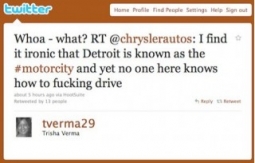
This wasn’t necessarily a presentation I attended at iMedia, the Social Business Summit, or SXSW, but among the many brand people I got to meet, it was an extremely hot topic of discussion.  The discussion was further fueled by something that happened the day before the Social Business Summit.  If you hadn’t seen the news, an employee from a company called New Media Strategies, accidentally dropped an f-bomb on behalf of their client, Chrysler’s twitter account.  As you can imagine, the employee was immediately fired and Chrysler let the agency go the following day.

Many of the brand people I met worked in various parts of the company, and something mentioned in the Ad Age article about the incident sparked a lot of discussion…

Turf battles over social media between marketing and communications have been an issue at the automaker — and other companies — for a few years. Early in the day after the tweet went out, Chrysler’s communications team was grappling to get hold of the details of the episode after bloggers and media began calling, in part because Chrysler’s marketing department controls Facebook and Twitter social-media accounts that are “consumer facing.” The communications department has separate Twitter, Facebook, YouTube and Flickr accounts that are meant to be “media facing.”

Many companies say the divide only serves turf and budget wars, not the brands. “All that has blurred, so it’s critical for communications and marketing to be coordinating and cooperating all the time,” said Stuart Schorr, VP-communications and public affairs at Jaguar-Land Rover North America. One of the issues creating the turf war, he noted, is which department gets the budget.

What I think we all discovered was social media is something that can’t be fit into a traditional box, as it has blurred the lines between paid and earned media, marketing and customer service, as well as transactional versus relational communications.  I’m not sure anyone has figured it out, but everyone expressed frustration about how this confusion was causing issues within their companies  (like the ones mentioned above).

The general perception is that social media is “cheap,” because sites like Twitter, Facebook, and YouTube don’t necessarily charge you to be there.  However, in order to do it right, you have to invest first in listening to conversations about your brand and industry… which isn’t easy, when there are over 1 billion tweets per week, 1 billion Facebook messages posted per day, or the 24 hours of video uploaded to YouTube every minute.  Imagine the resources it takes just to do this… and if you want to respond to any of these messages, that takes more resources – and as pointed out above, multiple resources across functions/silos.

Hopefully you can agree, at the very least, it takes a large amount of time and organization.  Generally, brands are already heavily committed to traditional media – and spending money to outsource this work to traditional media agencies – because the “push my message through a one-to-many framework” has been in place for so long.  Even more important, leaders aren’t yet prepared to organize new internal communications structures to deal with a “new” media which requires one-to-one relationships.

In the meantime, there are certain to be many, many more ethical debates (like this one – Should You Outsource Social Media?) about whether or not you should hire someone to manage customer relationships in social media on your behalf.  Please tell us what your take in this debate is by commenting on this post.

Real Time Marketing

Presenter: Shiv Singh, PepsiCo
This was easily the best and most practical presentation of the day, providing a very clear outline for building a company structure to take advantage of a real-time environment.  The recent revolution in in Egypt highlighted the power of real-time communication and timeliness of information. Businesses can utilize social media for real time marketing, but there are six elements that need to be in place to execute effectively:

  • Real-time Insights – It’s most important to be aware and know what your customers are thinking and doing in real-time.  The listening tools must be in place to provide a stream of updates.
  • Real-Time Response – When you know what your customers are saying, you need to be in a place to act immediately.  A response only has meaning if it’s timely, so having staff who can respond in real-time provides an answer or response immediately.
  • Real-Time Content Studio – Not only do you need to be able to respond immediately, but you need content and creative experts organize to be able to produce content in the moment.
  • Real-Time co-creation – We can work together within the organization and with the consumer to develop the message and let it evolve.
  • Real-Time Distribution – As a brand, the tools should be there to allow you to talk directly to consumers without having to go through your agency or a middle-man.
  • Real-Time Engagement – Interacting and engaging with customers in real time creates engagement and trust.

All of this fits within a pop culture frame, meaning an awareness of the environment and what’s going on in the world at that moment.  The way we think and process information is changing, and new media technologies are literally addictive says psychologist Susan Weinschenk, fueling a “dopamine induced loop of seeking behavior and instantanious reward.”

There are 30 billion Facebook updates a month and a brand’s marketing message is competing for attention with all those status updates.  Therefore, brands need to think like a content company, regularly producing relevant content that cuts through the clutter.  During fashion week, Pepsi launched its new skinny can with a campaign called “Get the Skinny.”  During fashion week, they set up a content center for information on culture and fashion, essentially acting as a small news organization for the week.  It resulted in over 90,000 new Facebook fans and a large amount of engagement online with the brand.

Brands must be aware of culture and what the general public is thinking in order to take advantage of real-time opportunities.  During the BP disaster in the Gulf, Pepsi took the opportunity to expand the Pepsi Refresh Project.  They decided to give away and extra $1.3 million to fund reat ideas to help fund Gulf communities.  Because they were structured as outlined above, within a couple days, they got the idea, had it approved, and launched the site.  The next phase of the Pepsi Refresh Project will take advantage of consumer generated videos, allowing organizations who would like the grants to make a case to consumers via video.

Overall, in order to make this happen, Singh suggests that all of the following are needed to make it happen

  1. Be able to ride “glocal” culture trends as they’re shaped by consumers.  Your company must be organized to communicate in real time, both on a global and local basis.
  2. Target your brand loyalists and let them spread your message, but to do so you need to know who they are and have a relationship with them.
  3. The ability to engage in real-time, meaningfully.  It’s about engagement, not just broadcasing your message, but if you’re able to do so, your message will be amplified by others.
  4. Have a content studio to operate as a media organization in real-time.
  5. Build your own distribution network.
  6. Organize to be able to go from strategy to execution in seconds.
  7. Don’t limit this to digital – make everything addressable, targeted, and instant.
  8. Acknowledge real-time marketing has no geographic boundaries.

I got a question via twitter from @kellythul who asked what KPIs or metrics Singh utilizes for measuring success.  Singh suggested something he helped to develop while at Razorfish – the SIM Score.  The SIM Score for a brand is the ‘Net Sentiment’ for that brand in social media divided by ‘Net Sentiment’ for the industry.  Net Sentiment is defined by Razorfish as “Net Sentiment for the Brand = (Positive + Neutral Conversations – Negative Conversations) / Total Conversations for the Brand.”  He suggested looking at your real time score and comparing it to competitive brands within your industry.  He says that he has definitely seen a correlation with changes in SIM score and sales, mostly in CPG type industries.


Only Empowered Employees Can Serve An Empowered Customer

Presenter: Josh Bernoff, Forrester

In his new book, Empowered: Transformed by Social Technologies, he talks about the importance of enabling your HEROs, because only an empowered worker can serve and empowered customer – can’t run company top down anymore.  HERO stands for Highly empowered and resourceful operative.

The sales funnel has been extended, and it no longer ends with customers.  Here’s the new flow – Eyeballs -> Awarness -> consideration ->preference purchase -> Customers -> Supported ->Empowered -> Delighted -> Fan -> Broadcaster – the message then goes to others and starts over again.

Social participation has grown, which only highlights the importance and impact of this new model:

Year Creators Conversationalists Critics Collectors Joiners Spectators Inactives
2007
18%
25%
12%
25%
48%
44%
2010
23%
31%
33%
19%
59%
68%
19%

Bernoff believes there are four technologies empowering consumers: Smart mobile devices, Social technology, Pervasive video, and Cloud computing services.

How frequently do people tell others about products and services?  They looked at various social media and counted how often people told others about a product or service they were using.  They found 500 billion impressions, and during the same time period, total advertising impressions were 2 Trillion.  That means social media had 1/4 of the total number of impressions about products and services.  Which impressions do you think had more of an impact – referrals from friends and others on social media or advertising messages?

We need to start to treat our customers as a channel – they are another group which share our message.  The process for accomplishing this is – IDEA: Identify your mass influencers, Delivering groundswell customer service, Empowering with Mobile Information, and Amplifying fan activity.  Identifying the influencers is important because a small percentage of people control 80% of the influence online.  Delivering groundswell customer service requires reaching out and engaging in social media channels, such as Best Buy’s Twelpforce.  This requires empowered employees who can directly respond to customers. Empower people with mobile information, as the use of immediate information is most important.  Amplifying fan activity means enabling your fans to share their messages with others.  He used an example of a highly regulated health industry providing a way for customers to share their own testimonials on their site.

How do you run your organization to make this work? 3 groups that have to work together:

  1. HEROs – know customer needs, use tech to serve customers, operate safely
  2. Managers – Make innovation a priority, support Heros, work with IT to manage risk
  3. IT dept  – Support Heros with technology, scale up solutions, provide tools to manage risk

You must embrace these new technologies, because HEROs will find a way around your controls.  A recent study showed that despite blocking technologies employees said this, they:

– use smartphone for work – 8%
– Download and use apps on work comp – 12%
– use tools to find access to blocked sites while at work – 27%

Resistance is futile, spend your time empowering your employees.  This requires encouraging experimentation, committing to collaboration systems, and using tools to share best practices across the company.


10 Things I Learned (or re-learned) at SXSWi 2010

Last year was my first SXSW and nothing short of a personal epiphany. This year’s Austin mashup of technology, creativity, and cultural tsunami has once again shifted the way I think about what it all means— to my work and to my life:

10. Crisis = Opportunity.
How do we take advantage of the disruptive innovation that’s toppling business models? Jeremy Gutsche is the founder of TrendHunter.com, the world’s largest network for trend spotting and innovation. He’s also the author of, “Exploiting CHAOS: 150 Ways to Spark Innovation During Times of Change.” There’s one question from Jeremy that I’m now asking myself every day; a question designed to help capitalize on chaos: Can I focus what I’m trying to do in seven words or less?

9. Technology is the new art. 

The notion of left brain/right brain is passé. My ability to adapt and thrive at the intersection of art and technology presents endless opportunities. My insistence on playing on one side, to the exclusion of the other, is an express ticket to irrelevance. What can I do to recast my skills and be ready for whatever comes next?

8. Be a student of “The Next Big Thing.”
Then, step back and see the big picture. There’s a “next big thing” breaking out every day. Great branding and communication isn’t about throwing stuff at every next big thing. It’s about being helpful, relevant, and genuine in the marketplace. I need to understand the difference between “thin value” and “thick value” and do the right things to be relevant every day, while strengthening value over the long haul.

7. Content is king.
So why has it taken us so long to figure out that content requires user-centered message architecture? According to Margot Bloomstein, the principal of brand and content strategy consultancy based in Boston, a comprehensive user experience shouldn’t be a carrot on a stick where we try to lure people to our content on our terms. It should be a big, delicious plate of cookies carefully crafted ingredient by ingredient.

6. Words won’t work.
Dan Roam has helped leaders at Microsoft, Wal-Mart, Boeing, eBay, and the United States Senate solve complex problems through visual thinking. He wrote the international bestseller, “The Back of the Napkin: Solving Problems and Selling Ideas With Pictures.” Why do we spend so much time talking to clarify our ideas? The person who draws the best picture wins. My goals: Fewer words. Better pictures. Stronger stories.

5. I didn’t know Twit.
Twitter is my primary news source. The shape, speed, and value of information on Twitter is unlike anything we’ve ever seen. At SXSW, Twitter co-founder and CEO Evan Williams changed the way I think about it. The No. 1 company principle @twitter? Be a force for good. Why? Democratization of information changes the world. Tools like Twitter reach the weakest signals and can have profound impacts (think Haiti, Chile). Easy exchange of information gives people control. Everyone wins.

4. Corporate America is cautious.
Andrew McAfee is a research scientist at the Center for Digital Business, MIT Sloan School of Management. He researches and works extensively with corporations around the “2.0” model of communities, collaboration, and transparency. According the McAfee, the biggest corporate mindset challenges to embracing 2.0: We are risk-averse, busy, budget-constrained, uninterested in social revolution, hostile to auto-obsolescence, ROI-seeking, and overly convinced of our own uniqueness.

3. There’s no such thing.
There’s no such thing as social media or social marketing. It’s media. It’s marketing. It requires interesting, clear, helpful, user-focused content like it always has. There’s no such thing as Web content, mobile content, tablet content, Wii content. Everything is converging and users just want it to work and work right everywhere.

2. Technology = inclusion.
I tweeted. I posted. I photo’d. I video’d. I checked in. Got followed. Got retweeted. Direct messaged. Played contact and conduit. This is where I belong … with one foot inside the office and one on the path to the future of media.

1. After living in the future for five days at SXSW, I need to ask more questions:

  •  What are the right levers for change?
  • How do we create the right measurements of success?
  • What can I do to help solve problems, not solve symptoms?
  • How do I help strengthen our resolve as communication consultants that “less bad” is not the same as good?
  •  What can I do to help move the friction of process to real momentum and flawless execution?

Every profession bears the responsibility to understand the circumstances that enable its existence.

Tired of “Transparency” Yet?

Ran into Evan Williams while out at SXSW.

During his keynote conversation, Evan Williams, CEO of Twitter (@ev), discussed recent conversations the company was having about its identity.  Like any young company, they are strugging to define their culture and principles.  One thing that resonated with me was his discussion about “transparency.”

We’ve all heard or used the word, probably fairly recently, and we can all agree it’s becoming a bit cliché.  During his discussion, Williams talked about Twitter’s philosophy of not being focused on transparency, but rather openness.  He used the analogy of a door, “It can be transparent and you can see through it, but when it’s open, it’s about getting in, shaping it, and defining it.”

So many, especially brands, struggle to provide “transparency,” and are unwilling to lose control of their brand or message.  As the world evolves, audiences will expect openness (more than just transparency), and they’llhave to let go of a little control to succeed (See “New Rules of Marketing & PR” post about David Meerman Scott’s presentation).

Twitter encourages users and developers to take their APIs and create new things built upon their service.  While they may not be thrilled with all of the uses (Williams noted that they’ve recently sent several cease and desist letters, mostly to Twitter spam services), they know that its been the company’s openness that has allowed it to succeed.  Similarly, it was Facebook’s openess to application developers which also helped it to leave MySpace in the dust and even pass Google as the most visited site on the web.

While most brands are still working on “being transparent,” those who will succeed in this new world will be those who focus on being open.

Brand 2.0

Presenter: Kevin Yam – Directer, mobile and interactive platforms, National Geographic

500-x-BusHomeFew other publications have the longevity of National Geographic, but like any magazine, it has had to adjust to adapt to technological changes and the way that users choose to experience media.  A few years ago, the company looked at all of its media offerings – magazines, tv, games, online, image collection, music, books, films, and maps – and discussed how it could offer that compelling content together across all of that existing media.  As they develop new content, they consider how it could be used (licensing) and how to best tell the story in many different ways.

Developing this led to a heavy focus on user experiences, which forced them to examine the context in which their content was consumed.  With the emergence of mobile, consumers now have immediate access to information and resources, and National Geographic wants to be there with their rich, outstanding content.  This recent led to the development of a Bird Finder app which helps users identify birds (using location information), and incorporates sounds and video.  Additionally the app allows them to “check in” the bird, creating crowdsourced maps of where types of birds have been seen.

They also recently completed a project to tell the story of going to Antarctica – Bus 2 Antarctica.  They used new and social media to help tell the story of, “1 man, 10 weeks, and 10,000 miles,” traveling from National Geographic’s offices to Antarctica.  He kept followers up-to-the-hour on his travels via Twitter (@bus2antarctica), a blog, facebook, an interactive map, and media partnerships with FOX, ABC, and CBS.  The traveler used only an iPhone, still camera, video camera, GPS, and a tracking device to report his stories through all of these media.  It helped to prove they could tell a tremendously compelling story, in real time, for an extremely low cost.  Every brand needs to consider how they can take advantage of new and social media to tell their story or provide brand content.

Geolocation on the “Horizon”

Presenter: Jason Finkelstein, Director of Product Management & Marketing, WaveMarket, Inc.

Geolocation is here, but it’s still got a long way to come (pun intended).  Geolocation started with in-car navigation systems and then moved to personal navigation devices.  Now we’re onto personal location devices that can track you or devices.  The focus of this presentation was on mobile phones.

55% of all SMS messages are “where r u?” – That’s about 650 billion location based text messages in 2009.

We are just starting to see the future of location based services:

Today:

  • Navigation
  • Enterprise tracking
  • Family locator
  • Friend finding
Tomorrow:

  • Checkins and notifications when friends are nearby
  • Facebook widgets
  • GPS-indexed local search
  • Location aware advertising/marketing/couponing
  • Crowdsourced traffic systems
  • Location aware messaging applications
  • Security/Fraud Prevention/Compliance

Location is a feature of many kinds of products and services, not an industry unto itself or a vertical market.

Types of Geolocation Data:

  • Latitude/longitude
  • Latency – how long does it take to find your signal/location
  • Confidence – radius – still not a lot of confidence in cellular tower location
  • Reverse Geocoded (real world address) and Points of Interest – pre-populated locations
  • Location Tagged Info (Tweets, Flickr photos, etc.)
  • Map Data Layers/GIS (This is a whole industry) – City names, street names, street geometry (one way street, speed limits), Satellite/birdseye/terrain

The industry is working on a “Z” (XYZ axis) to be able to track altitude.

Variables influencing ability to get location information from mobile devices:

Carrier Network – different carriers have different kinds of location built-into their networks, this location is accessed in different ways on each carrier network and can vary in accuracy and latency.

Device Type – 200 million mobile subscribers, Most (81.5%) have limited devices which generally don’t have GPS, but can be found. Some (18.5%) have smartphones with GPS built in.

While the use of GPS chips is increasing, if you are planning to develop location based apps today, you must still cater to the 4/5 of people who do not have this functionality.  The value chain for this development is structured like this:

1. Infrustructure players – Do the calculation of where that phone is – Qualcomm, Nokia Siemens Networks, Sony Ericson, Redknee

2. Wireless carriers – AT&T, Sprint, T-Mobile, Verizon – provide the phones and services

3. Location Aggregator – Veriplace – pulls together location data for API tie in by developers

4. LBS Developer/Content – develop the apps and plug-ins

5. End User – uses the device, apps, etc.

However, when GPS is built into the phone, this chain is not completely required.  Apps can then be built to interact with the internal GPS API to utilize location data.

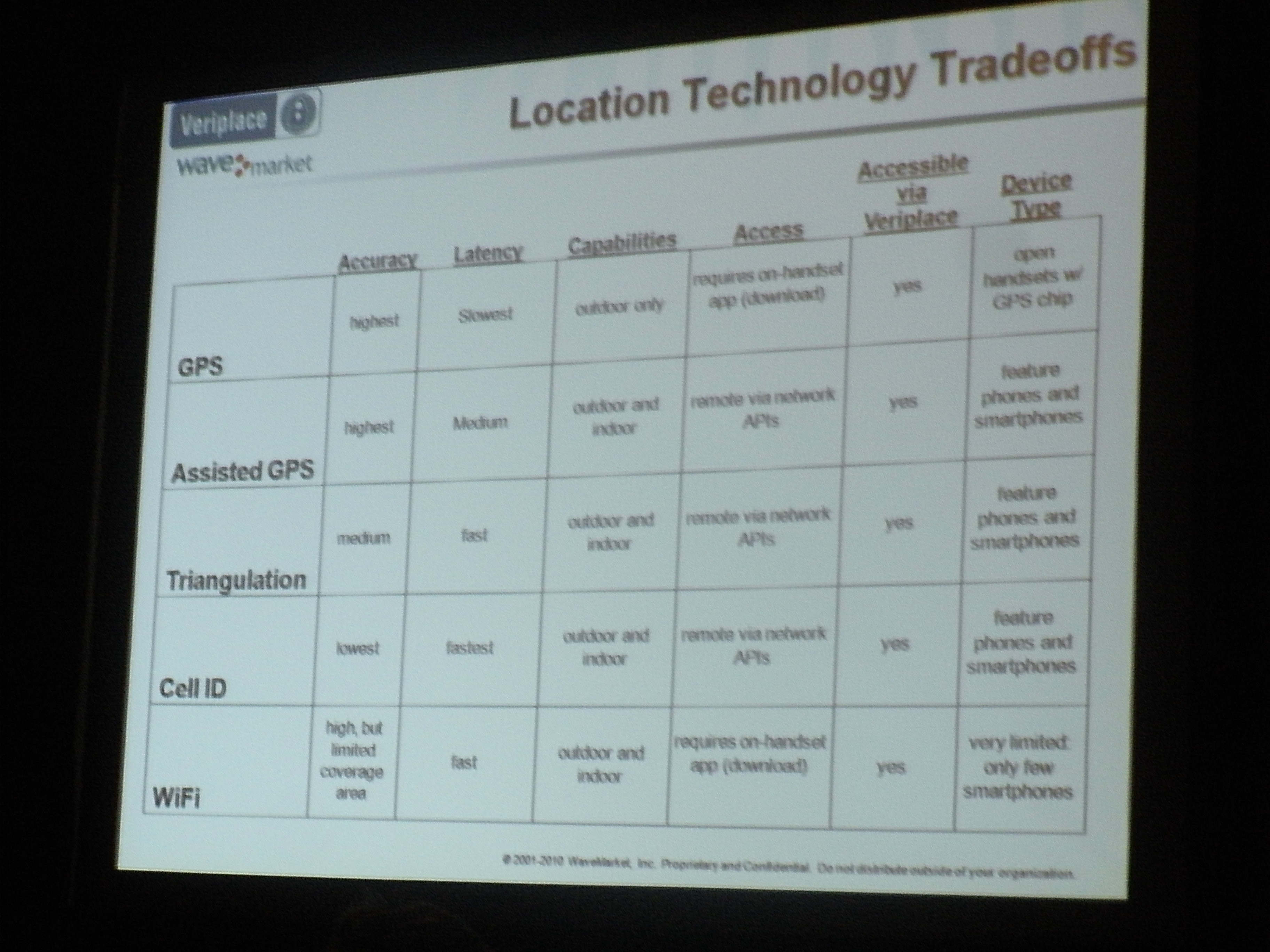
Here are the ways location can be accessed today along with advantages and disadvantages of each:

Standalone GPS – It’s free, uses GPS satellites, so need line of site location.  It’s high accuracy, but it takes a long time to get location (minutes), and some carriers lock the GPS chip.  Download and install an app is still a challange for most people and app developers must develop for different devices.  Also, the app must be running to access location.  It does provide latitude and longitute, which the others don’t.

Cell ID – It depends upon a location database of cell towers.  The phone connects to cell tower and this “location” uses knowledge of where the cell tower is located.  The accuracy of this is lower, but it’s used for both smartphones and feature phones, because it can be located indoors, and has quick location fix (<3 seconds).

WiFi – This also depends on a location database.  It’s similar to Cell ID, but uses MAC addresses on WiFi hotspots – which have limited coverage today.  It can be unreliable due to wifi spots that move. However, if the device has open access to wifi the cost is zero.

Carriers are supporting more location based technolgies on both smarphones and feature phones and sometimes use a combination of the methods above for identifying location:

Assisted GPS – A hybrid of GPS and Cell ID

Triangulation – AFLT – The next level of Cell IDs, it uses multiple Cell ID’s to center a location.  It’s easily accessible via carrier networks and quick  (<10 seconds)

Location is still a challenge for many developers because of this confusing web of networks and the many ways devices can use to find location.  App developers in this area are still sorting through the challenges of location information and authentication and a whole new layer of legal and privacy challenges have arisen.  A recent study showed that people are more concerned about privacy surrounding their location than their credit card data.

Therefore, developer have proceeded forward with a few approaches, such as choosing to focus only on downloadable apps for limited smartphones (iPhone/Android).  Some have made deals with carriers, but there’s a high barrier to entry, so some are working through aggregators like Veriplace to add location to certain app types like sms/voice/web.

Mobile Content is Social

Presenters: Michael Sharon – Facebook , Tom Watson – Facebook, Justin Shaffer – Hotpotato

By itself, mobile devices are immersive – it’s always with you and provides a way for you to exist in a physical or mental place other than where you currently are.  Tools that have been added to those devices have made them “social hubs,” allowing you to connect with others almost anywhere.  There are several things which will continue to evolve to make it even more social.

Friends – Above all, users will tell and demonstrate that this is most important.  However, the debate is what information people want from their friends.  When Facebook changed its mobile friend feed from alphabetized to most recent, it saw an enormous spike in use.  The next debate is figuring out if people want to see the “Top News” or “Most Recent.”  More and more, you’ll see a combination of your Facebook contacts merging with your address book to make sure you have the most updated contact information as well.  Finally, Facebook Connect is even making the gaming experience more social as people can connect games and apps to their friends.

Notifications – There are two types of notifications people are interested in – Active, or what’s happening now, and Passive, or what’s happened since I last checked.  While “push” features make active notifications easier, there’s a fine line between wanted updates and spam.  Therefore, it is extremely important to test this feature before implementation.

Sharing – Facebook knows that people want to share photos (and more and more video and audio).  What has helped this explode has been the speed at which someone can post a photo from a mobile device, and the added ability to “tag” people in photos.  Tagging photos has significantly increased photo viewing as sharing photos becomes a social experience.

Serendipity – The introduction of location based services help you figure out which of your friends is nearby.  This feature has already been implemented by Foursquare, Gowalla, HotPotato, etc.

Discovery – While finding out a friend is nearby is serendipitous, there’s also the potential to discover new people or events.  Mobile offers the ability to do this even better, but what we have yet to see are the privacy implications and the ability to see both your friends and people you don’t know who are nearby (or at the same event).

Control – There has been an explosion in where you can post content.  The same photo/message can be uploaded to Twitter, Facebook, Flickr, YouTube, etc. in the click of a button.  Users want to know how they can decide where to send it, and “take it back” if necessary (which apparently happens WAY more often than you might think).

Intent – Tools need to be designed to elicit the response you’re looking for.  Make it easy to find the way you want people to participate and put it right up front.

Feedback – Commenting provides a cycle of reinforcement and mobile makes this instantaneous.  Feedback is essential, whether it’s comments or Rewards (like Foursquare badges or Gowalla virtual items). Giving somebody something to respond to makes it social.

Mobile becoming more social will be driven by 3 things – Touch, Speed, and Connection

Touch – How it’s designed and what it information it can allow you to share.  An emerging element of touch is a phone that automatically monitors things – temperature, location, weather, altitude, etc.  Things must be designed for the medium (Facebook’s mobile experience diverges significantly from its web experience) and the context in which it will be used.

Speed – Devices are become faster and can do more, but it’s also about the speed of transferring information through networks (getting this information into the cloud and not just onto the device).

Connection – API’s will rule the future.  It’s about connecting all of your networks and information together and allowing the user to determine how/when/what/where/etc. is shared.