Maximize Social Media Success

Deliver digital marketing success: Steps PR professionals can take to maximize social media

Dux Raymond Sy (@MeetDux), PMP Managing Partner, Innovative-e

The presentation started out by talking about the recent “viral” phenomenon of “Gangnam Style” by the Korean artist Psy (if you’re not aware of it, see the video on the right).

We are in a social revolution, whether you like it or not. Here are 4 things that are happening today which will continue to increase:

  • BYOD – Bring your own device
  • Speed of Business
  • Do More w/ Less20121005-112355.jpg
  • Engagement

We’re moving from a transactional era, to one of engagement – it’s not social or traditional, it’s both.

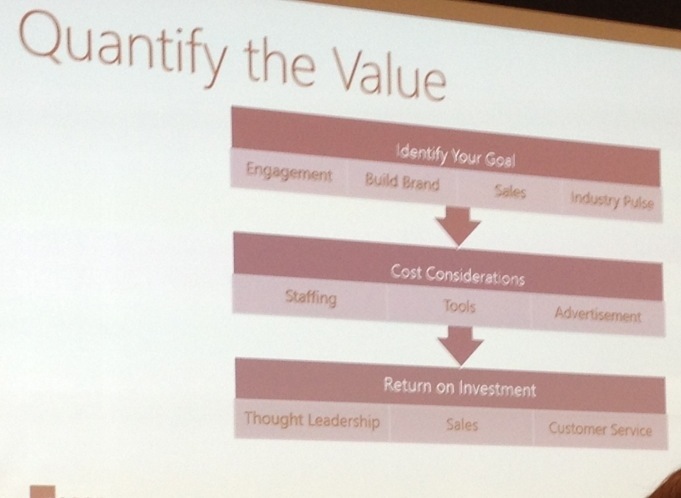
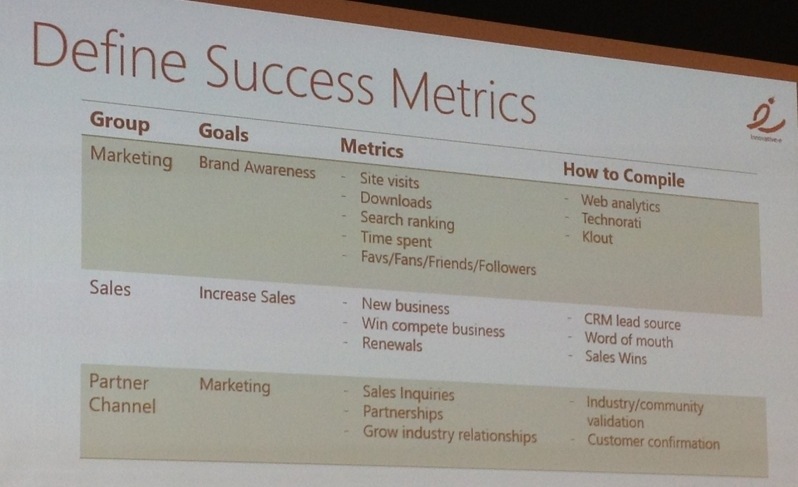
Define success criteria – Quantify the Value by the following steps:

  1. Identify the goal (i.e. engagement, build brand, sales, industry pulse)
  2. Cost considerations (i.e.Staffing, tools, advertisement)
  3. Return on Investment (i.e.thought leadership, sales, customer service)


Then Integrate Business Strategy. (see image at right)

How not to be successful with social

  • Making it a corporate hobby
  • Purely selling vs engaging in social

Consistency is very important

  • It has to be part of your daily business
  • Scheduling social media activities helps a lot

Engagement must be both proactive and responsive.

Utilize Relevant Tools to Integrate and Synchronize:

  • Client apps – Hootsuite, Seesmic
  • Scheduling tools – socialoomph.com
  • Hashtags – Use and monitor these for relevant info.
  • Sharing tools – Bit.ly, RSS feeds (External RSS can feed into SharePoint)
  • Polls – Voting tool that works in PowerPoint – @votebytweet

Amplify

Maximize your “Echo” system – Influence influencers by connecting with them in social media

Big Finish by Dux…

Mobile Social Gaming

Started off the day with a mediocre session about Social Gaming but I left with a few more nuggets that further emphasize the importance of Mobile.  The session provided some good insights into what are some key pieces that make up a successful social game. If you hope to be successful, you need to create resources and drains.  The opportunity to grow revenue lies in providing an opportunity for users to spend. Mobile is of course an important part of social games because…

  • It’s BIG
    • 475 Million –  Worldwide circulation of newspapers
    • 825 Million – Registered Cars
    • 1.8 Billion – Unique Credit Card Holders
    • 2.25 Billion – Tooth Brushes in Use
    • 4 Billion – FM Radios
    • 4.965 Billion – Mobile subscribers
  • It’s PERSONAL
    • 91% of people have their mobile within arm reach 24/7
    • 60% of married people won’t share with their device with their spouse
    • It takes on average of26 hours for a user to report lost wallet, 68 minutes to report a lost mobile phone.

Brand 2.0

Presenter: Kevin Yam – Directer, mobile and interactive platforms, National Geographic

500-x-BusHomeFew other publications have the longevity of National Geographic, but like any magazine, it has had to adjust to adapt to technological changes and the way that users choose to experience media.  A few years ago, the company looked at all of its media offerings – magazines, tv, games, online, image collection, music, books, films, and maps – and discussed how it could offer that compelling content together across all of that existing media.  As they develop new content, they consider how it could be used (licensing) and how to best tell the story in many different ways.

Developing this led to a heavy focus on user experiences, which forced them to examine the context in which their content was consumed.  With the emergence of mobile, consumers now have immediate access to information and resources, and National Geographic wants to be there with their rich, outstanding content.  This recent led to the development of a Bird Finder app which helps users identify birds (using location information), and incorporates sounds and video.  Additionally the app allows them to “check in” the bird, creating crowdsourced maps of where types of birds have been seen.

They also recently completed a project to tell the story of going to Antarctica – Bus 2 Antarctica.  They used new and social media to help tell the story of, “1 man, 10 weeks, and 10,000 miles,” traveling from National Geographic’s offices to Antarctica.  He kept followers up-to-the-hour on his travels via Twitter (@bus2antarctica), a blog, facebook, an interactive map, and media partnerships with FOX, ABC, and CBS.  The traveler used only an iPhone, still camera, video camera, GPS, and a tracking device to report his stories through all of these media.  It helped to prove they could tell a tremendously compelling story, in real time, for an extremely low cost.  Every brand needs to consider how they can take advantage of new and social media to tell their story or provide brand content.

Mobile Content is Social

Presenters: Michael Sharon – Facebook , Tom Watson – Facebook, Justin Shaffer – Hotpotato

By itself, mobile devices are immersive – it’s always with you and provides a way for you to exist in a physical or mental place other than where you currently are.  Tools that have been added to those devices have made them “social hubs,” allowing you to connect with others almost anywhere.  There are several things which will continue to evolve to make it even more social.

Friends – Above all, users will tell and demonstrate that this is most important.  However, the debate is what information people want from their friends.  When Facebook changed its mobile friend feed from alphabetized to most recent, it saw an enormous spike in use.  The next debate is figuring out if people want to see the “Top News” or “Most Recent.”  More and more, you’ll see a combination of your Facebook contacts merging with your address book to make sure you have the most updated contact information as well.  Finally, Facebook Connect is even making the gaming experience more social as people can connect games and apps to their friends.

Notifications – There are two types of notifications people are interested in – Active, or what’s happening now, and Passive, or what’s happened since I last checked.  While “push” features make active notifications easier, there’s a fine line between wanted updates and spam.  Therefore, it is extremely important to test this feature before implementation.

Sharing – Facebook knows that people want to share photos (and more and more video and audio).  What has helped this explode has been the speed at which someone can post a photo from a mobile device, and the added ability to “tag” people in photos.  Tagging photos has significantly increased photo viewing as sharing photos becomes a social experience.

Serendipity – The introduction of location based services help you figure out which of your friends is nearby.  This feature has already been implemented by Foursquare, Gowalla, HotPotato, etc.

Discovery – While finding out a friend is nearby is serendipitous, there’s also the potential to discover new people or events.  Mobile offers the ability to do this even better, but what we have yet to see are the privacy implications and the ability to see both your friends and people you don’t know who are nearby (or at the same event).

Control – There has been an explosion in where you can post content.  The same photo/message can be uploaded to Twitter, Facebook, Flickr, YouTube, etc. in the click of a button.  Users want to know how they can decide where to send it, and “take it back” if necessary (which apparently happens WAY more often than you might think).

Intent – Tools need to be designed to elicit the response you’re looking for.  Make it easy to find the way you want people to participate and put it right up front.

Feedback – Commenting provides a cycle of reinforcement and mobile makes this instantaneous.  Feedback is essential, whether it’s comments or Rewards (like Foursquare badges or Gowalla virtual items). Giving somebody something to respond to makes it social.

Mobile becoming more social will be driven by 3 things – Touch, Speed, and Connection

Touch – How it’s designed and what it information it can allow you to share.  An emerging element of touch is a phone that automatically monitors things – temperature, location, weather, altitude, etc.  Things must be designed for the medium (Facebook’s mobile experience diverges significantly from its web experience) and the context in which it will be used.

Speed – Devices are become faster and can do more, but it’s also about the speed of transferring information through networks (getting this information into the cloud and not just onto the device).

Connection – API’s will rule the future.  It’s about connecting all of your networks and information together and allowing the user to determine how/when/what/where/etc. is shared.


Customer Service Goes Social

Presenter: Melanie Baker, Postrank

Technology has increased consumers’ expectations for speed and response, and companies have to adapt to provide the level of customer service that’s now expected of them.  Customer service tends to be a bottleneck simply because the amount of people who are “assigned” to do this is limited – there’s typically a “customer service center” or “response center.”  While these are certainly necessarily for efficient business, company cultures must change so that everyone is a customer services advocate.  Even if they can’t directly help or answer the questions, customers want to know that they are being dealt with personally and with sincerity – no matter how they decide to contact you (phone, Twitter, email, etc.).

Baker suggests starting by having everyone in your company go through the same training as the “customer service” people.  Even if it isn’t “in their job” to handle customer service, they need to be prepared to do so if the situation presents itself.  Provide education and resources on how to handle situations.  Opening up this information to everyone in the company – rather than limiting access to it – makes for a more customer-centric organization.  And as consumers take to talking about your company in social media, everyone is prepared to assist (when appropriate), and it’s not just shoved off to “the people whose job it is,” – great customer service should be everyone’s job.

New Rules of Marketing & PR

Presenter: David Meerman Scott, New Rules of Marketing & PR

No one doubts that the rules have changed and social media has made it necessary for businesses to interact with and engage with customers and potential customers.  If companies want to be successful in this new world, Meerman suggests a few principles they’ll have to abide by.

Lose control – Brands don’t just have to adapt and change to their customers’ wants/needs, but they should let their customers help them shape the brand.  It lets them feel most engaged with the brand and makes them more likely to evangelists of your brand.

Be human – Customers are individuals and they want to be dealt with on a one-on-one basis.  They want to deal with a person, not a big faceless corporation, and they want to be genuinely listened to.

Nobody cares about your products except you – People care what they do for them (make their lives easier, better, etc.).  Highlight the benefits and services you provide and don’t use big, fancy, or irrelevant language to talk about them (See The Gobbledygook Manifesto).  Find out the information people are looking for – which you are an expert in – and give them content.  Every brand should be constantly putting out content that illustrates its values and is relevant and interesting to their target consumers (Brand Journalism).

Create triggers that encourage people to share – If people love what you provide them, give them a way to share it with others.  Give them both a method and very subtle reminders to do so.

No coercion required – If people love you, they’ll want to share your message or talk about your brand.  Strive to be the type of brand people want to tell others about – Apple, HP (video), etc.

Stop making excuses – These are the new rules, and the only reasons not to follow them are self-imposed.  It doesn’t matter what your product/service/industry is, anyone can follow these rules.