Mobile Social Gaming

Started off the day with a mediocre session about Social Gaming but I left with a few more nuggets that further emphasize the importance of Mobile.  The session provided some good insights into what are some key pieces that make up a successful social game. If you hope to be successful, you need to create resources and drains.  The opportunity to grow revenue lies in providing an opportunity for users to spend. Mobile is of course an important part of social games because…

  • It’s BIG
    • 475 Million –  Worldwide circulation of newspapers
    • 825 Million – Registered Cars
    • 1.8 Billion – Unique Credit Card Holders
    • 2.25 Billion – Tooth Brushes in Use
    • 4 Billion – FM Radios
    • 4.965 Billion – Mobile subscribers
  • It’s PERSONAL
    • 91% of people have their mobile within arm reach 24/7
    • 60% of married people won’t share with their device with their spouse
    • It takes on average of26 hours for a user to report lost wallet, 68 minutes to report a lost mobile phone.

Geolocation on the “Horizon”

Presenter: Jason Finkelstein, Director of Product Management & Marketing, WaveMarket, Inc.

Geolocation is here, but it’s still got a long way to come (pun intended).  Geolocation started with in-car navigation systems and then moved to personal navigation devices.  Now we’re onto personal location devices that can track you or devices.  The focus of this presentation was on mobile phones.

55% of all SMS messages are “where r u?” – That’s about 650 billion location based text messages in 2009.

We are just starting to see the future of location based services:

Today:

  • Navigation
  • Enterprise tracking
  • Family locator
  • Friend finding
Tomorrow:

  • Checkins and notifications when friends are nearby
  • Facebook widgets
  • GPS-indexed local search
  • Location aware advertising/marketing/couponing
  • Crowdsourced traffic systems
  • Location aware messaging applications
  • Security/Fraud Prevention/Compliance

Location is a feature of many kinds of products and services, not an industry unto itself or a vertical market.
Types of Geolocation Data:

  • Latitude/longitude
  • Latency – how long does it take to find your signal/location
  • Confidence – radius – still not a lot of confidence in cellular tower location
  • Reverse Geocoded (real world address) and Points of Interest – pre-populated locations
  • Location Tagged Info (Tweets, Flickr photos, etc.)
  • Map Data Layers/GIS (This is a whole industry) – City names, street names, street geometry (one way street, speed limits), Satellite/birdseye/terrain

The industry is working on a “Z” (XYZ axis) to be able to track altitude.

Variables influencing ability to get location information from mobile devices:

Carrier Network – different carriers have different kinds of location built-into their networks, this location is accessed in different ways on each carrier network and can vary in accuracy and latency.

Device Type – 200 million mobile subscribers, Most (81.5%) have limited devices which generally don’t have GPS, but can be found. Some (18.5%) have smartphones with GPS built in.

While the use of GPS chips is increasing, if you are planning to develop location based apps today, you must still cater to the 4/5 of people who do not have this functionality.  The value chain for this development is structured like this:

1. Infrustructure players – Do the calculation of where that phone is – Qualcomm, Nokia Siemens Networks, Sony Ericson, Redknee

2. Wireless carriers – AT&T, Sprint, T-Mobile, Verizon – provide the phones and services

3. Location Aggregator – Veriplace – pulls together location data for API tie in by developers

4. LBS Developer/Content – develop the apps and plug-ins

5. End User – uses the device, apps, etc.

However, when GPS is built into the phone, this chain is not completely required.  Apps can then be built to interact with the internal GPS API to utilize location data.

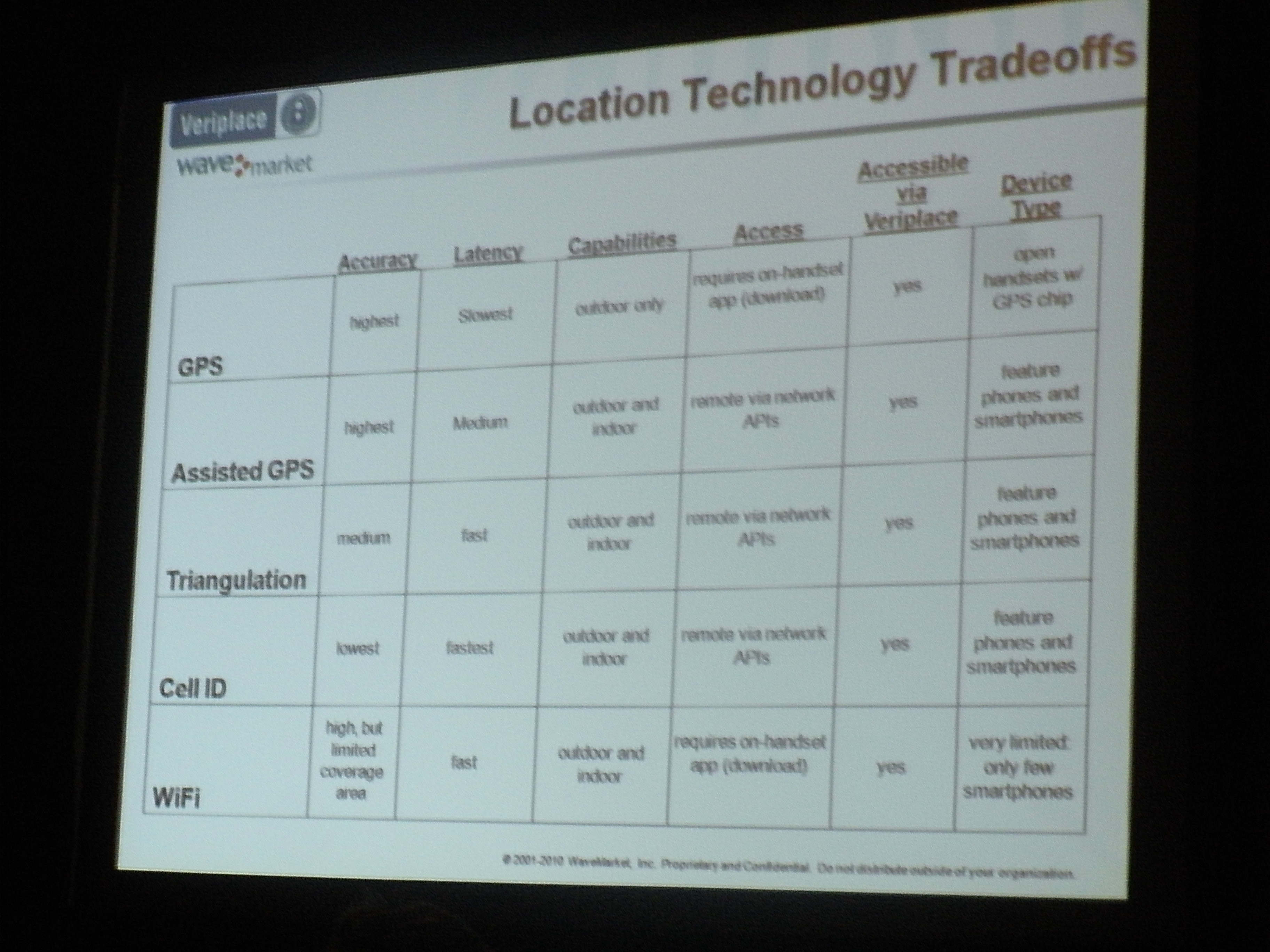
Here are the ways location can be accessed today along with advantages and disadvantages of each:

Standalone GPS – It’s free, uses GPS satellites, so need line of site location.  It’s high accuracy, but it takes a long time to get location (minutes), and some carriers lock the GPS chip.  Download and install an app is still a challange for most people and app developers must develop for different devices.  Also, the app must be running to access location.  It does provide latitude and longitute, which the others don’t.

Cell ID – It depends upon a location database of cell towers.  The phone connects to cell tower and this “location” uses knowledge of where the cell tower is located.  The accuracy of this is lower, but it’s used for both smartphones and feature phones, because it can be located indoors, and has quick location fix (<3 seconds).

WiFi – This also depends on a location database.  It’s similar to Cell ID, but uses MAC addresses on WiFi hotspots – which have limited coverage today.  It can be unreliable due to wifi spots that move. However, if the device has open access to wifi the cost is zero.

Carriers are supporting more location based technolgies on both smarphones and feature phones and sometimes use a combination of the methods above for identifying location:

Assisted GPS – A hybrid of GPS and Cell ID

Triangulation – AFLT – The next level of Cell IDs, it uses multiple Cell ID’s to center a location.  It’s easily accessible via carrier networks and quick  (<10 seconds)

Location is still a challenge for many developers because of this confusing web of networks and the many ways devices can use to find location.  App developers in this area are still sorting through the challenges of location information and authentication and a whole new layer of legal and privacy challenges have arisen.  A recent study showed that people are more concerned about privacy surrounding their location than their credit card data.

Therefore, developer have proceeded forward with a few approaches, such as choosing to focus only on downloadable apps for limited smartphones (iPhone/Android).  Some have made deals with carriers, but there’s a high barrier to entry, so some are working through aggregators like Veriplace to add location to certain app types like sms/voice/web.

Mobile Content is Social

Presenters: Michael Sharon – Facebook , Tom Watson – Facebook, Justin Shaffer – Hotpotato

By itself, mobile devices are immersive – it’s always with you and provides a way for you to exist in a physical or mental place other than where you currently are.  Tools that have been added to those devices have made them “social hubs,” allowing you to connect with others almost anywhere.  There are several things which will continue to evolve to make it even more social.

Friends – Above all, users will tell and demonstrate that this is most important.  However, the debate is what information people want from their friends.  When Facebook changed its mobile friend feed from alphabetized to most recent, it saw an enormous spike in use.  The next debate is figuring out if people want to see the “Top News” or “Most Recent.”  More and more, you’ll see a combination of your Facebook contacts merging with your address book to make sure you have the most updated contact information as well.  Finally, Facebook Connect is even making the gaming experience more social as people can connect games and apps to their friends.

Notifications – There are two types of notifications people are interested in – Active, or what’s happening now, and Passive, or what’s happened since I last checked.  While “push” features make active notifications easier, there’s a fine line between wanted updates and spam.  Therefore, it is extremely important to test this feature before implementation.

Sharing – Facebook knows that people want to share photos (and more and more video and audio).  What has helped this explode has been the speed at which someone can post a photo from a mobile device, and the added ability to “tag” people in photos.  Tagging photos has significantly increased photo viewing as sharing photos becomes a social experience.

Serendipity – The introduction of location based services help you figure out which of your friends is nearby.  This feature has already been implemented by Foursquare, Gowalla, HotPotato, etc.

Discovery – While finding out a friend is nearby is serendipitous, there’s also the potential to discover new people or events.  Mobile offers the ability to do this even better, but what we have yet to see are the privacy implications and the ability to see both your friends and people you don’t know who are nearby (or at the same event).

Control – There has been an explosion in where you can post content.  The same photo/message can be uploaded to Twitter, Facebook, Flickr, YouTube, etc. in the click of a button.  Users want to know how they can decide where to send it, and “take it back” if necessary (which apparently happens WAY more often than you might think).

Intent – Tools need to be designed to elicit the response you’re looking for.  Make it easy to find the way you want people to participate and put it right up front.

Feedback – Commenting provides a cycle of reinforcement and mobile makes this instantaneous.  Feedback is essential, whether it’s comments or Rewards (like Foursquare badges or Gowalla virtual items). Giving somebody something to respond to makes it social.

Mobile becoming more social will be driven by 3 things – Touch, Speed, and Connection

Touch – How it’s designed and what it information it can allow you to share.  An emerging element of touch is a phone that automatically monitors things – temperature, location, weather, altitude, etc.  Things must be designed for the medium (Facebook’s mobile experience diverges significantly from its web experience) and the context in which it will be used.

Speed – Devices are become faster and can do more, but it’s also about the speed of transferring information through networks (getting this information into the cloud and not just onto the device).

Connection – API’s will rule the future.  It’s about connecting all of your networks and information together and allowing the user to determine how/when/what/where/etc. is shared.

The Rise of Mobile, Web Run-Times, and APIs

DISCLAIMER: Despite my average tech knowledge, this session was WAY over my head.  I’ve tried to capture it as best I can and hopefully you get it.

Daniel Appelquist, Tech Strategist at Vodaphone in UK

It’s the Web, but not as we know it.

Interactivity and graphics

Both Canvas and SVG are integrated into HTML5

W3C Widgets

Widgets and HTML5

  • Widgets can use HTML5
  • Widgets is a different take on offline apps from HTML5 Appcache
  • HTML5 Apps Web Apps written in HTML5 packaged up as Widgets
  • Use Phonegap to package these as iPhone apps (for legacy purposes)

APIs

Web Location: the W3C Geo API – Browser using location information

Used by Google maps, local search, Gowalla

Why is location sexy?

  • Find what you’re looking for
  • Refine search
  • Add location to any Web App
  • Apps like Gowalla are already on the web – http://m.gowalla.com

W3C Device APIs – working on:

  • Contact book, calendar, filesystem, capture audio/video, messaging, device interface, etc.

Mobile: Agency, Carrier & Manufacturer

Presenter: David Hewitt, Sapient

There are key challenges for mobile stakeholders and there are opportunities for agencies to assist.  Here are the challenges and opportunities:

Network operators business challanges

  • Reduce costs, churn
  • Driving quality, consistency, and experience

Opportunity for agencies

  • Position carriers for differentiation
  • Bring in the big ideas – that can actually be implimented
  • Ability to facilitate dependencies between client groups
  • Ability to craft user experiences across multiple devices and help bring specific devices up to carrier standards

Agencies challenges

  • New, rapidly changing,
  • Competitive, need right ideas and empowering them with tec, need right capabilitys
  • Death by estimation – pick the ones that make sense and chart the path

Agency Opportunities

  • Educate clients about mobile
  • Leverage social media to drive sales
  • Include mobile in both media planning and campaign creation
  • Work with/hire people with mobile experience

Mobile – The Great Channel Equalizer

David Gill – Neilsen

Mobile is growing, but in what ways and what audience?  Mobile is growing, but one of the largest areas of mobile growth is mobile video.  This area experienced 57% growth last year as people viewed an average of 3 hours of mobile video each month.  This isn’t cutting down on TV viewing though – 59% of Americans with home internet access use TV and the Internet simultaneously at least once a month.  Subscription video content and downloaded video content are the areas of largest mobile video growth over the last year.  Teens overindex in the area of time spent with mobile video, with 36% of them spending 30 minutes to an hour on mobile video each month.

What’s driving this growth – better hardware, a better user experience, apps, sharing and discover, and expanded access to both devices and networks.

How big is it getting – There are currently 30 million people with smart phones, which is expected to nearly double by the end of 2010.  Neilsen is predicting that smart phones will be the majority of mobile phones by Q3 2011.  This is evident by the fact that year-after-year, people who get new phones are choosing smart phones.  Last year hit the highest marks ever in this area – 28.4% of people who got a new phone last year chose a smart phone.

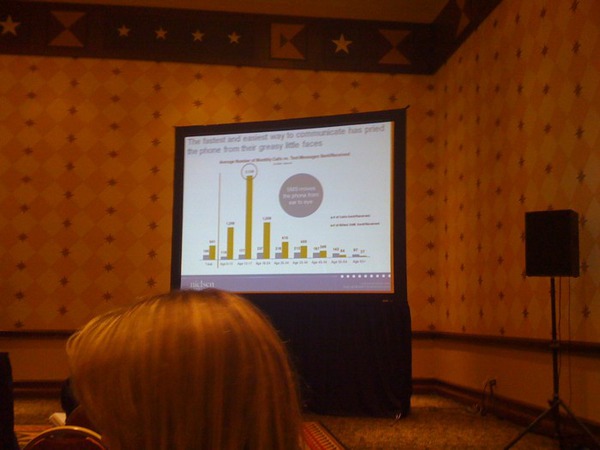
Apps are obviously a growing area.  They have not been very successful on Blackberries since most of these are “enterprise controlled” and downloading apps on them are restricted or frowned upon.  However, the area of most growth is among young kids who are downloading free apps.  Neilsen predicts this area will only continue to grow further.  Texting is a huge area for teens, but particularly among 13-17 year olds.  They text nearly twice as much as any other group (see the photo of the chart.

Overall, Neilsen is keeping a sharp eye on how teens are using mobile – video, texting, apps – because they believe this will drive the future of mobile.

Location Based Wars Heating Up

Unfortunately, I’m still sitting here in Bloomington waiting for my flight.  It’s now been delayed 2 hours and 15 minutes.  It’s given me time to double check things (although I’ll still probably forget something) and update my iPhone.

I’ve already mentioned that the location based wars were heating up before SXSW, but I was shocked when I went to update my iPhone today and had app updates from Foursquare, Gowalla, Loopt, and Whrrl.  And these are just the location based apps I have on my phone (along with Brightkite).

It should certainly be interesting to watch as things progress this weekend as each are running plenty of promotions.  Gowalla is even throwing a party, and the only way to get in is to “find” a virtual VIP wristband by checking in around Austin.  They’re also having a contest giving away some real items if you find them virtually.

Location Based Networking at SXSW

BrightkiteSince Twitter hit it big on Oprah about this time last year, everyone’s been wondering, “What’s the next big thing.”  The technology that has been emerging as the next big thing appears to be location based social networking tools.  Over the last year, services like Gowalla, Whrrl, and Foursquare have been catching on with the techset and are starting to reach the mainstream.  It has forced other services like Yelp to incorporate location based checkins to their services. 

Just in time for SXSW, one of the players in this area – Brightkite – is planning to launch a universal check-in feature to their service – tieing into the APIs of these other services.  Essentially, this would allow users to check in via Brightkite and it would automatically update their location on Foursquare and others (although Gowalla’s API is currently read-only).

It will be interesting to watch the location based social networking services battle at SXSW this year.  Me, I’ll keep updating the services I have on my phone – Yelp, Gowalla, and Foursquare (just removed Whrrl) – while I’m there.