Connecting Internally Using Video

Justin FongHow to create buzz and excitement with employee communications—from a stale monthly newsletter to an energizing monthly talk show
Justin Fong (@jgfong), Vice President of Internal Communications, Teach For America

Had an organization newsletter, until around February 2010, with notes from senior leaders and some other news items. Readership was poor, and at the same time, video was exploding.

Why video?

  • Richer media form
  • Brings people closer to the action
  • Greater ability to convey tone and emotion – brings people to life.
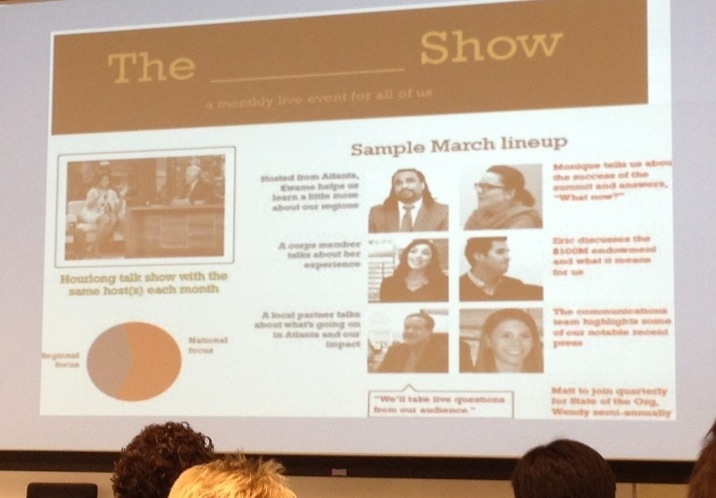
20121004-151418.jpg

Benefits of live video?

  • Minimal production time
  • Unscripted, real, human
  • Interactive
  • Event excitement

Change Management

  • Being honest about what’s not working – newletter results (10% readership)
  • Getting buy in from senior leadership
  • Appealing to the masses
  • Pilot and test

Goals:

  • Entergizing our people and create excitement about the work
  • Liberates people to laugh more
  • Broadens understanding of their work

Discussions Behind the Scenes

  • Talk about diversity
  • Discuss the narrative, what’s the story and who will deliver it?
  • Talk about wordrobe
  • Feedback from the audience
  • Tone/feeling of each show

Growth

Phase I

  • $300 camera, WebEx (audio via phone)
  • Host and co-host
  • Multiple cameras (another $300 camera) with feeds from other cities
  • Video was only so-so, audio-video out of sync, and could only do it live.

Phase II

  • Mix live shots with recorded segments
  • Livestream.com @ $350/month
  • Chat Functionality – to create event excitement
  • New equipment: $2500 camera, microphones, lights
  • Travel expenses are the bulk of cost
  • Streaming relies on internet connection

Phase III

  • Highest production quality, all pre-taped
  • Studio shots and segments from the field
  • Team of four travels to produce
  • Video quality is usually external-grade
  • Audience misses the excitement of a live event

Attracting an audience

  • Attendance is about 50-60% of the organization
  • Trailers, posters, and Yammer promote the show
  • Groups watch the show together as a ritual
  • Create a brand around the show – with a logo for each show
  • Focus on the quality of the program
  • Weaving the fabric of the organization’s culture – creating tradition, ritual, rhythm with Year in Review and Back to School Tour

Lessons:

  • Stick with it
  • Pilot – by not committing too much, being flexible, leaving space for innovation
  • Constantly evolve – the first show looks drastically different than today’s
  • Think expansively about the potential impact of internal communications
  • Don’t be afraid you can do it

Using Video and Storytelling

Drew KellerHow organizations need to use video and storytelling to create and protect their brand


Drew Keller (@DrewKeller), Owner, StoryGuide

Your brand is a structure – organization and clarity – under which people can define, talk about, identify your company.

Why manage brand in social enterprise video?

Content – either internal or external – is going to be shared – that’s social, so consider how it’ll be distributed or syndicated.  There’s a lot of video out there (70 hours of video is uploaded every minute, and there are over 700 tweets linking to videos every minute), so you need to make sure your audience can find what you want them to find.

Brand Storytelling

Always start with 3 questions when considering a video:

  1. What are the expectations?  It should be an emotional response the audience gives (not views/hits/likes)
  2. What is your story?  Create a narrative structure
  3. Who is your audience?  Choices you make should be driven by the reaction/response/needs of the type of person you’re trying to reach.

Keep it short and to the point (see the chart)

What video gets watched & shared?

  • Tastemakers drive awareness
  • Communities of participation
  • Surprise – the unexpected

A mix of unexpected, short, and transparent – if all 3, creates engagement.

3 biggest people challenges to manage video branding

  1. Corporate cowboy – No clue there are brand guidelines, creates content that dilutes the brand.
  2. Design renegade – Think they are smarter than the organization and want to do their own thing.
  3. Turf builder – Create brand identity for their team/area, and has little to do with the organization.

When Brand Videos Go Awry

Going for the laugh – The problem with comedy is always contextual and cultural. The paradigm is usually as sane person surrounded by lunatics, or the lunatic surrounded by sanity.  The viewer is an observer of someone acting out.  There’s a complicated rhythm and cadence to comedy that’s really an art form.  Corporate video, which goes for funny, almost always makes fun of a stereotype – the easy joke.   Be careful… any content you create, even internally, you have to imagine that it’s going to show up on YouTube.

This is an example from Microsoft of a video created in Europe, illustrating how cultural differences in comedy/taste can impact the brand.

Beware of Unmanaged Team Videos

  • Often created with the best intentions
  • Usually reflect team values/culture, not necessarily company values
  • Can confuse market base with non-aligned message – not consistent with company image
  • Tend to leverage unlicensed media
  • Can create firestorm when local cultural values are not shared by wider audience

Mitigate this by educating people on the values of the brand and brand associations.  All video – internally and externally – should reflect the brand message and should be reviewed by the brand managers.

Branding Too Much?

A recent Harvard Business Review Article points out that you can use too much branding in your video.  Specifically, a study discovered that the more prominent or intrusive the logo, the more likely visitors will stop watching.  They suggest using “Brand Pulsing” where you weave logo and other brand elements into the video that is logical, integrated it into content.  This technique has ben shown to increase viewership and retention by 20 percent.

Takeaways

  • Be consistent – Internal & External
  • Unique, creative and compelling story
  • Tone of message fits the company’s values
  • All brand assets must fit brand identity
  • Respond quickly to challenges – have a plan in place
  • Sweat the details

Check out the excellent series on video and storytelling by StoryGuide.

Ragan’s Coverage of this session.

My Plan for Oct. 3

The Ragan Employee Communications, PR and Social Media Summit is coming up next week. You can always follow my live (West Coast time zone) on Twitter (@kkozlen), or here on this blog. If requested, I might do some live video coverage via this site… please take a look at my plan for the conference and let me know if there are any questions or things I can look into on your behalf.

The first thing I’m attending is a pre-conference workshop on Wednesday, October 3, covering various aspects of employee communication. Here are the workshop sessions I’ll be attending:

Dux Sy

9 a.m.-11 a.m (PST)
Transform your corporate communications with SharePoint
Dux Raymond Sy (@meetdux), PMP Managing Partner, Innovative-e

By leveraging SharePoint 2010, corporate communicators are empowered to create relevant solutions that can increase productivity by streamlining and automating communication processes and minimizing communicators’ dependence on IT.

  • Exploit the key benefits of SharePoint for corporate communicators
  • Automate corporate communications processes and workflows with SharePoint
  • Integrate SharePoint with existing corporate communication tools
  • Create a Web-based dashboard to track and measure relevant corporate communication metrics
  • Leverage social and mobile capabilities to better engage corporate audiences

Mark Schumann

12:30 p.m.-2:30 p.m. (PST)
Leadership communications: How a communicator in the social media world can support and maximize the impact when an executive communicates
Mark Schumann (@dmarkschumann), past Chair, IABC
Mark Schumann, ABC, past Chair of IABC and a 17-time Gold Quill winner, for a compelling workshop on how to reinvent your communication skills to provide the support a leader needs in the social media world.  Behind every great leader is a great communicator. And, in this 24/7 business environment of constant interaction, how a communicator supports a leader has significantly changed. No longer is helping a leader craft a message adequate support. Today’s communicator must continually coach the leader to make the most of each opportunity to engage.

This session will cover:

  • Help a leader discover a communication style, tone and level of comfort with a range of interactions
  • Coach a leader to work within an authentic voice that is natural to express and absorb
  • Introduce new media to a leader without forgetting that every tool is a means to an end of stakeholder engagement
  • Establish a curriculum of leadership message and content
  • Encourage a leader to become more involved in the development of communication strategy and approaches without delegating the task
  • Continually reinforce to the leader that communication is a fundamental part of the role

Drew Keller

3 p.m.-5 p.m. (PST)
How organizations need to use video and storytelling to create and protect their brand
Drew Keller (@DrewKeller), Owner, StoryGuide

Corporate communicators must explain, defend, and bolster the corporate brand internally and externally with imagination and verve. This is no small task now that social media has made it more difficult to manage your brand on many platforms. Video is one of the strongest weapons in your arsenal to create the look and feel of your brand. When you make a video, your audience pays attention to every detail. They look in the corners of your shots, they listen to the words, and they absorb your message… intended or accidental. Therefore it is critical that every video you produce has an identifiable relationship with the personality of your product.

This session will cover how to use video to tell your corporate stories. You will learn how to:

  • Make certain that your stories reflect your company or organization’s philosophy
  • Make sure the look and feel of your videos reflect the brand positively
  • Avoid common pitfalls of content creation that does not advance your brand
  • Capture inspirational and memorable stories that will bring your company renown
  • Write the perfect script through employee interviews and brainstorms