
Enhancing Employee Engagement Online
 |
 |
Come on, get happy: How Expedia enhances employee engagement online
Kristin Graham, Vice President, Engagement & Communications, Expedia, Inc.
Mark Schmitt, Senior Communications Manager, Employee Programs, Expedia, Inc.
The Culture Connection
Every company has a culture, but there’s also subcultures, and there are occasional cultural disconnects. Culture is the defining element of the company (the personality that makes it unique). The sub-culture is how an individual or group experiences the culture. Companies have both. The right combination can:
- Improve company performance – increased retention and engagement
- Enhance the customer experience
- Inspire intense passion for the product
- Drive innovation
Mission: To revolutionize travel through the power of technology
Cultural elements needed to be defined, so they came up with Supporting Values:
- Passionate about travel – love travel and making it easier and better.
- We are Innovative – use intelligence and technology to create and simplify.
- We are Enterprising – seek out opportunity, take risks and act with speed.
Engagement Expectations
Employees want (based on feedback):
- Leaders who are “available”
- Personal development
- Ongoing, specific feedback
- Sense of community
- Flexibility
- Reasonable compensation (Money & More)
Key to success/general goals:
- Set a few expectations that match your culture and meet every one
- Build employee trust: what you do vs. what you say
- Communicate: early and often
- Visible Leadership– Includes a CEO blog with an “Ask the CEO” page where employees can ask questions and he’ll respond on the blog within a week. Tjhey have a quarterly town hall on video, and a Leader Travel Blog
Quarterly town hall on video.Leader Travel blog – how they experience the brand and experience as a consumer
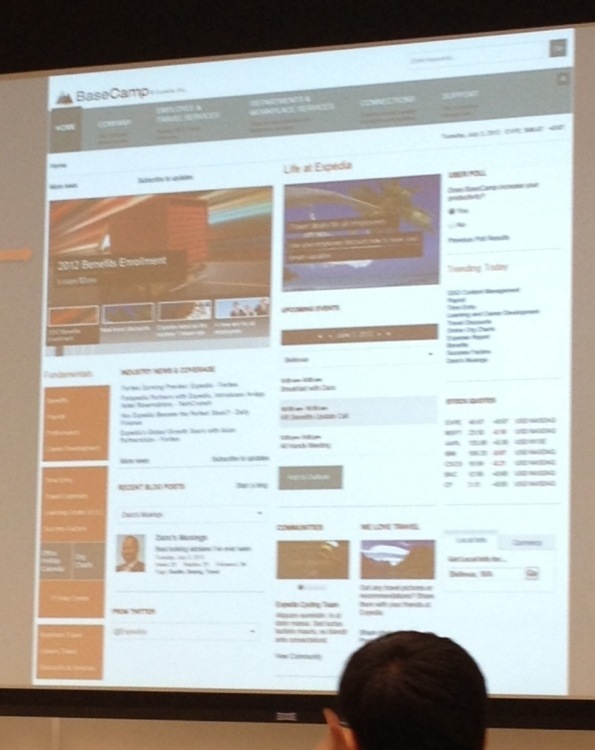
- Personalizaation – Company News Your Way – Create a new Intranet portal that showcase local interest, make coverage scalable, leverage employee sentement, and creates 2-way communication (see photo).
- Segmentation – GO! site a wellness program – targeted users based on a matrix by age, motivation type, hourly/salaried, and global (cultural similarities and benefits offerings) with information that was likely most relevant to them.
- Philanthropy – Global Day of Caring – A day off to give your time. Everyone registered on a website with what they were doing and then asked for photos.
- Technology – We love travel internal site – Employee travel site with tips, advice, recommendations and allows users to post photos, comments, etc. The external website folks asked to post the employee photos on the public facing site.
Results
- Segmentation engages folks by making it about them.
- People look for community – real or virtual
- Technology can make communication more personal, local and relevant
- Feedback isn’t optional anymore (internal feedback) – incorporate it into what you’re doing
- “Fun” is a strategic element – if you’re not having fun or enjoying it, they won’t enjoy it or be engaged
Tags
Related Posts
Share This


 Subscribe via email