Guiding Senior Leaders

Diana Kowalsky Libby Catalinich

Support a strong corporate culture by guiding your senior leaders to speak with authenticity and transparency
Diana Kowalsky (@dianakowalsky), Internal Communications Manager
Libby Catalinich (@lcatali), Director of Corporate Communications, REI

REI has 123 stores in 30 states, with 10,500 employees and has over $2 billion in sales. The have a co-op ownership – anyone can become a member for as little as $20. Pay dividends of around 10% each year. Because they are not a shareholder owned company, they tend to be more transparent and open. However, when you tell everyone, everything, you need to be more focused on being strategic about messages. The company has many long-tenured employees and it has traditionally been a smaller company. Now, as they are growing, the culture is changing and growing which is a bit uncomfortable for many. Two-thirds of employees don’t even have a company email address, making connecting with employees a bit difficult. Therefore, leaders are the source of information, especially since research indicates their leaders are the best source of information.
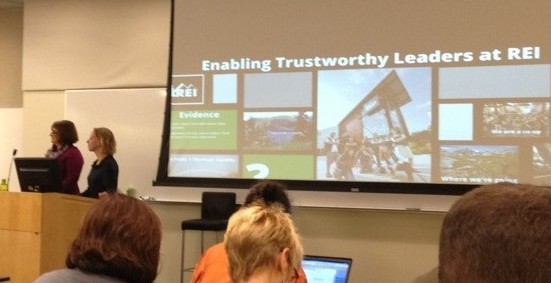
2 Types of Leaders at REI:

  • Day-to-day leaders – lots of direct contact with employees
  • Strategic leaders – Set long-term vision and direction of the company

3 Characteristics of trustworthy leadership

  1. Honesty – Leaders need to tell it like it is, and mean what they say.
  2. Humility – Leaders are open to feedback and learning from employees.
  3. Humanity – Leaders speak from the heart and make personal connections with employees.

Honesty
They accomplish this by encouraging conversations – The leadership team visits every store, every year to do this. The CEO and other leaders also stay connected by living among employees – at lunch, in the vanpool, at service projects, etc.

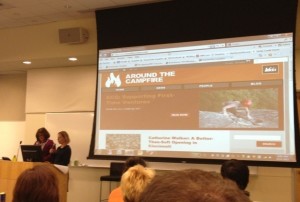
They also connect online, using various social media – recently built www.aroundthecampfire.mobi as an employee portal (built on WordPress). In the first month, they’ve had over 200 comments, and average use is 5 minutes.  CEO and other senior leaders blog here, no filters.

They learned that leaders weren’t necessarily prepared to blog, and they’ve had to teach them what to talk about and give them direction. Make sure you keep it real, prepare leaders for what to expect, and be consistent.

Humility

Make sure you ask for feedback.  Get data and act on it.  They give each leader feedback on themselves.  They’ve also focused on sharing ideas, and recently created REIdea, a SharePoint community to share ideas between store managers.

They learned that feedback isn’t always easy to get or give, but you can drive it by telling stories with examples of how change was driven by feedback.  Most the time, if you want to know, just ask.

Humanity

You need to focus on cultivating personality, having fun, and being real.  Focus on making leaders accessible and doing things to bring out their personality.

They’ve learned it’s about incremental change.  You need to start small – suggest they talk about something other than business on their blog.  Mix in personal learnings and illustrations with your talks and erase the corporate speak.

Case Studies

  • Marriage Equality – CEO came out on blog and gave reasons for the change in the company.
  • Layoffs – Prepared information for local leaders, so they had consistent speaking points and knew how to handle situations.

Results

People stick around when they have leaders they trust, like and believe in.  They’re ranked as one of the best companies to work for, and have record retention of employees in the retail industry.

Moving Employees to Action

Caitlin DuffyEmployee communications tactics for an ADD world: How to engage, collaborate and motivate employees
Caitlin Duffy (@duffycait), Managing Editor of MSW, Microsoft

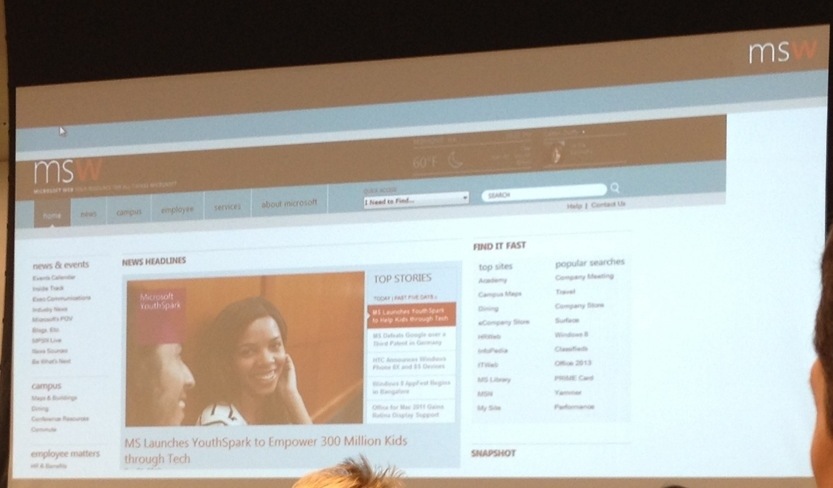
MSW is Microsoft’s internal portal site, includes news and information, as well as links to company resources.  They have a five person editorial team, and a vendor who built the site and manages placing the content.  They handle enterprise-level topics, and localized information is handled separately.  Their sections include – Articles (1 daily editorial story and external story responses), employee submission of stories, snapshot (employee submitted photos), and a few others.  They let people choose their own homepage/portal and don’t force this site on them.  They still have a very high awareness and readership rate.

5 lessons for employee engagment:

  1. Skate to where the puck is going

    Microsoft MSW

    Microsoft’s MSW is their internal portal – a source for news and links to company intranet resources.

    People want information wherever/whenever, want shorter bursts of information, and they expect to be able to interact.  They created “The Pulse” as an extension for their MSW internal brand.  It’s a place for microblogging and interaction in order to engage in conversations.  They can use this to monitor employee sentiment and change internal perceptions around certain issues.

    Similarly, mobile is critical – there’s often more participation due to accessibility of content whenever/wherever – so they’ve developed all these tools on a mobile app.  Mobile is so critical, they’ve eliminated their mass email program to free up resources to implement the mobile aspect of the site.

    What didn’t work – “Submit a Question” – surveys revealed people wanted to ask executives questions.  So they developed a tool to let people post questions and vote them up based on popularity.  Failed because questions that came in often related to secret information that wasn’t ready to be discussed.  They failed to work together with departmental communications managers to be prepared for the questions coming in.

  2. Make it Easy for People to Act
    Infographics make it easy to explain content in a simple way, and can be utilized both internally and externally.  What doesn’t work: A complicated call to action.
  3. Make your Events Social
    Utilized their social platform to socialize events.  There were some minor issues with employee submissions, they were prepared and acted on it.
  4. Make it Real
    Don’t force participation, highlight events, meetings, employee retail deals, etc. to give them what they want and may not be aware of them.
  5. Involve them in Big Moments
    This includes product launches, acquisitions, company meetings, and other big changes impacting the company.  This can be used as a focus group to determine employee sentiment and engagement.


Changing Nature and Pace of Communications

Frank ShawStrategies for the changing nature and pace of communicationsFrank X Shaw (@FXShaw), Corporate Vice President of Corporate Communications, Microsoft
Trends impacting communications:

  • Tech trends – personal computing, cloud computing, social computing.
  • Consumer trends – multi device world, your stuff – everywhere, social networking
  • Marketing trends – Social media marketing, multi channel marketing, video, Interactivity

Nature and pace of communications has changed in the following ways:

  • 20121004-095150.jpgPublishing explosion – Technology tools make it easier and faster than ever for everyone to publish.
  • Influencers are dynamic – Microsoft now watches and develops relationships with blogging influencers. They are literally scouting the up and coming influencers on industry blogs.
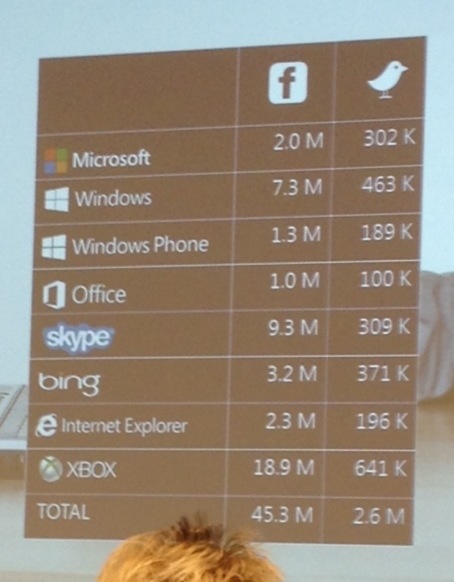
  • Direct storytelling drives action– You can now tell your story as a brand without having to go through anyone else. Microsoft created a News Center to tell their story directly. Internally, they created a news center (includes social features) – it has 5 million page views/month and reachs about 85% of employee base on a monthly basis. They also utilize their corporate Facebook page and have learned, images and tone is everything. People engage most frequently with images. Tone has to be light, some humor, invites conversation, and there’s almost no selling.
  • Engaging invites attention – Before engaging, Microsoft asks the following questions.

    • Do you have the right resources to engage or respond?
      It’s not cheap. You need a dedicated resource to engage. An example: Smoked by Windows Phone – It has a lower cost as a campaign, but it requires a dedicated resource.  They’ve invested in resources because it has great ROI.
    • Does engaging align to your goals?
      Engagement should support a goal. Example: Microsoft Lost Decade – respond, but didn’t want to draw attention to source article, so they responded on TechCrunch article.
    • What is the value you can deliver or contribute?
      On internal surveys, they discovered that external press coverage is one of their most influential things which impacts their employees’ view of the company. Now, when they run a story from the media on their News Central site about the company, they run an accompanying article to tell employees their point of view and give them message points for responding. This clearly adds value to their employees view of company. Externally, goals have clearly defined marketing goals and are usually part of a larger campaign.
    • Will you shift the conversation in your favor?
      Anticipate debate and issues, and share your company’s point of view to help shift the conversation. After a conversation emerges, always discuss whether or not to engage in the conversation. Then when you decide to, track the conversation.
    • Does the risk out weigh the reward?
      If results are going to be negative, what is the impact? Think about it from a short term vs long term – if there’s long-term gain, that will be the focus. Also examine legal/shareholder responsibility and potential impact. Brand, customer, and employee implications need to be reviewed. Finally, personal/professional reputation is examined.

Maximize the Impact when an Executive Communicates

Leadership communications: How a communicator in the social media world can support and maximize the impact when an executive communicates
Mark Schumann (@dmarkschumann), past Chair, ABC
http://re-communicate.com

The first half of the presentation focused on leadership communications in the social world, while this section focused on the anchors of executive communication.

6 Anchors to helping leaders become better communicators:

  1. Candor – Nothing is more important than making sure people feel like you’re telling the truth.  You can do this by telling people something they don’t know, sharing insights, and giving them something they haven’t heard before.  We always have to find something new – people tend to believe it must be the truth if it’s something new. Tips – share something that surprised you – for example, tie it to something that happened today (hold up the iPad to look cool), people believe it’s more candid and timely if you talk about what’s going on in the news. Likewise, they’re going to believe more if you tell them something that’s not on a PowerPoint slide (seems less rehearsed).  Finally, tell me what you want me to remember, and if you do that, you need to look me in the eye.
  2. Clarity – It’s so easy to get caught up in a convoluted narrative. Be direct (candor) and summarize your message to provide better clarity. Remember the message. There’s always a clearer way to explain it, and never stop at trying to make the message simpler.
  3. Curiosity – Contributes to an image of caring. Connect with people and have a human moment. Walking the halls is a huge opportunity to illustrate this. Leaders shouldn’t just hurry past them on way to meetings. Everyone has a story, and the more a leader can demonstrate an interest in the people they’re speaking with, the more open they’ll be to listening. Begin your talk with a question to learn what people have to say, and then speak to those questions.
  4. Caring – Find me something that will touch my heart, and I’ll show you how it changes my point of view.
  5. Content – The punchline must be heard. People need to know what they need to remember and what they should do with that information. Give the audience meat – always have great content or information.
  6. Conversation – Leaders need to be trained in having a conversation, not a speech. A speech should be nothing more than a conversation with a whole bunch of people.

“I can say anything (as a leader) as long as people believe I’m being candid, clear, and caring.”

Tip: Never say “but” ever again – it makes people defensive. Say “and” – it makes people feel inclusive.

Strengthen a Leader’s Candor

What gets in the way:

  • Truth – Especially when the truth hurts, it can’t always be delivered so directly.
  • Spin – Too much explaination and details looks suspicious.
  • Fear – Often people are afraid of what they’re about to hear, and then they’re afraid of what they didn’t say.
  • Lawyers – have a great relationship with this area, understand the rules – what can and can’t be said.
  • Media – not talking directly with people – recorded messages.
  • Pride – Sometimes leaders let their pride get in the way

Things to consider:

  • What do you need to communicate? Use the CEO sparingly, only when you need them.
  • How informal must we be?  They start with a comfort in formality.
  • How spontaneous can we be? Don’t kill questions by making people wait till the end. Questions are spontaneous.
  • Who else should we include? Have the people there who can answer the questions, but don’t make them look like they don’t know the answers.
  • How much conversation can we stage? Facilitate discussion between leaders, reveal how they work together. People want unscripted moments.

Reveal a Leader’s Caring

What gets in the way of caring:

  • Distance – Physically (higher floors) and on the org chart, leaders need to be connected to the real world at all times.
  • Uncertainty – Not knowing what to say.
  • Entourage – They have to break out of their comfort zone and involve others.
  • Formality – This keeps people at an arms length
  • Logistics
  • Timing

5 Reminders a leader must live by to be perceived as someone who cares:

  1. You are being watched – always – especially now with technology
  2. You are never alone – people are always watching, listening, etc.
  3. You only have a moment – reactions by individuals are a collection of small moments
  4. You can disappoint people – It’s easy when the expectations are great
  5. Social media doesn’t make you social – It’s about being human and opening up

Articulate a Leader’s Clarity

What gets in the way of clarity

  • Details – They know the topic and want to tell everyone everything.  People just need to understand the big picture and only include what’s necessary to illustrate this.
  • Voice – This is the way we say things.  They might use the company’s voice, not their own.
  • Lawyers – Certain ways we have to say things.
  • Editing – Being too close to the content.
  • Tradition – People may infer things based on past practices
  • Deadlines – Not enough time to craft the correct message.

6 things corporate communications must be able to tell their leader with a straight face:

  1. No one will understand you
  2. No one will believe you
  3. No one will follow you
  4. No one will care about what you are saying
  5. You would be behind in the polls (if you were running)
  6. Your head cheerleader is losing their cheer

Organize the content

Know your audience:

  • Who am I trying to reach?
  • What do they hunger for?
  • What must they understand, believe and do?
  • Who do they trust?
  • What do they hope for?
  • What disappoints them?
  • What angers them?
  • What do they want to get the message – video, live, phone?
  • How few words?
  • What will make me crazy?

Stimulate a Leader’s Curiosity

  1. Clarify and develop the communication competencies
  2. When you coach, support, advise, and nurture
  3. Capture and package the soul – people react to the person
  4. Protect the leaders from themselves

How to reinvent what others must see in a leader

Detox – Documentation of habits, discard certain things, deny them opportunity to go back to bad habits that get in the way

Declare – This is the kind of communicator I want to be (everyone wants to be better when they understand how important it is to their job) – discover, describe, develop – long term effort to be more effective

Deliver – Prepare, rehearse, focus on detail, delegate, and debrief

 Here’s Ragan’s coverage of the same session.