SXSW Video: A little help from my friends.

It’s been five, long, jam-packed days. Koz and I will keep working to post more sights, sounds, and insights from South by Southwest Interactive 2010.

There’s certainly no shortage of interesting spaces where “digital creatives” connect during SXSW to do what they do. Here’s a peek …

Click for video

Twitter’s ‘@anywhere’ Third-Party-Integration App Announcement

Just a quick follow-up to the video clips Koz posted yesterday from Twitter co-founder and CEO Evan Williams’ SXSW Keynote interview:

  • There’s been a flood of analysis, opinion, and information on the heels of Williams’ (@ev) announcement of the new Twitter third-party-integration application, “@anywhere.”
  • If you’re not currently a Twitter user, the ability @anywhere will provide to seamlessly mesh Twitter with other sites, such as The New York Times, Amazon, and eBay, and let users share links and add “follows” without leaving the sites, may certainly bring more users to Twitter.
  • Here’s a good write-up from TechCrunch about the features and third-party partners (so far).

I can easily see how @anywhere will change the way I use Twitter. It may sound silly, but I also get how it aligns with Twitter’s No. 1 company principle: Be a force for good.

As @ev said yesterday, “Access to information … is about reducing the walls between influencers and the influenced. Democratization of information changes the world.”

ANYONE can Create a Video Game

Panel: Dustin Clingman – Full Sail University, Dave Werner – Atmosphir, Michael Agustin – GameSalad, Adam Saltsman – Flixel, Troy Gilbert – Mockingbirdgames, Shanna Tellerman – Wildpockets

Building a game is getting easier and easier, and the panelists build tools to help people without tech skills/knowledge build video games.  From simple to complex, it sounds like the video game industry is hungry for new ideas since many games are built upon the same premise – shoot ’em up, explore, etc.

Games don’t have to be just fun and/or entertaining, they have proven to be used to teach very effectively.  While it can obviously be used to teach simple tasks, games are tremendously good at teaching individuals organization or organizational models such as world-politics, physics, math, science.  If you have trouble explaining your business model to employees, consider a game that teaches them what the elements/values/principles of your model are.  When used for good, these games can communicate and engage users in things like the impact of natural disasters, geopolitics, and other significant societal issues.

Some games and systems choose to take advantage of “regular operative conditioning” which rewards you for a repetitive task.  It has been proven that people have an innate need to solve things and with things like gambling, people become addicted to the dopamine that is released when they are challenged and rewarded.  This is a tremendously effective tool for getting people engaged in your game, but it can also be dangerous if people start working toward “points” rather than pursuing the true purpose of the game.  However, reward structures – in the form of points, virtual items, money, etc. – can be a tremendously effective way of hooking people in and keeping them engaged.  Feedback, recognition, rewarding, earning, and achieving are human urges that come through in games.  You don’t necessarily have to make a “game” in order to incorporate this or exploit these urges.

If you are interested in getting started building your own game, here are a few resources to consider:

  • Game Maker, by yo-yo games – Not great, but it does the things people want it to do.
  • Game Jam – An event that is a good way to get with a group of developers.
  • Mockingbirdgames – Provides easy, super basic tools, and very limiting.  It’s flash based for the browser with plug-ins with existing communities.
  • GameSalad – Good for scaling and porting across formats. Xml format to be ported to mobile devices, flash for browser, etc. – want to be able to scale.
  • Flixel – Flash games for pc/linux – both web browser and download and play – incorporates social sharing
  • Wildpockets – Web based 3-D games that supports community – all points/currency shared across games

Get SXSW Slides

There are only two of us, and we’re making it to as many sessions as we can, but if you’d like to see some slides from additional sessions at SXSW, take a look here (if you have access to slideshare.net) – http://www.slideshare.net/tag/sxsw2010

View more presentations from Daniel Burka.

What does corporate America think of 2.0?

Do mainstream companies get Twitter? Are executives in non-high tech industries embracing social technologies and the communities that form on top of them, or are they scared to death?

A report from the field was delivered at South by Southwest Interactive today by MIT scientist Andrew McAfee, who coined the phrase “Enterprise 2.0.”

McAfee laid out some good news and some bad news about the corporate mindset on the free-form collaboration that is 2.0, and offered some advice on how to talk to your boss about social tools that are evolving around the user:

  • Corporate mindset challenges: We are risk-averse, busy, budget constrained, uninterested in social revolution, hostile to auto-obsolescence, ROI-seeking, and convinced of our own uniqueness.
  • Some good news: We can be swayed by theory, evidence, narratives, peers; we’re afraid of being left behind.
  • Talking to the boss: Present theories and frameworks, not jargon. Use data, case studies, and narratives. Make it relevant to our business; combat “time-wasting narcissism” perceptions about social tools.

According to McAfee, social software is maturing and we’re beginning to see more evidence of the business benefits of 2.0 (McKinsey Study, CEO case studies). Only time will tell if a tipping point is in the cards.

For more highlights, see the Twitter stream from today’s event. More at SXSW Report.

Presenter: Andrew McAfee, Principal Research Scientist, Center for Digital Business, MIT Sloan School of Management. Contact: @amcafeeamcafee@mit.edu. Resources: 2.0 Adoption Council

Web Series 2.0: Big Campaigns on Digital Dollars

Panel: Melissa Fallon – Davie Brown Entertainment, Chris HanadaRetrofit Films, Milo Ventimiglia – DiVide Pictures, Wilson ClevelandCJP Digital Media, Andrew Hampp – Ad Age

Media is increasingly fragmented and more and more people are turning to the web to get both information and entertainment.  One of the panelists noted that even TV executives mentioned that their kids don’t watch TV anymore, but instead view shows on the web.  Many brands are moving some money over to digital, particularly for online video.  However, the perception is that digital is cheap.  While many are willing to “work with what you’ve got” you can certainly do better work with better budgets.  The challenge with getting those budgets is is that there are few examples out there and many still think in terms of traditional media measurement.

“”Big brands tend to say, ‘give me something that’s never been done before… but I want you to give me examples of how it has successful in other places’,” said Melissa Fallon of Davie Brown Entertainment.

Since paid media is, paid, you are guaranteed eyeballs, but that’s not something that online video can deliver.  The real challenge is distribution and syndication.  Partner with your existing fan networks to let them share your message.  For example, a video series for IKEA was successful by getting the top 10 IKEA fan blogs to post and promote the online episodes (the blog that directed the most traffic got a spot in the season finale).  People aren’t going to seek out your show, you have to go to where they are and put it in the channels where they are.  However, you can also use paid media effectively to cross promote your web videos.

What is most effective is when you can pair a brand with a creative way to tell a story online.  Good content is good content, whether its on the web or on TV – content really is king.  The challenge is really determining what your brand is about and then finding a compelling way to tell that story.  In a way, Chief Marketing Officers need to be like producers and movie studio execs – they’re investing in something that they want to make sure it is successful.  Especially as brands begin building their own content – which is necessary, because no one understands their business or industry better than they do, and they should make sure their brand sentiment is the one that people see.

The challenge for big brands moving forward is that online video and storytelling is now accessible to anyone.  A small brand or unknown player in your industry has the same (if not easier access to) things like YouTube and other social media outlets – and if they’ve got a compelling story, they’ll get the recognition and set the bar in your industry.  For example, “The Temp Life” is a web series created in 2006 for Spherion.  Their challenge was they had trouble building loyalty among their temps.  Therefore, the webisodes highlight that the brand knows the jobs aren’t always great, but we can empathize with you.

Finally, big name talent has started to play in the online video and social media space.  The key is getting them involved and engaged with your story or project.  Right now, it’s not necessarily about the money for them, it’s about collaboration.  They’re doing it because it’s fun, its different, and they feel like they can be part of the creative process.  When a big name brand is attached, the actors also feel more comfortable that it’s not completely going to flop – there’s money and credibility behind it.

Gary Vaynerchuk Now

Here’s a quick video from the Gary Vaynerchuk presentation going on right now.

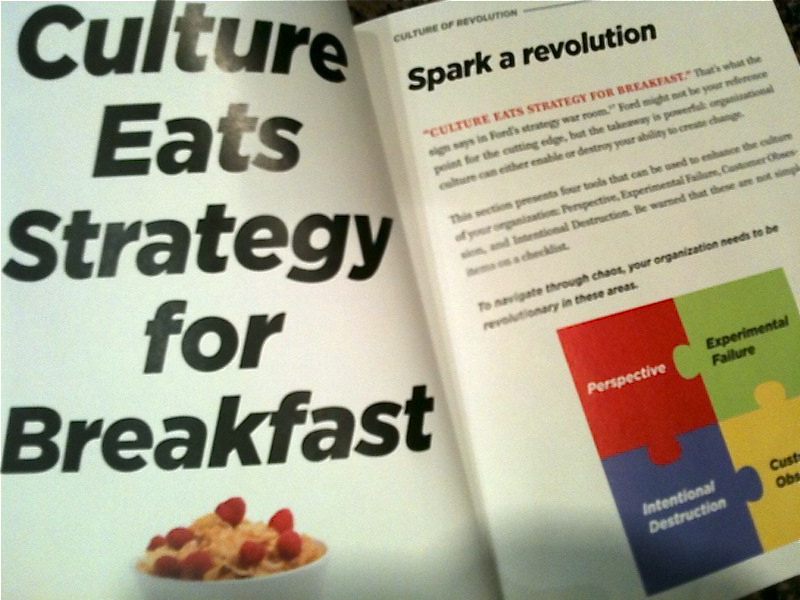
Exploiting Chaos: What’s more important, culture or strategy?

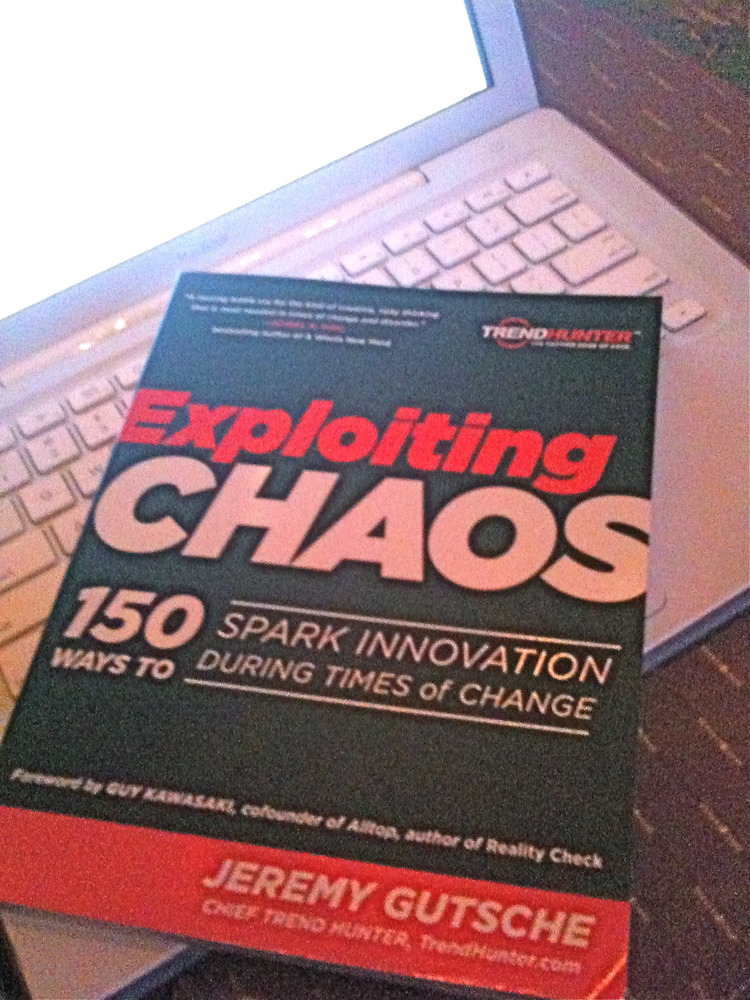
According to Jeremy Gutsche, culture eats strategy for breakfast. Gutsche, MBA, CFA, is founder of TrendHunter.com, the world’s largest network for trend spotting and innovation. He is also the author of, “Exploiting CHAOS: 150 Ways to Spark Innovation During Times of Change.”

Did you know that Hewlett-Packard, Disney, Hyatt, MTV, CNN, Microsoft, Burger King, and GE all started during periods of economic recession? Periods of uncertainty fuel tremendous opportunity, but the deck gets reshuffled and the rules of the game get changed.Gutsche offers some pretty compelling insights for capitalizing on the chaos. Here are a few choice quotes from today’s event (and some secret goodies at the bottom):

    • Can you focus what you’re trying to do in seven words or less?
    • There is no point in innovating if you think you already know the answer.
    • Find a way to be irresistible to a specific group.
    • Successful businesses innovate and create opportunities to fail.
    • Win like you’re used to it. Lose like you enjoy it.
More good stuff in the live-blogging stream here. And click here for Jeremy’s secret goodies just for SXSW insiders.

SXSW: Bizness, brews, and bonding

It’s Sunday night and I’ve landed in one of the many South by Southwest lounges – with a cold Lone Star Beer at my side and blisters on my feet.

There is significant party cred attached to the SXSW franchise, and no shortage of (free) drinks and (free) food to be found at the Austin Convention Center and beyond. But that’s just one small piece of a cozy conference vibe that fosters a culture of work hard, play hard, and get to know each other. (Related story: Booze and Blogging.)

Make no mistake about it: SXSWi is a five-day marathon. The choice of sessions, panels, workshops, keynotes, and meetups is overwhelming. And with two more days yet to go, it was energizing to hear from many of you over the weekend who were following along on Twitter and foursquare. What a great blend of technology and inclusion.

Thanks to a tip from @briansullan, I tracked down Web standards guru and author, Jeffrey Zeldman, and co-author, Ethan Marcotte. Ed Matesevac, @ep3runs, turned me on to Dan Ariely––an acclaimed professor at Duke University and best-selling author of “Predictably Irrational: The Hidden Forces that Shape Our Decisions.”I also noted Company partners outside our department tapping into Twitter and retweeting some of our live-blogging. Thanks for joining us!

SXSW Interactive ends Tuesday night and we’ll keep bringing it to you until then.

Sunday at SXSW in Pictures

Just few shots from today, incuding the ScreenBurn at SXSW Arcade and the Women Love Tech Meetup.


Creativity Through Play

Presenter: Sara Summers, User Experience Evangelist for Microsoft

Play is important, particularly in the workplace.  Science (lead by Dr. Stuart Brown at The Institute of Play) has proven that a life without play leads to depression, rigidity, and dissocial activities.  It’s critical, not just to our well being, but for adaptation and idea generation.  It’s proven that play drives us to seek novelty and newness.

Play elicits our best qualities – it inspires empathy, helpfulness, hopefulness, and betters emotions.  It’s crucial to visual thinking and processing.  Dr. Robert Epstein’s “Shifting” suggests a period of individual ideation, followed by group building and generation produces significantly better ideas.

“To invent, you need a good imagination and a pile of junk.” -Thomas Edison

It’s a short blog post, but most of this workshop involved hands on play and brainstorming to illustrate the points made.

A period of individual ideation, followed by group building and generation produces significantly better ideas. – Dr. Robert Epstein #sxsw

Tags

Related Posts

Share This

SXSW: Missed opportunity

This is my 2010 South by Southwest Interactive badge. New this year is a QR Codethat enables attendees to “scan” each other’s codes with their smartphones instead of exchanging business cards. Scan. Download. Export. Follow up.

I haven’t really seen scanapalooza catching on among attendees, but that’s OK. To me, there’s a more obvious aspect that’s missing.
With this data source hanging around my neck, I expected that at every session, panel, workshop, and after-hours event, someone would be capturing the code when I arrived and opening the door to some pretty-good granular data about who attended everything. And from that data, formulating some who, what, when, and where assumptions to apply to the future vision for SXSWi.
After all, this is a technology conference. Next year, I’m thinking my badge will be a smart card––and wherever I go (and whatever I spend) will be tracked and processed seamlessly.
I’m just sayin’.

Tags

Related Posts

Share This