Privacy, publicity, and micro-blogging in the dark.

Danah Boyd delivered opening remarks today at South by Southwest Interactive. This image is a graphic recording of the event

One of the world’s foremost authorities on social networks, Boyd works at Microsoft Research New England and also serves as a Fellow at the Harvard University Berkman Center for the Internet and Society.

In a very large, very dark ballroom at the Austin Convention Center, I micro-blogged keynote highlights on Twitter. Here’s a link to posts from the event:

South by Southwest Interactive Keynote: Privacy and Publicity with Danah Boyd.

Saturday at SXSW in Photos

Here’s the Saturday photo gallery…

The Rise of Mobile, Web Run-Times, and APIs

DISCLAIMER: Despite my average tech knowledge, this session was WAY over my head.  I’ve tried to capture it as best I can and hopefully you get it.

Daniel Appelquist, Tech Strategist at Vodaphone in UK

It’s the Web, but not as we know it.

Interactivity and graphics

Both Canvas and SVG are integrated into HTML5

W3C Widgets

Widgets and HTML5

  • Widgets can use HTML5
  • Widgets is a different take on offline apps from HTML5 Appcache
  • HTML5 Apps Web Apps written in HTML5 packaged up as Widgets
  • Use Phonegap to package these as iPhone apps (for legacy purposes)

APIs

Web Location: the W3C Geo API – Browser using location information

Used by Google maps, local search, Gowalla

Why is location sexy?

  • Find what you’re looking for
  • Refine search
  • Add location to any Web App
  • Apps like Gowalla are already on the web – http://m.gowalla.com

W3C Device APIs – working on:

  • Contact book, calendar, filesystem, capture audio/video, messaging, device interface, etc.

Mobile: Agency, Carrier & Manufacturer

Presenter: David Hewitt, Sapient

There are key challenges for mobile stakeholders and there are opportunities for agencies to assist.  Here are the challenges and opportunities:

Network operators business challanges

  • Reduce costs, churn
  • Driving quality, consistency, and experience

Opportunity for agencies

  • Position carriers for differentiation
  • Bring in the big ideas – that can actually be implimented
  • Ability to facilitate dependencies between client groups
  • Ability to craft user experiences across multiple devices and help bring specific devices up to carrier standards

Agencies challenges

  • New, rapidly changing,
  • Competitive, need right ideas and empowering them with tec, need right capabilitys
  • Death by estimation – pick the ones that make sense and chart the path

Agency Opportunities

  • Educate clients about mobile
  • Leverage social media to drive sales
  • Include mobile in both media planning and campaign creation
  • Work with/hire people with mobile experience

Mobile – The Great Channel Equalizer

David Gill – Neilsen

Mobile is growing, but in what ways and what audience?  Mobile is growing, but one of the largest areas of mobile growth is mobile video.  This area experienced 57% growth last year as people viewed an average of 3 hours of mobile video each month.  This isn’t cutting down on TV viewing though – 59% of Americans with home internet access use TV and the Internet simultaneously at least once a month.  Subscription video content and downloaded video content are the areas of largest mobile video growth over the last year.  Teens overindex in the area of time spent with mobile video, with 36% of them spending 30 minutes to an hour on mobile video each month.

What’s driving this growth – better hardware, a better user experience, apps, sharing and discover, and expanded access to both devices and networks.

How big is it getting – There are currently 30 million people with smart phones, which is expected to nearly double by the end of 2010.  Neilsen is predicting that smart phones will be the majority of mobile phones by Q3 2011.  This is evident by the fact that year-after-year, people who get new phones are choosing smart phones.  Last year hit the highest marks ever in this area – 28.4% of people who got a new phone last year chose a smart phone.

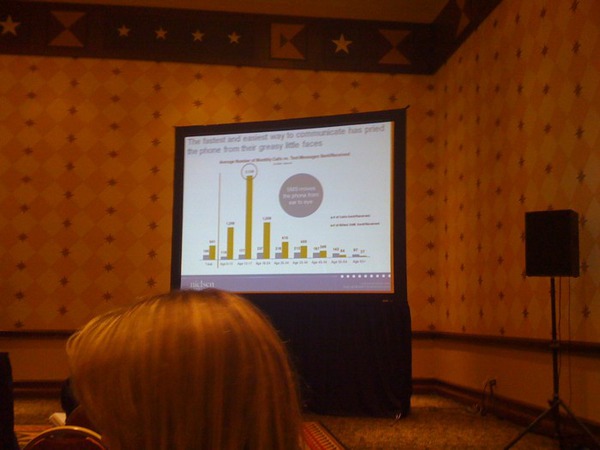
Apps are obviously a growing area.  They have not been very successful on Blackberries since most of these are “enterprise controlled” and downloading apps on them are restricted or frowned upon.  However, the area of most growth is among young kids who are downloading free apps.  Neilsen predicts this area will only continue to grow further.  Texting is a huge area for teens, but particularly among 13-17 year olds.  They text nearly twice as much as any other group (see the photo of the chart.

Overall, Neilsen is keeping a sharp eye on how teens are using mobile – video, texting, apps – because they believe this will drive the future of mobile.

Is WordPress Killing Web Design?

Panel: Dan Oliver, Jina Bolton, Brendan Dawes, Dan Mall, Shane Mielke

Problem is designing within a pre-set structure – structure and sitemap take priority over content and goals of site.  It is a tool that comes in behind the design to see if it fits.  The panel agrees that it creates bad habits if you start thinking that it is the right process to develop sites. It creates a lot of focus on things that are easily changeable like fun headers and footers.  There also get to be issues when people start seeing sites that all look the same.  Some on the panel felt that CMS tools like WordPress are creating a “standard” web design which can be dangerous.

These are customizable, but there’s a heavy reliance on themes.  A well-trained web designer can become lazy by relying on themes, but if you don’t know much, it’s an easy way to learn, get up to speed, and customize your site for your needs.

Scenes from Day 1 @ SXSW

See pictures here…

Tags

Related Posts

Share This

SXSW Scene: Who’s the dude playing four square?

Foursquare playing foursquareKoz and I were leaving the Austin Convention Center tonight and saw these guys playing four square right outside the doors. We stopped to watch and take a few pictures.


It was a fun, retro moment that reminded me of what four square used to mean … and of the new meaning it has taken on in the age of social media.


Little did we know that the guy in the blue shirt in this friendly game was one of the founders of foursquare, Dennis Crowley.

While other up-and-coming brands are spending hundreds of thousands of dollars to get their buzz on at South by Southwest Interactive, this simple game (which cost about $5.99 in sidewalk chalk) had people lined up to play.

Pain Free Design Sign Off

Presenter, Paul Boag, Headscape,writer of The Website Owners Manual

Pain free for the clients – not for you, but if your client is happy, then you are happy. What do clients want to be happy:

  • To understand the process
  • Reassurance about decisions
  • To feel in control
  • To be confident in the end result
  • To personally like the design

It’s about collaboration, not confrontation

6 Principles of Collaboration

1. Ensure the client understands their role in the project – if they understand their role, they understand the process and feel in control.  Make it clear to the client that it’s their job to find problems and it’s the designer’s job to find solutions.  The challenge of most situations is that the clients come back with solutions (make the logo bigger), not the problem.  If they offer solutions, ask them what problem they hope it solves.

2. Have a strong methodology.  Show them your process – how everything on your end works.  It gives them confidence in you and your work.

3. Include the client early and often.  It makes them feel in control and more engaged with the project.  If they feel like they’ve shaped the final result, they’re more invested in it.

4. Educated the client about the decisions being made.  They need to understand how things work – color theory, why things are done the way they are, etc.  You’re giving them ammunition to defend the work.

5.  Ask for specific types of feedback from the client.  Don’t ask them what they “think” – be specific.  Ask them if it meets their business objectives or how they feel their customers/audience will respond.  Asking them what they think puts them into an uncomfortable situation because they’re not design people.  Ask them questions relating to their comfort zone – audience, business goals, etc.

6. Avoid saying no.  Always say yes, but help them think through the process and the consequences of the decision they’re making.  It puts them in control, and helps them weigh the decision they’re making.

Real world practice

1. Kickoff meeting – The client discusses goals and ideas, and you should make them feel passionate about it.  Give them the freedom to feel included.  Ask if there are any other stakeholders – let’s get everyone together and get them excited about the process.  Be sure to get everyone in from the beginning to brainstorm the challenge.  Make it clear how the process will work.  Emphasize that it’s collaborative and what you need from them in terms of involvement and decisions as far as when and how that will happen.  Ask them for words to describe what they hope it will turn out like.

2. Inspiration – Provide look and feel of designs you are aware of that you think they’re looking for.  Explain why you think these example designs have a look and feel that meets their objectives.

3. Moodboards – Quick and easy, spend about an hour per board.  Equivalent to multiple comps.  Show them how the approaches could work – typography, images, style, etc.  Do a few versions until you’re pretty close to what they’re looking for, but make sure you differentiate between their personal likes and what is effective for the audience.

4. Wireframes – Quick drawing of what it would look like – nothing developed too far along.  Work together with them – pencil on paper – and design along with them.  Discuss the organization and content.  Give them time to think it over.

5. Design Mockup – Present only to the key contact at this stage.  Others who haven’t been part of this process won’t have the background.  Give the contact the ammunition they need to defend it when they show others – for his agency that means a video with a full description of what they went through to get there along with explanations so that’s what they can use to present it to others.  When they offer changes, ask why – get to the problem, not what they think the solution is.

6. Design Testing – Test the site for both design and usability to make sure it works.

7. Iterations – Should only be minimal because of the process.

Ways to Deal with Bastards

fat bastardPanel: Lori McLeese, Jason Shellen, Karen Walrond, Brian Mason

The panel consisted of a diverse group of techy folks who’ve bounced around in the business.  It was basically a discussion covering how to deal with four types of difficult people and offered tips for each:

Staff

  • If it’s obvious it won’t work out… don’t be passive agressive or wait… deal with it now.
  • You can’t fire someone simply for being an asshole, but get them to agree it’s not working out.
  • Document by email to make sure you don’t get into trouble.
  • Dealing with difficult staff – TIPS – Timely (deal with it soon), Impact (make sure your message gets across), Private, Specific (be specific about the change you want to see)

Peers

  • Dealing with competitors in a high performing environment – it’s OK to be competitive, but don’t let it get emotional – emotions get in the way.
  • When someone is being a difficult, it’s usually because they are incompetent and you shouldn’t engage someone below your level. It’s actually a defense mechanism that they’ll only dig their heels in further.

Business Partners

  • Set expectations up front, in detail, vocalized, and documented repeatedly.
  • Look at choices – can you or can’t you work with them.
  • Partnership is a 2 way street. If they violate your core values, abandon the partnership.

The Boss

  • Deal with it, or look for a way out.

Tags

Related Posts

Share This

Organizational Pitfalls on the Path to Multichannel Experience

Discussion lead: Zachary Jean Paradis, from Sapient

Despite the complex title, it was really about the challenges of making sure your marketing message is consistent across a lot of different media outlets. The primary challenges involved “traditional” organization structures which focus on siloed bits of information or roles. Even with the best communication, it is quite a struggle to get these messages spread from the top-down. Adding to the challenge are the use of multiple agencies and multiple countries/locations.

In the realm of changing organization structure, someone from Walmart mentioned that they had recently combined all of their e-commerce efforts under a “global e-commerce” area to ensure they were consistent. Several groups talked about fluid environments – involving folks from many different areas – and creating “execution teams” or groups charged with implementing a particular campaign/messaging effort. These groups are incentivised based on their success at accomplishing a common goal, which, in theory, creates a multi-channel effort. While focusing on the overall success of the communications goal, it is still tremendously important to focus on channel revenue attribution (a fancy way of saying, “take a look at how much each media contributes to sales”). By doing this, you’ll be able to track how successful each channel is and provide the best ROI for your efforts. It’s important to keep the customer service/front line folks in the loop, as they’ll be key to letting you know what is really working – even helping to measure by asking the simple, “how did you hear about us,” or “what made you call.”

There were several groups – both on the agency side and the brand side – which talked a trend toward “customer experience” consultants.  Folks from Mother and Naked Communications,talked about a focus on understanding the needs of the customer and delivering a story and promise no matter what form this may take.  Someone from USAA reinforced this point, stating that they didn’t set forth to build the first iPhone app that lets customers deposit checks simply by taking a picture of it, but it came out of ideas to make the customer experience easier (How do they let military men/women who move around alot and may have limited access to the internet while on duty do business easier/better).  Brands need to closely monitor customer needs and deliver on their brand promise.  New tools, like Twitter, Yelp, etc. make it easier to find our what their frustrations are and where your brand may not be delivering consistently on its promise.

Finally, there’s a fine line between delivering your message across multiple channels and “spam.”  Be sure you’re not saturating the market with your message.

Friday night fire drill at SXSW. Fun.

(1327 KB)
Watch on posterous

Sent from my iPhone

Posted via email from bettywriter

Tags

Related Posts

Share This