Mobile Content is Social

Presenters: Michael Sharon – Facebook , Tom Watson – Facebook, Justin Shaffer – Hotpotato

By itself, mobile devices are immersive – it’s always with you and provides a way for you to exist in a physical or mental place other than where you currently are.  Tools that have been added to those devices have made them “social hubs,” allowing you to connect with others almost anywhere.  There are several things which will continue to evolve to make it even more social.

Friends – Above all, users will tell and demonstrate that this is most important.  However, the debate is what information people want from their friends.  When Facebook changed its mobile friend feed from alphabetized to most recent, it saw an enormous spike in use.  The next debate is figuring out if people want to see the “Top News” or “Most Recent.”  More and more, you’ll see a combination of your Facebook contacts merging with your address book to make sure you have the most updated contact information as well.  Finally, Facebook Connect is even making the gaming experience more social as people can connect games and apps to their friends.

Notifications – There are two types of notifications people are interested in – Active, or what’s happening now, and Passive, or what’s happened since I last checked.  While “push” features make active notifications easier, there’s a fine line between wanted updates and spam.  Therefore, it is extremely important to test this feature before implementation.

Sharing – Facebook knows that people want to share photos (and more and more video and audio).  What has helped this explode has been the speed at which someone can post a photo from a mobile device, and the added ability to “tag” people in photos.  Tagging photos has significantly increased photo viewing as sharing photos becomes a social experience.

Serendipity – The introduction of location based services help you figure out which of your friends is nearby.  This feature has already been implemented by Foursquare, Gowalla, HotPotato, etc.

Discovery – While finding out a friend is nearby is serendipitous, there’s also the potential to discover new people or events.  Mobile offers the ability to do this even better, but what we have yet to see are the privacy implications and the ability to see both your friends and people you don’t know who are nearby (or at the same event).

Control – There has been an explosion in where you can post content.  The same photo/message can be uploaded to Twitter, Facebook, Flickr, YouTube, etc. in the click of a button.  Users want to know how they can decide where to send it, and “take it back” if necessary (which apparently happens WAY more often than you might think).

Intent – Tools need to be designed to elicit the response you’re looking for.  Make it easy to find the way you want people to participate and put it right up front.

Feedback – Commenting provides a cycle of reinforcement and mobile makes this instantaneous.  Feedback is essential, whether it’s comments or Rewards (like Foursquare badges or Gowalla virtual items). Giving somebody something to respond to makes it social.

Mobile becoming more social will be driven by 3 things – Touch, Speed, and Connection

Touch – How it’s designed and what it information it can allow you to share.  An emerging element of touch is a phone that automatically monitors things – temperature, location, weather, altitude, etc.  Things must be designed for the medium (Facebook’s mobile experience diverges significantly from its web experience) and the context in which it will be used.

Speed – Devices are become faster and can do more, but it’s also about the speed of transferring information through networks (getting this information into the cloud and not just onto the device).

Connection – API’s will rule the future.  It’s about connecting all of your networks and information together and allowing the user to determine how/when/what/where/etc. is shared.

Customer Service Goes Social

Presenter: Melanie Baker, Postrank

Technology has increased consumers’ expectations for speed and response, and companies have to adapt to provide the level of customer service that’s now expected of them.  Customer service tends to be a bottleneck simply because the amount of people who are “assigned” to do this is limited – there’s typically a “customer service center” or “response center.”  While these are certainly necessarily for efficient business, company cultures must change so that everyone is a customer services advocate.  Even if they can’t directly help or answer the questions, customers want to know that they are being dealt with personally and with sincerity – no matter how they decide to contact you (phone, Twitter, email, etc.).

Baker suggests starting by having everyone in your company go through the same training as the “customer service” people.  Even if it isn’t “in their job” to handle customer service, they need to be prepared to do so if the situation presents itself.  Provide education and resources on how to handle situations.  Opening up this information to everyone in the company – rather than limiting access to it – makes for a more customer-centric organization.  And as consumers take to talking about your company in social media, everyone is prepared to assist (when appropriate), and it’s not just shoved off to “the people whose job it is,” – great customer service should be everyone’s job.

New Rules of Marketing & PR

Presenter: David Meerman Scott, New Rules of Marketing & PR

No one doubts that the rules have changed and social media has made it necessary for businesses to interact with and engage with customers and potential customers.  If companies want to be successful in this new world, Meerman suggests a few principles they’ll have to abide by.
Lose control – Brands don’t just have to adapt and change to their customers’ wants/needs, but they should let their customers help them shape the brand.  It lets them feel most engaged with the brand and makes them more likely to evangelists of your brand.

Be human – Customers are individuals and they want to be dealt with on a one-on-one basis.  They want to deal with a person, not a big faceless corporation, and they want to be genuinely listened to.

Nobody cares about your products except you – People care what they do for them (make their lives easier, better, etc.).  Highlight the benefits and services you provide and don’t use big, fancy, or irrelevant language to talk about them (See The Gobbledygook Manifesto).  Find out the information people are looking for – which you are an expert in – and give them content.  Every brand should be constantly putting out content that illustrates its values and is relevant and interesting to their target consumers (Brand Journalism).

Create triggers that encourage people to share – If people love what you provide them, give them a way to share it with others.  Give them both a method and very subtle reminders to do so.

No coercion required – If people love you, they’ll want to share your message or talk about your brand.  Strive to be the type of brand people want to tell others about – Apple, HP (video), etc.

Stop making excuses – These are the new rules, and the only reasons not to follow them are self-imposed.  It doesn’t matter what your product/service/industry is, anyone can follow these rules.

Media Relations Goes Social

Presenter: Capt. Nathan Broshear, US Air Force

The US Air Force has recognized the power or social media and has been actively opening up its network allowing every airman to post their experiences (in photo, video, etc.) to their personal Twitter, Facebook, etc.  Their goal is to humanize military members, and they feel that this helps enable that mission.  Of course there are concerns about what they may post, and geolocation as part of social media is creating concerns, but as Broshear put it, “you’ve got a 26 year-old kid in charge of a $50 million airplane, and you’re not going to trust him with a Facebook page?”

Obviously, during times of crisis, war, etc. the military is sought out by the media for information.  “I don’t have to find them,” says Broshear.  “They find me.”  Social media has made it easier than ever for media to connect with their public affairs officers.  The Air Force has stopped sending out press releases and manages their relationships with various media through social networking  outlets.  “Only 16 percent of people trust PR people,” says Broshear, ” but 70 percent trust people like themselves or their peers.  It only makes sense to connect via social networks and build relationships with people.”

The theme is that social media enables relationships – which is essential for PR people.  People are coming to the Air Force for bite sized pieces of information when they need them, and that’s a benefit that social media offers.  They are always connected to each other through social media and the flow of communication goes both ways.

Crush It! with Gary Vaynerchuk

Gary Vaynerchuk, Author of Crush it! – Cashing in on your passion

Filled with energy, gratitude, and passion Gary Vynerchuk demands attention (and it doesn’t have to do with him dropping the regular f-bomb).  He’s passionate about what he does and is an evangelist for using your passion to promote your love on the web.  He’s all about using social media to connect with individuals, whether its for your personal brand or your business.

He’s passionate about his belief that everyone is, or should be, in the customer service business and technology is only making that more necessary.  He relayed a story about his brother showing up at a restaurant after calling for a reservation.  They told him he’d have to wait, so he pulled out his phone to call to let people know, and as soon as he pulled out his phone, the hostess told him she’d find him a table immediately.  In the age of social media, and review sites like Yelp, companies are starting to realize they have to change the way they do business and start paying attention to customers needs.  “Word of mouth connects us to good shit, or tells us what to avoid, and that’s the new way of the world,” says Vaynerchuk

Vaynerchuk believes in investing in customer relationships, showing you care for them, and eventually it will pay off.  He says, “everyone is trying to be a 19 year-old dude – they’re trying to close too fast.”  Every business needs to be providing their customers/communities with the attention and content they’re looking for.  Content has never been more valuable, and everyone is in the content business.  People told him his book wouldn’t sell (it made the NYT best sellers list) because he “gave too much content away,” but he believes we live in a “thank you economy” where people are appreciative of his knowledge and buy because of the trust and relationship that has been built.  “You have to care and do good first,” he says, “it’s the only way to convert.

Twitter’s ‘@anywhere’ Third-Party-Integration App Announcement

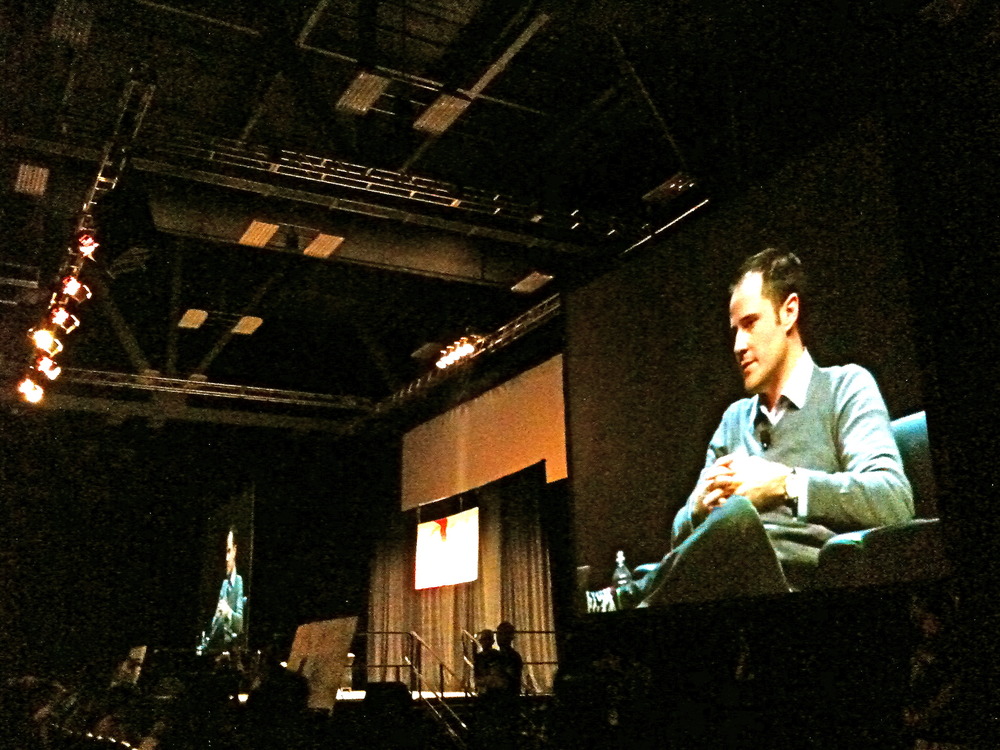
Just a quick follow-up to the video clips Koz posted yesterday from Twitter co-founder and CEO Evan Williams’ SXSW Keynote interview:

  • There’s been a flood of analysis, opinion, and information on the heels of Williams’ (@ev) announcement of the new Twitter third-party-integration application, “@anywhere.”
  • If you’re not currently a Twitter user, the ability @anywhere will provide to seamlessly mesh Twitter with other sites, such as The New York Times, Amazon, and eBay, and let users share links and add “follows” without leaving the sites, may certainly bring more users to Twitter.
  • Here’s a good write-up from TechCrunch about the features and third-party partners (so far).

I can easily see how @anywhere will change the way I use Twitter. It may sound silly, but I also get how it aligns with Twitter’s No. 1 company principle: Be a force for good.

As @ev said yesterday, “Access to information … is about reducing the walls between influencers and the influenced. Democratization of information changes the world.”

What does corporate America think of 2.0?

Do mainstream companies get Twitter? Are executives in non-high tech industries embracing social technologies and the communities that form on top of them, or are they scared to death?

A report from the field was delivered at South by Southwest Interactive today by MIT scientist Andrew McAfee, who coined the phrase “Enterprise 2.0.”

McAfee laid out some good news and some bad news about the corporate mindset on the free-form collaboration that is 2.0, and offered some advice on how to talk to your boss about social tools that are evolving around the user:

  • Corporate mindset challenges: We are risk-averse, busy, budget constrained, uninterested in social revolution, hostile to auto-obsolescence, ROI-seeking, and convinced of our own uniqueness.
  • Some good news: We can be swayed by theory, evidence, narratives, peers; we’re afraid of being left behind.
  • Talking to the boss: Present theories and frameworks, not jargon. Use data, case studies, and narratives. Make it relevant to our business; combat “time-wasting narcissism” perceptions about social tools.

According to McAfee, social software is maturing and we’re beginning to see more evidence of the business benefits of 2.0 (McKinsey Study, CEO case studies). Only time will tell if a tipping point is in the cards.

For more highlights, see the Twitter stream from today’s event. More at SXSW Report.

Presenter: Andrew McAfee, Principal Research Scientist, Center for Digital Business, MIT Sloan School of Management. Contact: @amcafeeamcafee@mit.edu. Resources: 2.0 Adoption Council

Web Series 2.0: Big Campaigns on Digital Dollars

Panel: Melissa Fallon – Davie Brown Entertainment, Chris HanadaRetrofit Films, Milo Ventimiglia – DiVide Pictures, Wilson ClevelandCJP Digital Media, Andrew Hampp – Ad Age

Media is increasingly fragmented and more and more people are turning to the web to get both information and entertainment.  One of the panelists noted that even TV executives mentioned that their kids don’t watch TV anymore, but instead view shows on the web.  Many brands are moving some money over to digital, particularly for online video.  However, the perception is that digital is cheap.  While many are willing to “work with what you’ve got” you can certainly do better work with better budgets.  The challenge with getting those budgets is is that there are few examples out there and many still think in terms of traditional media measurement.

“”Big brands tend to say, ‘give me something that’s never been done before… but I want you to give me examples of how it has successful in other places’,” said Melissa Fallon of Davie Brown Entertainment.

Since paid media is, paid, you are guaranteed eyeballs, but that’s not something that online video can deliver.  The real challenge is distribution and syndication.  Partner with your existing fan networks to let them share your message.  For example, a video series for IKEA was successful by getting the top 10 IKEA fan blogs to post and promote the online episodes (the blog that directed the most traffic got a spot in the season finale).  People aren’t going to seek out your show, you have to go to where they are and put it in the channels where they are.  However, you can also use paid media effectively to cross promote your web videos.

What is most effective is when you can pair a brand with a creative way to tell a story online.  Good content is good content, whether its on the web or on TV – content really is king.  The challenge is really determining what your brand is about and then finding a compelling way to tell that story.  In a way, Chief Marketing Officers need to be like producers and movie studio execs – they’re investing in something that they want to make sure it is successful.  Especially as brands begin building their own content – which is necessary, because no one understands their business or industry better than they do, and they should make sure their brand sentiment is the one that people see.

The challenge for big brands moving forward is that online video and storytelling is now accessible to anyone.  A small brand or unknown player in your industry has the same (if not easier access to) things like YouTube and other social media outlets – and if they’ve got a compelling story, they’ll get the recognition and set the bar in your industry.  For example, “The Temp Life” is a web series created in 2006 for Spherion.  Their challenge was they had trouble building loyalty among their temps.  Therefore, the webisodes highlight that the brand knows the jobs aren’t always great, but we can empathize with you.

Finally, big name talent has started to play in the online video and social media space.  The key is getting them involved and engaged with your story or project.  Right now, it’s not necessarily about the money for them, it’s about collaboration.  They’re doing it because it’s fun, its different, and they feel like they can be part of the creative process.  When a big name brand is attached, the actors also feel more comfortable that it’s not completely going to flop – there’s money and credibility behind it.

Evan Williams SXSW Keynote

Here’s a few quick clips from the Evan Williams Keynote conversation…


Gary Vaynerchuk Now

Here’s a quick video from the Gary Vaynerchuk presentation going on right now.

Privacy, publicity, and micro-blogging in the dark.

Danah Boyd delivered opening remarks today at South by Southwest Interactive. This image is a graphic recording of the event

One of the world’s foremost authorities on social networks, Boyd works at Microsoft Research New England and also serves as a Fellow at the Harvard University Berkman Center for the Internet and Society.

In a very large, very dark ballroom at the Austin Convention Center, I micro-blogged keynote highlights on Twitter. Here’s a link to posts from the event:

South by Southwest Interactive Keynote: Privacy and Publicity with Danah Boyd.

Booze and Blogging

Presenters: @livethelushlife, @bebellanti, @johnwise, @titosvodka, @thrillist

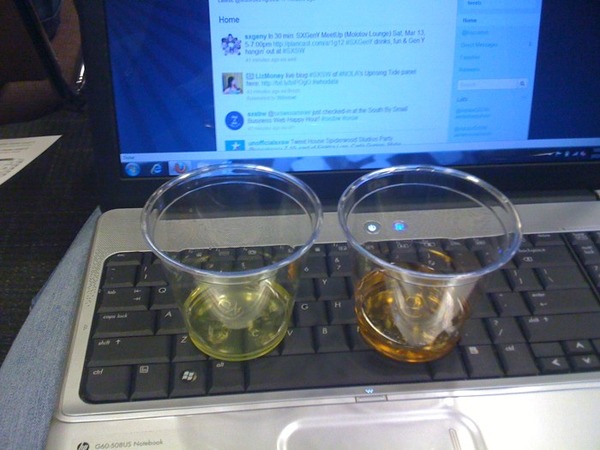
It’s 5 pm on Saturday, so I’m “off the clock.”  That’s why my last SXSW session was this one.  BONUS: This one involved trying booze while I was blogging this (see the picture here).

First, I learned that the first “viral drink” is the “Pickelback” (seen here) which involves taking a shot of Jamison Whisky and then a shot of pickel juice.  The pickel juice completely eliminates the whisky flavor and leaves a little warm spot in your belly.  It became a “viral drink” after it was reported that Pickles were more popular than Canadian rockers Nickelback on Facebook.

Tito’s Vodka has become a “word of mouth” brand here in Austin and has spread.  It started to spread locally, but took off with the introduction of Twitter.  Now they’ve moved to Facebook and try to enable others to “share the Tito’s love.”  They’ve started doing a newsletter and videos on Twitter.   There’s more to it than just vodka, Tito has a real story and according to the presenter, he’s a “love bomb.”  His video outakes are “YouTube gold.”  There is a man behind the brand and their marketing team makes efforts to be personable and show that there are real people behind the brand.

It’s not all fun and drinking.  Bloggers/marketers in this area have to follow liquor laws and regulations and are held to the same marketing measurement standards as any other group.  However, social media is social and it is particularly effective in this industry.