More than a Crowd at SXSW this Year

Attendance at SXSW has grown by leaps and bounds the last several years.  In 2009, attendance at the Interactive portion of the conference was around 10,000.  Last year, for the first time, the interactive crowd overtook the music crowd with over 14,000 attendees.  If growth holds true, they are expecting nearly 20,000 people to attend SXSWi this year.  In a previous post, I highlighted a post from Robert Scoble, who wondered if SXSWi has gotten too big to be the meaningful experience it once was.

Here, I guess Bettywriter and I did a pretty good job covering the event last year, because we’re now aware of many more Central Illinoisans attending.  Of course, we know it’s not just our reporting skills, it’s the topics and companies that use SXSW as a platform to highlight their cutting edge products and services. Along with being able to rub elbows with cutting edge thinkers, it’s invigorating to be around so many people that share innovation, technology, and creativity as a passion.

Just here in Blono (that’s Bloomington-Normal for short for non-locals), we’re aware of at least 21 people going for the interactive portion alone.  I’m certain they’ll have a great time and come back with a renewed energy and enthusiasm for digital, creative, and new media.  The more that can bring this feeling back to Central Illinois, the better.

While we certainly invite anyone attending SXSWi to join us in blogging and reporting from the event, we hope those locals attending will join us on this blog.  If you are attending SXSWi and would like to participate in sharing your SXSWi experience and knowledge here, please contact us.

Challenge: build “MicroSXSW” to bring back fun at SXSW

I read a great article from Robert Scoble on his blog Scoblizer about the growth of SXSWi. He discusses the explosive growth of it, and what can be done to bring back some of the intimacy and true connections that make this a great growth and learning experience.

Do we turn SXSW into something that really becomes a parody of itself, or do we try to save it?

Me? I want to get more of those intimate experiences we used to have. I remember when the entire Web Standards Project fit at one picnic table. I remember having a fun conversation with a small group, all huddled around Craig Newmark in the rain at a BBQ place across the street. I remember being able to get into parties without being a VIP and last year the VIPs even had to wait in line at nearly every party. Heck, I remember when Scott Beale Tweeted in 2007 that he was sitting all alone in an empty pub and I joined him and had a leisurely beer at a picnic table with him and a few other friends. Those days are seemingly gone.

Can we bring them back?

Visit An industry challenge: build “MicroSXSW” to bring back fun times at SXSW at Scoblizer to give your input and suggestions.

10 Things I Learned (or re-learned) at SXSWi 2010

Last year was my first SXSW and nothing short of a personal epiphany. This year’s Austin mashup of technology, creativity, and cultural tsunami has once again shifted the way I think about what it all means— to my work and to my life:

10. Crisis = Opportunity.
How do we take advantage of the disruptive innovation that’s toppling business models? Jeremy Gutsche is the founder of TrendHunter.com, the world’s largest network for trend spotting and innovation. He’s also the author of, “Exploiting CHAOS: 150 Ways to Spark Innovation During Times of Change.” There’s one question from Jeremy that I’m now asking myself every day; a question designed to help capitalize on chaos: Can I focus what I’m trying to do in seven words or less?

9. Technology is the new art. 

The notion of left brain/right brain is passé. My ability to adapt and thrive at the intersection of art and technology presents endless opportunities. My insistence on playing on one side, to the exclusion of the other, is an express ticket to irrelevance. What can I do to recast my skills and be ready for whatever comes next?

8. Be a student of “The Next Big Thing.”
Then, step back and see the big picture. There’s a “next big thing” breaking out every day. Great branding and communication isn’t about throwing stuff at every next big thing. It’s about being helpful, relevant, and genuine in the marketplace. I need to understand the difference between “thin value” and “thick value” and do the right things to be relevant every day, while strengthening value over the long haul.

7. Content is king.
So why has it taken us so long to figure out that content requires user-centered message architecture? According to Margot Bloomstein, the principal of brand and content strategy consultancy based in Boston, a comprehensive user experience shouldn’t be a carrot on a stick where we try to lure people to our content on our terms. It should be a big, delicious plate of cookies carefully crafted ingredient by ingredient.

6. Words won’t work.
Dan Roam has helped leaders at Microsoft, Wal-Mart, Boeing, eBay, and the United States Senate solve complex problems through visual thinking. He wrote the international bestseller, “The Back of the Napkin: Solving Problems and Selling Ideas With Pictures.” Why do we spend so much time talking to clarify our ideas? The person who draws the best picture wins. My goals: Fewer words. Better pictures. Stronger stories.

5. I didn’t know Twit.
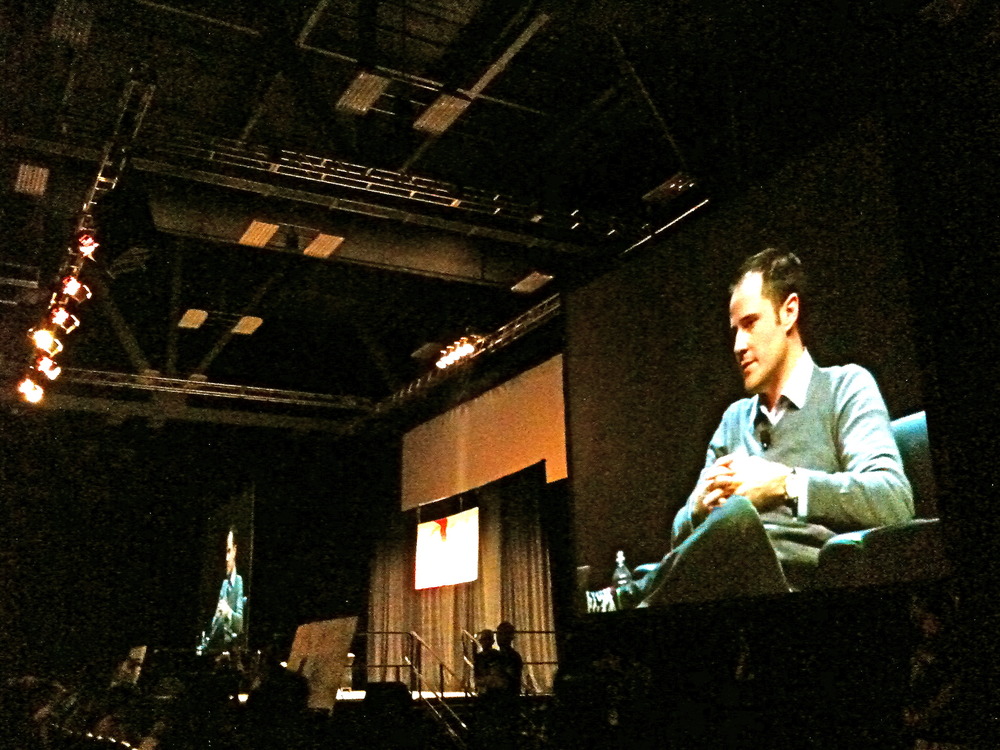
Twitter is my primary news source. The shape, speed, and value of information on Twitter is unlike anything we’ve ever seen. At SXSW, Twitter co-founder and CEO Evan Williams changed the way I think about it. The No. 1 company principle @twitter? Be a force for good. Why? Democratization of information changes the world. Tools like Twitter reach the weakest signals and can have profound impacts (think Haiti, Chile). Easy exchange of information gives people control. Everyone wins.

4. Corporate America is cautious.
Andrew McAfee is a research scientist at the Center for Digital Business, MIT Sloan School of Management. He researches and works extensively with corporations around the “2.0” model of communities, collaboration, and transparency. According the McAfee, the biggest corporate mindset challenges to embracing 2.0: We are risk-averse, busy, budget-constrained, uninterested in social revolution, hostile to auto-obsolescence, ROI-seeking, and overly convinced of our own uniqueness.

3. There’s no such thing.
There’s no such thing as social media or social marketing. It’s media. It’s marketing. It requires interesting, clear, helpful, user-focused content like it always has. There’s no such thing as Web content, mobile content, tablet content, Wii content. Everything is converging and users just want it to work and work right everywhere.

2. Technology = inclusion.
I tweeted. I posted. I photo’d. I video’d. I checked in. Got followed. Got retweeted. Direct messaged. Played contact and conduit. This is where I belong … with one foot inside the office and one on the path to the future of media.

1. After living in the future for five days at SXSW, I need to ask more questions:

  •  What are the right levers for change?
  • How do we create the right measurements of success?
  • What can I do to help solve problems, not solve symptoms?
  • How do I help strengthen our resolve as communication consultants that “less bad” is not the same as good?
  •  What can I do to help move the friction of process to real momentum and flawless execution?

Every profession bears the responsibility to understand the circumstances that enable its existence.

Top 10 Things I learned from my SXSW Experience

  1. Share your passion.  “Keep Austin Weird” is the motto of the SXSW home city, and it’s really about celebrating the passion people there display.  Whether it was art, films, music, or interactive, everyone wore their passion on their sleeve, and it’s a freeing, collective sense of, “these people get me.”  Whether you’ve quit your day job to pursue your passion (and you’re “crushing it” thanks to Gary Vaynerchuk), or simply geek out with others who share yours, it can be invigorating and life changing.
  2. Tech Geniuses are people too.  It was truly amazing how accessible people were at SXSW, from bumping into new media reporter Robert Scoble, riding the social media bus with Social Media Club Founder Chris Heuer, riding the elevator with Jamie Lynn Sigler (although not a tech genius, it was still very cool!), meeting author and social media evangelist Gary Vaynerchuk, to meeting and chatting with Twitter CEO Evan Williams.
  3. Location, location, location.  After Facebook and Twitter, everyone’s been wondering, “what’s next?”  It was evident at SXSW that Location Based Social Networking is emerging as the next big thing.  Like any social network, the power of it is in the number of people using it, and while it was estimated that only about 30-40% of the tech geeks at SXSW were using it, it showed some incredible potential.
  4. Content, content, content.  People turn to the Internet and social media to get information that’s entertaining and immediately relevant to them.  If you’re a company, your product must be relevant (at least at one point in peoples’ lives), and fortunately, you’re an expert in that area.  Brands are already prepared with answers to questions when people call them, but they need to post it where people can find it when they go looking for it.
  5. It’s how you use it (your content).  It’s not enough just to push your content.  As National Geographic pointed out, it’s using your content to provide a contextual experience.  Think about the user experience and how your content can enrich their experience.
  6. Openness is the new Transparency.  Twitter CEO, Evan Williams, used the analogy of a door, “It can be transparent and you can see through it, but when it’s open, it’s about getting in, shaping it, and defining it.”  While most companies still struggle to be transparent, most consumers have moved past transparency and expect to be able to define and shape those they choose to work or do business with.
  7. Sponsorships that make Sense.  Chevy sponsored by the “Volt Lounge” – a place to relax, get work done, and power up – as well as providing power-strips at many of the outlets around the convention center.  Not only did this provide a MUCH needed service to the many attendees who carried multiple devices, but it also had a very direct tie-in to the launch of the Chevy Volt, their new electric car.
  8. You can’t do it all.  There were approximately 15-20 interactive sessions going on during any given hour at SXSW.  Despite wanting to learn it all, you can only do so much (although Twitter allows you to attend 2-3 sessions at a time).  Likewise, there are so many new technologies to try out, there’s no way to keep up.  Try as many as you (sanely) can and count on the other tech thinkers to help you filter the winners.
  9. Mobile location still has a long way to come.  There are many, many different ways for a mobile device to access location – GPS, Cell-ID, Triangulation, etc. – and there are even more ways to try to use that information.  When building apps or programs that use location data, there are many different advantages and disadvantages to the way you choose to use it.
  10.  You can’t fake authenticity… and social media is all about authentic engagement with your customers and prospects.  You can’t scale it and you can’t farm it out to someone else to do on your behalf (or worse, give it to the intern who doesn’t yet understand your culture).  As Gary Vaynerchuk put it, “people’s bullshit detectors are better than ever.”  You have to treat social media interactions the same way you would as if the person was sitting in front of you – they want to feel like you’re listening and genuinely care about them.

SXSWi is Finished, but We’re Not

SXSW is one of the busiest, most intense new media experiences I’ve had. Each day was long with between 4-10 sessions and workshops each day and networking activities until the wee hours of the morning. Over the next few days, we’ll summarize most of those activities, and give some of our own thoughts and analysis on the goings-on at SXSW. Stay tuned!

Customer Service Goes Social

Presenter: Melanie Baker, Postrank

Technology has increased consumers’ expectations for speed and response, and companies have to adapt to provide the level of customer service that’s now expected of them.  Customer service tends to be a bottleneck simply because the amount of people who are “assigned” to do this is limited – there’s typically a “customer service center” or “response center.”  While these are certainly necessarily for efficient business, company cultures must change so that everyone is a customer services advocate.  Even if they can’t directly help or answer the questions, customers want to know that they are being dealt with personally and with sincerity – no matter how they decide to contact you (phone, Twitter, email, etc.).

Baker suggests starting by having everyone in your company go through the same training as the “customer service” people.  Even if it isn’t “in their job” to handle customer service, they need to be prepared to do so if the situation presents itself.  Provide education and resources on how to handle situations.  Opening up this information to everyone in the company – rather than limiting access to it – makes for a more customer-centric organization.  And as consumers take to talking about your company in social media, everyone is prepared to assist (when appropriate), and it’s not just shoved off to “the people whose job it is,” – great customer service should be everyone’s job.

SXSW Video: Podcast Playground

PepsiCo’s Podcast Playground was back again this year, and it appeared to be a busy place throughout South by Southwest Interactive. One day, I stopped to watch a live Blip.tv interview with LLCoolJ about his latest venture, boomdizzle.com. The PepsiCo Zeitgeist was also on display, mining Twitter conversations and presenting trends in real time. Here’s a quick video of the Playground …

Click for  Video

SXSW Video: Chevy Volt Recharge Lounge

Before South by Southwest Interactive, I put up a post about Chevy’s SXSW marketing efforts––including plans for the Chevy Volt Recharge Lounge. Just wanted to share a quick look at the lounge. I didn’t see a lot of people using the technology, but all those power outlets sure got a workout.

Click here for Video

SXSW Video: A little help from my friends.

It’s been five, long, jam-packed days. Koz and I will keep working to post more sights, sounds, and insights from South by Southwest Interactive 2010.

There’s certainly no shortage of interesting spaces where “digital creatives” connect during SXSW to do what they do. Here’s a peek …

Click for video

Twitter’s ‘@anywhere’ Third-Party-Integration App Announcement

Just a quick follow-up to the video clips Koz posted yesterday from Twitter co-founder and CEO Evan Williams’ SXSW Keynote interview:

  • There’s been a flood of analysis, opinion, and information on the heels of Williams’ (@ev) announcement of the new Twitter third-party-integration application, “@anywhere.”
  • If you’re not currently a Twitter user, the ability @anywhere will provide to seamlessly mesh Twitter with other sites, such as The New York Times, Amazon, and eBay, and let users share links and add “follows” without leaving the sites, may certainly bring more users to Twitter.
  • Here’s a good write-up from TechCrunch about the features and third-party partners (so far).

I can easily see how @anywhere will change the way I use Twitter. It may sound silly, but I also get how it aligns with Twitter’s No. 1 company principle: Be a force for good.

As @ev said yesterday, “Access to information … is about reducing the walls between influencers and the influenced. Democratization of information changes the world.”

Get SXSW Slides

There are only two of us, and we’re making it to as many sessions as we can, but if you’d like to see some slides from additional sessions at SXSW, take a look here (if you have access to slideshare.net) – http://www.slideshare.net/tag/sxsw2010

View more presentations from Daniel Burka.

What does corporate America think of 2.0?

Do mainstream companies get Twitter? Are executives in non-high tech industries embracing social technologies and the communities that form on top of them, or are they scared to death?

A report from the field was delivered at South by Southwest Interactive today by MIT scientist Andrew McAfee, who coined the phrase “Enterprise 2.0.”

McAfee laid out some good news and some bad news about the corporate mindset on the free-form collaboration that is 2.0, and offered some advice on how to talk to your boss about social tools that are evolving around the user:

  • Corporate mindset challenges: We are risk-averse, busy, budget constrained, uninterested in social revolution, hostile to auto-obsolescence, ROI-seeking, and convinced of our own uniqueness.
  • Some good news: We can be swayed by theory, evidence, narratives, peers; we’re afraid of being left behind.
  • Talking to the boss: Present theories and frameworks, not jargon. Use data, case studies, and narratives. Make it relevant to our business; combat “time-wasting narcissism” perceptions about social tools.

According to McAfee, social software is maturing and we’re beginning to see more evidence of the business benefits of 2.0 (McKinsey Study, CEO case studies). Only time will tell if a tipping point is in the cards.

For more highlights, see the Twitter stream from today’s event. More at SXSW Report.

Presenter: Andrew McAfee, Principal Research Scientist, Center for Digital Business, MIT Sloan School of Management. Contact: @amcafeeamcafee@mit.edu. Resources: 2.0 Adoption Council