
Transmedia Storytelling
 Presenter: Barbara R. Vance
Hashtag: #brvance
With traditional storytelling, the audience enters at a certain point and exits at a certain point. There’s control over when it begins and ends. With transmedia storytelling, you’re creating a world where people can enter and continue following the story as far as you take it. Transmedia storytelling allows you to take a story beyond a one-off, it’s a deeper story which allows you to create more. Transmedia storytelling is about building a good story, it’s not necessarily a “marketing gimmick,” but good marketers know how to tell good stories.
If you want to build a good story, you first need to deeply understand 3 things – The Character, The Plot, The Story World. In order to keep this information straight, you need to keep in a database – because you need to know it all, inside and out. Central database so all contributors know the world and keep the stories consistent. This is your foundation, cohesion, and it makes your world easier to develop. You need to know the story even deeper than what you actually reveal to the audience. You can use this technique to drop in hints and information that is revealed later. The only way to have good forshadowing is to do this.
Character
A story is not about a character, it’s about many characters, a network of characters. The job of the other characters is to make the main character real and flesh them out. You don’t need to tell people about a character, we should learn about them by watching them interact with other people, and you need that network to show how they compare to others.
We like stories because we like to understand ourselves, and we want to get a certain emotion out of it. This means, as a writer, you are a slave to the audience. Keep your audience in mind and what they’re looking for, and offer that to emotional connection in your story.
Character traits:
Selectivity – Only choose traits that are relevant to the story, and when you’re developing the character, you need to only reveal things that are relevant to the story. It’s OK to have quirks with a character, but it needs to have some relevance to the story. People pick up on these things and try to anticipate how it will be applied, but only give as much information about a character is needed. Don’t forget that the more information revealed about a character, the more perceived importance there is.
Reason Why – Why does the character have the traits they have? it needs to be strategic about why they do it. For example, it wasn’t until the 3rd movie we learn why Indiana Jones hates snakes. But what it revealed was that he was adventurous, even as a boy, and has a heroic streak. Constantly ask yourself why surface traits matter on a deeper level, as it helps you build character traits across stories.
Play off each other – Character traits should play off of each other. They should be fun. If you’ve got someone who can’t stand pompus people, put him in a room with them. Capitolize on purposeful inconsistencies in characters. If your hero is perfect all the time, and doesn’t have inconsistencies, they’re not a human character, but make sure they are consistent inconsistencies.
Archetypes
They provide a universal form to build the foundation on which your story sits. There’s no shame in building a story on archetypes, but make sure you make it a somewhat unique archetype. Gives the audience a foundation of understanding, relateability to how we understand people. People come to the story faster when they know a little of what to expect from the person. That’s why many transmedia stories are based off of superheros – because they’re easy to understand.
Hero vs Main Opponent
They are the 2 most important people in the story, and the audience should know and care more about what’s going on with these two than anyone else.
HERO
Flawed – If you’re hero doesn’t have problems, he won’t be genuine, won’t be relateable. If the audience can’t find a bit of themselves in the hero, they won’t be able to relate to them.
Interesting/Quirks – They have some interesting little things that make them unique.
Mysterious – We want to know more about this person. As a writer, you have to plant this mystery. For example, in the opening scene of Mad Men, we see him look at a purple heart – reveals there is something about him we don’t know. That’s where you go back to the database and know what is revealed and when.
Moral problem – The hero always has an issue they are dealing with. The opponent challenges the hero, forcing them to restle with it more.
Tries Options – The hero will always try to take the easy way out first. It makes the story build along with the pressure to succeed.
Opponent
– They should always be as fleshed out of a character as the hero – if not, they don’t seem formidable
– Wants the same thing as the hero – this is what creates the conflict
– Not necessarily someone the hero hates – but they kind of hate each other because they want the same thing
Event = Change
If something happens, it’s a transition in the plot. Every event needs to elicit a change. The hero needs to be under pressure the entire time, and these changes amount to a greater amount of pressure on the hero. For example, the hero should embody this quote from Martin Luther King, “The true measure of a man is not how he behaves in moments of comfort and convenience but how he stands at times of controversy and challenges”
Story & Character Progression
Introduce Hero -> Reveal Hero’s True Nature -> How true nature is at odds with outer appearances -> Pressure -> Climax -> Hero is changed
Your story is about polarity and it’s about a balance. The good guys get something and bad guys get something – back and forth. For example, here’s the story contradiction from Lord of the Rings illustrated whether it was positive or negative for the hero Frodo:
+Frodo has the ring -almost encounters Ringwrath +Encounter Strider -Ringwrath attack +Strider fights them off -Frodo wounded +Frodo healed +frodo gets a fellowship +Frodo says, I will take the ring -cannot pass over the mountains -Mines of Moria -Orcal -Baltrog
The audience has to feel like no one has the upper edge for too long, so you have to make sure you keep the ball in the air, going back and forth like a tennis match. The conflict progression gets worse and worse with constant rising pressure. You have to make these changes big and extreme, because the audience finds a middle ground boring.
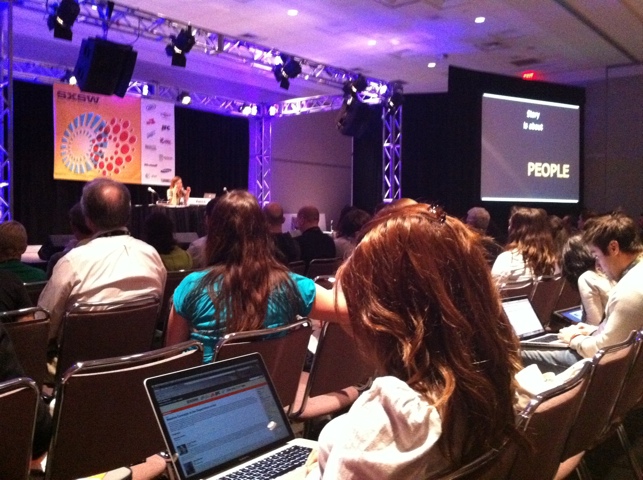
Ultimately, stories are fundamentally about people, and when you’re building a whole world for transmedia storytelling, you can’t forget that it’s about people. A lot of effort goes into creating the world, but people won’t want to explore that world if the story is not there.
Tags
Related Posts
Share This


 Subscribe via email