
Tags
Related Posts
Share This


The Connected Company
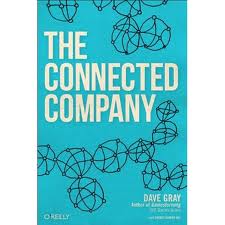 Presenter: Dave Gray, XPLANE
This was an incredible presentation which essentially compared large companies and large cities, and how large cities are able to adapt, while large businesses struggle. Companies are Complex Systems, and he had a graphic of the org chart at Microsoft. It’s so large and complex, an external company compiles this and sells it to vendors.
Research has shown a 3/2 Rule, meaning that as organizations scale larger, profits drop at a 3/2 rate. More employees have proven less profits. In cities and urban planning however, there’s a 2/20 rule. As you double the size of a city, productivity in that location goes up nearly 10 fold. The reason has to do with relationships to environment, which essentially establishes – are you flexible/adaptable, or process/machine driven?
Both cities and companies start out small. As companies grow, the machine/processes established don’t work because of the increase in people, so they have to re-organize their structure or re-program the machine. Companies need to break down silos and processes, because studies of long-lived successful companies have shown they were:Companies are often like machines – very process oriented, and the CEO is in charge, pulling levers to make things happen. The problem is that processes are designed to sit on a stable foundation. No time has been worse for that then the present environment of change. People and technologies are changing because they are based on people and behaviors.
Had a Strong Identity – Shared values, cultures, and beliefs.
Active Listeners – They are able to identify and jump on new opportunities (and have the cash to do so).
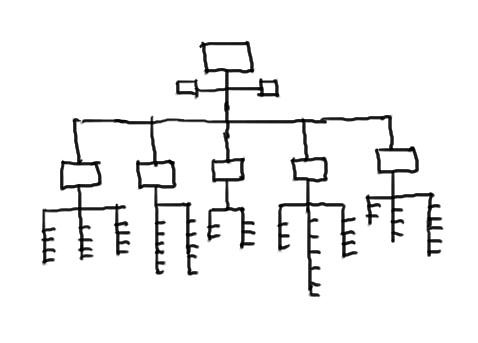
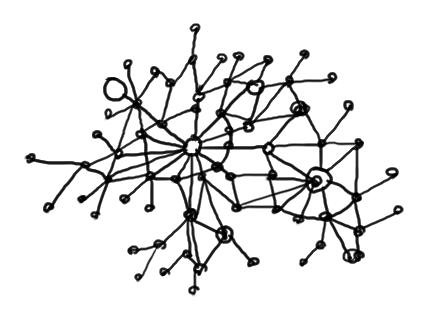
Most companies are designed by division (for labor specialization). This creates territory or turf when you create separate tasks. Companies should be designed with connections, connecting the core with periphery, or flocking, where they share standard protocols and shared services, learning from each other. Imagine companies as they are today with large organizational charts, vs a connected business or web of cross-functional, cross-experienced teams. If a chain breaks in a hierarchy, everything under falls down. In hierarchies, if a link in the chain breaks, the system breaks, but in a web, you can work around it.
 Lessons from Urban design:
Think at the level of the street – Get an organization wide initiative that requires a cross-functional team.
Spaces need owners – Wikis needs a gardener, blog owner to organize content, community manager to organize stuff, but they require connectivity for information and support.
Jumping off points – There are opportunities encountered along the way – you came for this, but what about that? Utilize the serendipity to start to make new changes.
Watch, listen, adjust, adapt – Have a strong feedback loop – pay attention, fix broken windows (You know what this means if you’ve read Malcom Gladwell), tweak, small changes add up, tell it what it needs.
Finally, connections within your company are vital, but connections between partner companies are just as important. In a day in age when no one wants to be liable, and things are held to contracts, it creates issues for users, destroying attitudes between both companies. Unless things are easily linked and plug easily into one another easily, this can be just as destructive.

 Subscribe via email